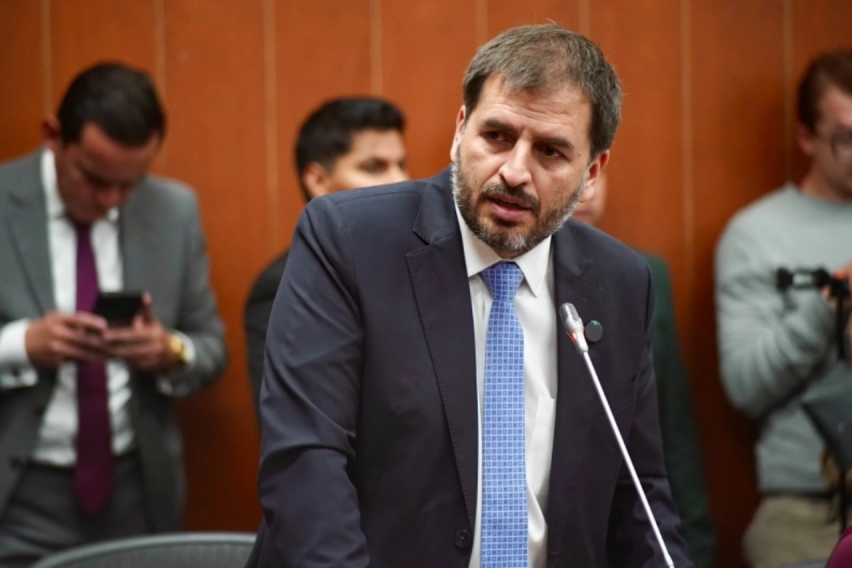
The Colombian Senate's Seventh Committee approved, in its first debate, a bill known as the "Laura Law: Children, Not Experiments." The bill still has to clear the rest of the legislative process. In October it received the backing of President Abelardo de la Espriella.
According to the Senate press office, the committee rejected motions to shelve the bill and to suspend debate. It also amended the text and confirmed Sen. Andrés Eduardo Forero Molina of the Democratic Center party as the bill's rapporteur. Committee members agreed to hold technical working sessions and a public hearing so that health professionals, academics and civil society groups can be heard.
Forero defended the bill, pointing to the risk of irreversible effects and what he described as uncertainty about whether these interventions benefit minors. "Given the scientific evidence available so far, what we want is for such a major, life-altering decision to be made once a person reaches adulthood," the senator wrote on X.
What the "Laura Law" would do
The report submitted for the first debate would ban three kinds of interventions on minors when they are done for gender-affirmation purposes: puberty blockers, hormone treatments and surgery. The text makes exceptions for diagnosed precocious puberty, certain congenital, genetic or chromosomal conditions, and other clinical uses backed by regulators. It also keeps in place the obligation to provide comprehensive mental health care and an interdisciplinary evaluation.
The report classifies prescribing, ordering or performing the banned procedures as a serious breach of medical ethics. Depending on how serious the conduct is and whether it is a repeat offense, a professional could have their license suspended for up to five years. The text also requires health insurers and healthcare providers not to authorize, fund or perform these interventions.
The story behind the bill's name
Bill 211 of 2026 was introduced on Aug. 26, with signatures from lawmakers across several parties. Among them were Forero, Rep. Luis Miguel López Aristizábal and Sen. Sara Castellanos Rodríguez.
According to the Pro-Life Caucus, as quoted by ACI Prensa, the bill is named for a young Colombian woman who was diagnosed with gender dysphoria at age 15. In the account the bill's sponsors have shared, she received hormone treatment and had surgery, and later said she regretted the procedures.
Objections to the bill
During the debate, Sen. Sandra Chindoy Jamioy of the Historic Pact questioned whether the bill is constitutional. Experts interviewed by El Espectador objected that the bill bans, in one sweep, interventions that have different goals, different risks and different degrees of reversibility.
In Ruling T-218 of 2022, Colombia's Constitutional Court found that a clinic had violated the rights of a 17-year-old by making the teen wait until adulthood for gender-affirming hormone treatment. The court said an interdisciplinary team must give minors information they can understand and must assess whether they are able to give free and informed consent.
The legislative record shows that the report for the second debate, before the full Senate, is still pending. If the full Senate passes the bill, it must then clear two debates in the House of Representatives before it can go to the president for his signature.
Original reporting by Diario Cristiano, Christian Daily International's Spanish edition.