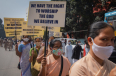
Christians have been the target of more than 88 incidents of harassment and assault in Israel so far this year, with 2026 on track to surpass last year’s record of 181 incidents, according to the Religious Freedom Data Center.
The Israel-based center announced this month in Jerusalem that this year’s attacks included 63 incidents thus far in the second quarter alone. Most of the incidents took place in the Old City of Jerusalem, including the site of the Armenian Patriarchate, and Mount Zion, the RFDC reported.
The incidents include spitting and verbal abuse, vandalism of graves, tombstones, statues and crosses, as well as racist graffiti and desecration of Christian religious sites.
Israeli researcher Yeska Hran noted during the release of the report that the figures have exceeded all expectations, and that such incidents have become a “daily reality” for Christian communities, according to Palestinian outlet Felesteen News.
Attorneys and human rights activists at the report release event criticized the way police handled complaints filed by Christians, with Uri Naroff, director of the legal department at the Israeli Religious Action Center, stating that most cases are closed without accountability, Felesteen News reported. From 2012 to 2021, authorities closed 19 of 25 complaints submitted by the center, citing “no suspect found,” “no violation found” or “case unsuitable for investigation,” Naroff said.
Catholic leaders spoke of a series of attacks on their properties, including toppled stone crosses, smashed cars and stones, eggs and trash thrown inside monasteries and Christian guesthouses. The Rev. Stanislav Kolakowski of the Sisters of St. Elizabeth in Jerusalem said attacks are recurring in waves, according to Felesteen News.
An attack on a French nun working in East Jerusalem in April drew international attention after it was captured on CCTV. The 48-year-old nun, a researcher at Jerusalem’s French School of Biblical and Archaeological Research, was thrown onto a rock and then kicked repeatedly as she lay on the ground, church leaders told AFP.
Photographs showed bruising on her face, and she received medical treatment for her injuries. Israeli police reportedly arrested a suspect but did not disclose his identity.
Israel’s Foreign Ministry condemned the attack, saying it “stands in direct contradiction to the values of respect, coexistence and religious freedom upon which Israel is founded,” and added that Israel “remains firmly committed to safeguarding freedom of religion and worship for all faiths.”
Middle East Eye reported that the Hebrew University of Jerusalem, affiliated with the nun’s research centre, said the attack was “not an isolated incident, but part of a troubling pattern of rising hostility toward the Christian community and its symbols.”
Also in April, an Israeli soldier was video recorded smashing a statue of Christ in southern Lebanon. The Israeli army later removed the soldier involved from duty.
A recent report by the Jerusalem-based Rossing Centre for Education and Dialague asserted a “continued and expanding pattern of intimidation and aggression” against Christians in Israel and East Jerusalem in 2025, Middle East Eye reported. Rossing recorded 155 incidents in 2025, including 61 physical assaults, 52 attacks on church property, 28 harassment cases and 14 incidents of defaced signage.
“The report said these cases likely represent only a fraction of overall incidents, describing them as the ‘tip of the iceberg,’” Middle East Eye reported. “It added that harassment is occurring in a ‘sociopolitical climate increasingly intolerant of diversity and more assertive in exclusivist national-religious claims,’ with Palestinian Christians particularly affected.”
In releasing its report this month, the RDFC noted that three Jewish youths spat on and insulted a priest with the Latin Patriarchate near the Damascus Gate in Jerusalem, while police reportedly tried to discourage him from filing a formal complaint.
Felesteen News stated that the increasing attacks against Christians in Jerusalem and other areas are believed “to reflect the growing influence of hardline religious and nationalist movements within Israeli society, at a time when churches accuse the authorities of not taking these violations seriously enough, which raises increasing concerns about the future of the Christian presence in the Holy Land.”
The RFDC describes itself as a non-political body dedicated to facts, documentation and objective data, free of sectoral or partisan interests.
“It is an organization with a clear Israeli commitment, viewing harm to the Christian community as a direct violation of the founding values of the State of Israel,” the center states on its website. “Alongside formal procedures, it strives to create direct, ongoing human connections between Christian institutions and Jewish-Israeli volunteers.”
It was founded by a Jewish-Israeli citizens led by Yiscah Harani, a scholar of Christianity, advisor to governmental and private organizations on Christianity, an active figure in the interfaith education and licensed tour guide and lecturer, the center says.
About 80 percent of Christians in Israeli territory, around 180,000 people, are estimated to be of Arab origin, approximately 7 percent of the total Arab population of the country.