Some Christian schoolchildren in Sri Lanka, especially children of non-traditional church pastors, are targeted by both bullies and teachers for their faith, according to a study by the National Christian Evangelical Alliance of Sri Lanka (NCEASL).
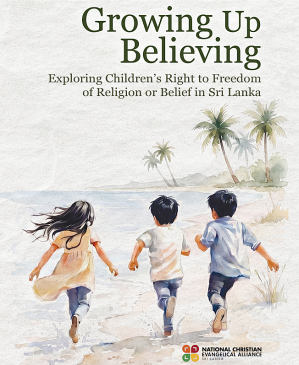
Between 2023 and 2025, the NCEASL found multiple incidents of religious freedom violations against children of minority religions in the majority Buddhist country, including discriminatory practices, acts of intimidation and physical violence, often linked to religious tension in the localities, according to the alliance recent report, “Growing Up Believing: Explorinig Children’ Right to Freedom of Religion or Belief in Sri Lanka.”
The study found Christian children face “bullying from peers and targeting by teachers, with children of pastors of non-traditional churches being more vulnerable to discrimination and bullying. This includes teachers scolding Christian students for attending church, forbidding them from reading their Bibles during breaks, and making them attend school on Sundays.”
In one incident, a student was coerced into participating in non-Christian rituals at school and threatened by teachers with expulsion for refusing, the report notes.
Apart from school, in some of the incidents of violence against Christians, children were indirect victims when their parents or churches were targeted. In one incident in 2025, non-Christian religious leaders who demanded a pastor’s church be discontinued in Hambantota District subjected his 12-year-old son to intimidation when he was alone at home, the report stated.
In another instance in 2025, 11 members of a church, including two girls, were physically assaulted during a protest by villagers against a church in Gampaha District. Likewise, in 2024 the 14-year-old son of a Christian pastor was assaulted along with some of the pastors of the church in Nuwara Eliya District.
The population in Sri Lanka is 68.6 percent Buddhist, 12.9 percent Hindu, 10.5 percent Muslim and 7.6 percent Christian, according to the Joshua Project. At least 80 percent of the Christians are estimated to be Roman Catholic.
Religion is a compulsory subject for students sitting for the General Certificate of Education (Ordinary Level) exam in Sri Lanka, with Buddhism, Saivanery (devotion to Lord Shiva in Hinduism), Roman Catholicism, non-Roman Catholic Christianity and Islam being the available options.
“While this curriculum is designed to reflect the country’s religious diversity, it can raise concerns regarding the protection of a child’s freedom of religion, belief, and conscience,” the NCEASL reported states. “In cases where a parent’s/student’s religion is not one of the available options for study or there is no qualified teacher available to teach the parent’s/child’s preferred religion, the child may be compelled to study and sit for an examination on a religion they do not adhere to.”
Such instances within a system of compulsory requirement can be seen as a violation of the child’s right to religious freedom and potentially create an environment of discomfort or alienation for students whose beliefs differ from the prescribed curriculum, according to the report.
“Due to a shortage of Christian teachers and insufficient funding to onboard them, there have been reports of Christian children forced to study and follow Buddhist or Hindu rituals in schools, leading to harassment, bullying, and poor academic performance,” it notes, adding that there were some cases where Christian children were denied admission to schools in violation of Education Ministry Circulars.
The Human Rights Committee in the country has emphasized that religious instruction should respect the beliefs of parents or guardians who do not adhere to a particular religion. While law does not mandate private schools to teach religion, it is generally included in most schools.
In an NCEASL survey that reached teachers in 22 out of the 25 districts, 17 percent of the respondents reported instances of students being pressured or coerced into participating in religious activities outside their own faith.
“These teachers taught in schools based in 14 districts – Mannar, Batticaloa, Kilinochchi, Hambantota, Ampara, Polonnaruwa, Kandy, Anuradhapura, Ratnapura, Vavuniya, Trincomalee, Kegalle, Galle and Mullaitivu – indicating that coercion and violations of religious freedom in schools are not confined to a single locality,” the report states.
The teachers provided examples such as attendance at Catholic Mass for all students, compulsory attendance at Hindu, Muslim and Buddhist religious events, compelling Christian students to wear pottus, forcing non-Buddhist children to bring oil, flowers and incense sticks for Buddhist religious events and participate in them.
“One teacher from a government school in Ampara shared that a Hindu male student who wanted to attend Christian worship on a Friday and went to a Church was punished by a Hindu science teacher,” the report states.
Schools should follow a “do no harm” approach, allowing children to participate in religious instruction voluntarily rather than being forced, the report states, citing Article 18(2) of the International Covenant on Civil and Political Rights (ICCPR), which protects people from coercion in matters of religion or belief. Article 18(4) of the ICCPR protects the parents’ rights to educate their children according to their own religious convictions.
“With regard to the freedom to manifest one’s religion or belief, both its positive and negative aspects must be equally protected: the right to express one’s beliefs and the right to be free from any pressure, particularly from State authorities or within State institutions, to engage in religious activities against one’s will,” the report states.
The survey found 79 percent of respondents stated that all students in the school were allowed to attend religious instruction classes that align with their own or parents’ religion; 6 percent stated that only some students have access to instruction in their own religion, citing the primary cause for it as lack of qualified teachers for certain religions, limited student numbers from specific religious groups, and lack of government or school support for instruction in minority religions.