
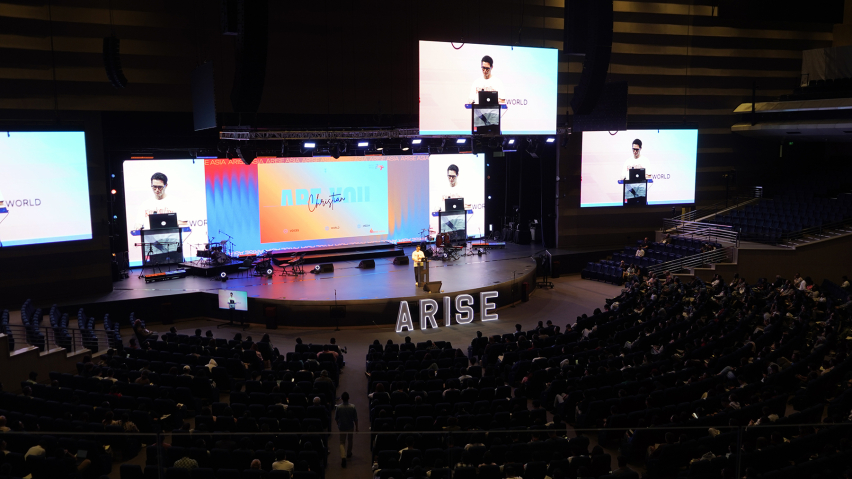
Two back-to-back sessions on the second day of the Arise Asia 2026 Congress on July 28 pressed some 4,000 young Christians toward the same question from different directions: what does it mean to share Christ in this generation, and are you actually doing it?
The first, a personal testimony from a Korean-American actor who left a two-decade entertainment career to work in digital missions, turned on a single question about identity: what is a Christian? The second, a panel of influencers and platform leaders from across Asia, examined how digital spaces have quietly become one of the most active mission fields in the world.
'What you consume is what you share'
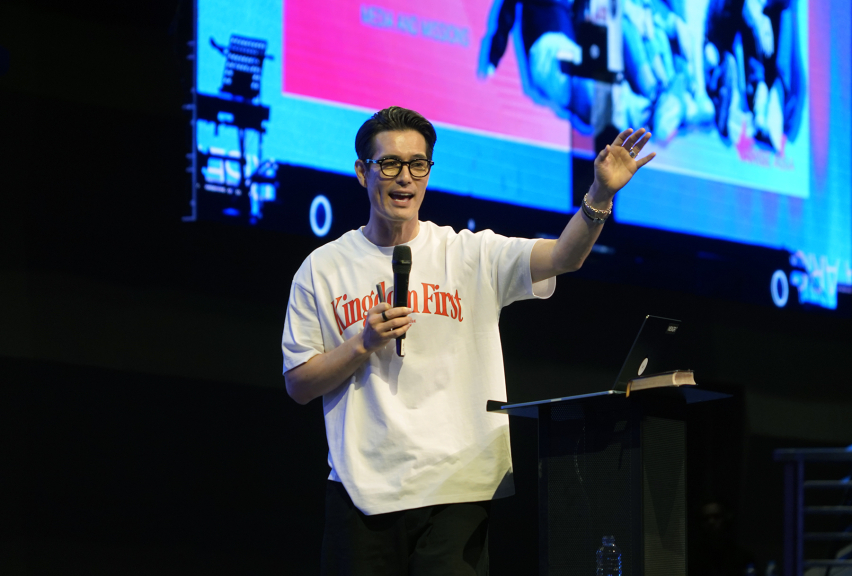
Ricky Kim started his address by pointing to a few human inventions, starting with a water bottle cap. He held up the cap and asked the delegates what it was for. When someone in the crowd answered "to grip the top and keep the water in" he nodded. It has a purpose, he said, and a creator. A robot that waved its fingers drew a stadium-wide "wow" in the year 2000 as people marveled at the progress of human engineering at that time. A fancy Dyson vacuum comes with an owner's manual that tells you how to fix it when it breaks.
"In Genesis 1:26-27 it says you're made in God's image," Kim told the congress. "There is an owner's manual that shows you what you do in life."
Having spent more than 20 years acting and modeling in Korean television before leaving the industry in 2015 to work in missions, Kim now serves as Asia Pacific Digital Ministry Director for One Hope, a global missions organization. Before that, he said, his life was shaped by loss. His mother left when he was six. His father died in an accident when he was 14, placing him in foster care. By college, he was preparing for law school — until his stepfather told him he had never once seen him read a book.
"I was challenged. I was upset. It was the truth," Kim said. He picked up a book and kept going. One day, reading alone, a single word stopped him: mathematician.
He paused on this for several minutes, asking how many delegates were mathematicians, then musicians. A person who has studied math for 20 years but doesn't absorb it into who they are, Kim said, would not call themselves a mathematician. A guitarist who has played for 22 years but never moved past a few basic chords — "I still play E minor, G, C, and D," he said, drawing laughter — would not claim to be a musician.
"What about this word: Christian?" he said. "The question is, what is the IAN?"
He returned to Matthew 22:37-40, where Jesus answers the question of the greatest commandment: love God with all your heart, soul, and mind, and love your neighbor as yourself. He traced the verse back through Deuteronomy 6, where Moses commands the Israelites to keep these words written on their doorframes and wrists, to pass them to the next generation without interruption. The people who received those commands, Kim reminded the delegates, had already seen the Red Sea split, manna fall from the sky, and enemies defeated without a battle. And still they turned to a golden calf.
"They're in love with the world. They're in love with culture. They're in love with everything that God said to stay away from," Kim said. The question Deuteronomy asks — and the question Jesus was asking the disciples — is whether the people standing before God were actually formed by what they claimed to believe, or merely adjacent to it.
Kim turned the question on the room. He asked how many of them would hand over their phones without hesitation. The phone, he said, carries a record of what you consume. And what you consume is what you share.
"If you guys gave me your phone right now, I could kind of guess," he said. "On your phone, it shows you how much data you consume and where you consume it from." He described the experience of waking up to find a phone under your back because you fell asleep watching a video, and the family that turned the car around on the way to church — not to retrieve a forgotten Bible, but a forgotten phone.
He is not, he said, accusing the delegates of not being Christians. He is asking whether the content of Christ is so present in their daily lives that it becomes what naturally comes out of them.
"Christian is Christ with an IAN," Kim said. "And the IAN is ‘I Am Nothing.’ I am nothing without Christ."
He left the entertainment industry after realizing that even while loving Jesus, he was consuming what he called "glorified" content — building a life around a platform rather than around Christ. After 2015, he spent years in Mexico, Argentina, Chile, Colombia, Brazil, and Guatemala, sharing the gospel across Latin America. He now works across Asia helping local churches develop digital ministry strategies.
Kim closed with a challenge. He said he is regularly asked whether he is a missionary or a pastor, and regularly conflicted by the question. His hope is that the delegates leave Manila in a condition where such labels are unnecessary.
"By the way your light shines, by the salt that you are sent to be — that your life lives out a flavor of Christ, a shining of Christ — your DNA will carry the mission and the power and the message of Jesus from Jerusalem, where you are today, to the ends of the world."
'Digital mission is a battlefield'
The panel that followed brought together four influencers from across Asia — from South Korea, South Asia, Nepal, and Indonesia — to discuss how social media, streaming, and Bible apps have become some of the most active evangelistic spaces in the world.
The panel was framed around the question how God is using digital spaces to bring people to Jesus, and how can every believer be part of that?
The most striking data point was that more people now open the Bible as a mobile app than attend church in any given week. One panelist representing a major digital Bible platform said the figure reflects a shift in where people are searching for God — particularly in restricted regions where public religious life is surveilled or prohibited.
"If people can start a Bible reading habit four times a week, they can make better choices," he said. "Our hope is to make sure they open the app every day, because no one installs an app by accident."
He shared three stories. In a village in central Arabia, a missionary working with an oral-learning community could not get his congregation to engage with printed Scripture. The platform connected them with an audio New Testament in their language — already available, simply not yet deployed. In South Asia, a 65-year-old woman who had answered a call to return to village ministry after 20 years working abroad began contributing devotional content in three languages. When her material went live, it reached more than 500,000 people. She has continued producing content through her husband's death. A third story involved a young woman in a restricted country who searched for a free book in an app store, downloaded the Bible, read it out of curiosity, found a church listed under a "Churches Near Me" feature, attended, and was baptized within months.
"Leverage whatever you have," the panelist said. "If you can't leverage what is free, you won't be able to do ministry in the digital space at all."
A Korean influencer on the panel described using The Chosen, the multi-season drama series about the life of Jesus, as a gathering tool. He said he watches it with his own children every Wednesday rather than preaching at them. He told the story of a pastor's son who had drifted from faith, and whose friends persuaded him to watch what he assumed would be another forgettable Christian film. He came back to church through it. A woman with no prior faith watched episode after episode, each time telling herself she was not a believer — until she was.
"When that emotion is in the most amazing and most inspiring story of the most amazing person, Jesus Christ, and it comes alive on screen, people are taken on an emotional journey," he said. He added a caution: posting without follow-up is not ministry. "If you're just doing post, post, post and not following up, you should maybe pause."
An influencer from Nepal described realizing during COVID-19 lockdowns that social media was a mission field. Isolated from family and working through her own fear, she started sharing Bible verses on Instagram. The messages and comments began coming in. "I started explaining: this is good news from God," she said. "In 2020, I realized this is the best field for me."
The panelist from Indonesia had the most visceral story. After surviving a fall from a 40-meter cliff in November 2022 — he was one of only two people ever to have survived that particular location — he asked God what to do with a second chance at life. He began live-streaming devotional sessions from a wheelchair, then from crutches. People sent him messages around the clock. "One of the funniest moments: I did counseling for someone for three hours," he said. "And then I listened to 10 people per day. It's so exhausting, but there's a big joy."
Through a chain of introductions that began with a follower recognizing him in public, he ended up praying with a Buddhist man who was suffering from multiple serious illnesses and who had declared he hated Christians. After prayer, the man slept through the night for the first time in months. After a follow-up medical check, his test results had improved. Later, he gave his life to Christ.
"Our responsibility is very simple," the panelist said. "To love Jesus and to love people."
The panel closed on a challenge to the assumption that digital mission requires a large platform. One panelist noted that true influence is not about follower counts. Another observed that he lost 80,000 social media followers after his first post declaring his faith in 2017 and had some of his accounts removed in a certain country. "Do you want to be an influencer?" he said. "The question is: are you called to the influence of social media? Because the influence of Christ is that they will throw stones at you."
All four agreed that the hardest part of digital mission is not gaining an audience — it is what you do with one. "You may be the sole voice that can take the gospel in your language," said the panelist representing the Bible platform. "Don't be worried whether the internet will come. They'll get the internet to your place. Be ready with the content."
Arise Asia 2026 continues through the week in Manila.
Follow Christian Daily International's full reporting on Arise Asia 2026.








