Freedom—of speech or of worship, from want or from fear—was both celebrated and contested on various fronts last week, reminding us that the battle for freedom demands vigilance from us all.
Freedom can be recovered through democratic means.
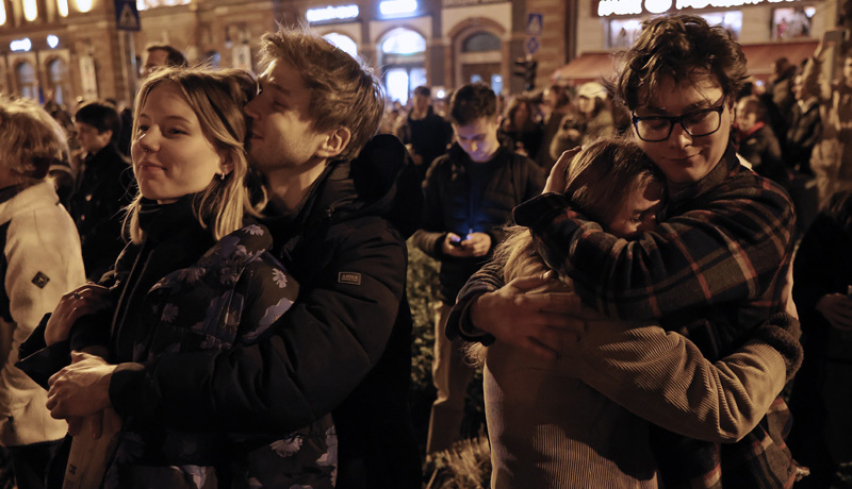
The week began on Sunday with jubilant crowds of Hungarians gathered in front of the Parliament Building in Budapest, dancing to celebrate the end of sixteen years of Viktor Orban’s illiberal, autocratic rule. They had turned out in unprecedented numbers to reclaim their freedom. They showed us that freedom can be recovered through democratic means; that illiberal systems are reversible.
Orban had reframed freedom around loyalty, identity, and control. He had narrowed freedom of speech through control of television and newspapers and suppression of dissent. Freedom of worship was privileged for some, restricted for others.
Freedom from fear was strengthened for insiders, weakened for outsiders and minorities. Freedom from want was delivered selectively, often politically mediated, with widespread corruption and a faltering economy. The result was that Hungary had been driven to the bottom of the EU countries economically and in corruption.
The godfather of the global far-right illiberal democracy model.
Orban had become both the godfather of the global far-right illiberal democracy model, currently entrenched in the White House, as well as being the Kremlin’s Trojan horse in the EU. His defeat was celebrated widely across Europe as a victory for freedom.
Legitimacy
However, a form of illiberalism was apparent again last week in Washington. An American president occupying the very office where in 1941 Franklin Roosevelt drafted the Four Freedoms (see below) attacked the spiritual leader of the Roman Catholic world in Rome for upholding traditional Christian teaching on war. Leo XIV had dared to challenge the legitimacy of America’s war on Iran.
Freedom includes moral accountability—not just political autonomy.
This was a direct confrontation between political power and spiritual authority, a contest over freedom of speech and freedom of worship in the public square. Is faith allowed to critique the state? Does power answer to morality, or must morality bend to power? Leo insisted that freedom includes moral accountability—not just political autonomy. Freedom included the right, even the duty, to challenge power morally.
Roosevelt had declared that freedom from fear meant "a world-wide reduction of armaments to such a point... that no nation will be in a position to commit an act of physical aggression against any neighbor—anywhere in the world". That includes threats to wipe out a civilization.
Inner freedom
Last Wednesday, readers of the Lectio 365 digital devotional reflected on inner freedom as spiritual resistance. They learned that April 15 was both the birthday of Corrie ten Boom and the anniversary of her death. Her family lost their freedom on February 28, 1944, when betrayed to the Gestapo.
They were dragged out of their house in Haarlem and taken to detention centers, reminiscent of the fate of thousands of so-called ‘illegals’ in America today. Or of Ukrainian civilians and soldiers captured by Russia today.
In the camp, Corrie and her sister Betsie discovered not freedom from suffering, but a freedom within suffering that no external power could take away. The Nazis could imprison their bodies but not their conscience, not their faith, not their capacity to love.
The ability to love and forgive when surrounded by hatred is a form of freedom no tyrant can touch.
Betsie insisted they should "give thanks in all circumstances", despite the fleas infesting their barracks—which later they realized kept guards away, allowing them to hold Bible studies. The ability to love and forgive when surrounded by hatred is a form of freedom no tyrant can touch.
For the sisters, inner freedom became a form of spiritual resistance. Betsie, who did not survive the camp, found a freedom rooted in hope beyond death. Corrie later told her audiences around the world that God’s presence extended into the darkest places. Even when everything outward was taken away, the deepest freedom was the freedom to love, trust, and give thanks. Freedom from bitterness. Freedom to forgive. Freedom to live without hatred.
Courage and resilience
Protecting freedom is a duty shared by everyone.
The celebration of freedom climaxed last Thursday in Middelburg, Zeeland, The Netherlands, when the Roosevelt Four Freedoms Award was presented to Volodymyr Zelensky on behalf of the entire Ukrainian people for their courage and resilience in the fight for freedom. Protecting freedom is a duty shared by everyone.
On January 6, 1941, President Franklin Roosevelt (whose family came from Zeeland) proclaimed in his State of the Union address that if democracy was to survive and flourish, people everywhere in the world were entitled to four human rights: freedom of speech, freedom of worship, freedom from want, and freedom from fear. Roosevelt’s "Four Freedoms" form the foundation of democracy and of the rule-based international world order under pressure from illiberal regimes today.
Ukraine’s ongoing struggle is for freedom from fear (against invasion and violence), freedom of speech and national self-determination, freedom for worship, and freedom from want as war devastates livelihoods.
The Four Freedoms are neither secure nor obsolete.
That same day, Russia launched one of its biggest attacks of drone and missiles, killing 17 and injuring more than 100 across country. This was a reminder that the the Four Freedoms are neither secure nor obsolete.
Freedom cannot be taken for granted. It requires vigilance from us all.
Originally published by Weekly Word. Republished with permission.
Jeff Fountain and his wife Romkje are the initiators of the Schuman Centre for European Studies. They moved to Amsterdam in December 2017 after living in the Dutch countryside for over 40 years engaged with the YWAM Heidebeek training centre. Romkje was founder of YWAM The Netherlands and chaired the national board until 2013. Jeff was YWAM Europe director for 20 years, until 2009. Jeff chaired the annual Hope for Europe Round Table until 2015, while Romkje chaired the Women in Leadership network until recently. Jeff is author of Living as People of Hope, Deeply Rooted and other titles, and also writes weekly word, a weekly column on issues relating to Europe.
Weekly Word is an initiative of The Schuman Centre for European Studies. Jeff Fountain is a New Zealander holding a Dutch passport, is currently the director of the Schuman Centre for European Studies (www.schumancentre.eu), and lives in Amsterdam, the Netherlands. Jeff graduated with a history degree from the University of Auckland (1972) and worked as a journalist on the New Zealand Herald (1972-3), and as travelling secretary for Tertiary Student Christian Fellowship (TSCF) (1973). He has lived in the Netherlands since 1975, and has travelled and spoken in almost every European country. For twenty years following the fall of communism, he was the European director for the international and interdenominational mission organisation, Youth With A Mission. He was chairman of the international, trans-denominational movement, Hope for Europe, for which he organised two pan-European congresses in Budapest in 2002 and 2011. In 2010, he established the Schuman Centre for European Studies (www.schumancentre.eu) to promote biblical perspectives on Europe’s past, present and future, to encourage effective engagement in issues facing Europe today.