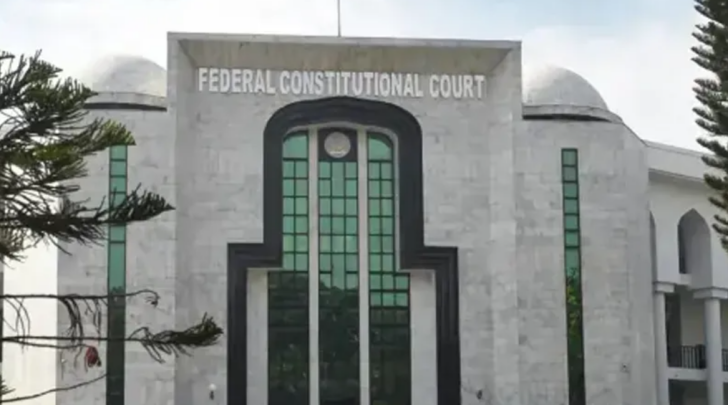
More than 25,000 Christians living in informal settlements in Pakistan’s federal capital have expressed cautious relief after the Federal Constitutional Court (FCC) ordered authorities to halt imminent evictions and finalize long-delayed regulations to legalize such communities within four weeks.
A two-judge FCC bench headed by Chief Justice Aminuddin Khan and Justice Arshad Shah issued the directive on Thursday (April 16) while hearing petitions filed by residents and Awami Workers Party leader, Dr. Asim Sajjad Akhter. The petitions argued that access to housing was a fundamental right and that it was the state’s responsibility to provide adequate living conditions to its citizens.
At the outset, the court expressed concern over the prolonged delays in framing a regulatory policy for informal settlements and instructed the Capital Development Authority (CDA) to consult stakeholders before finalizing rules.
During proceedings, Chief Justice Khan questioned Additional Attorney General (AAG) Aamir Rehman about the CDA’s failure to complete the regulations. Rehman attributed the delay to administrative changes, including the replacement of the CDA chairman, but assured the court that draft regulations were ready for approval.
Representing the petitioners, Supreme Court advocate Faisal Siddiqui argued that forced evictions without due process violated constitutional protections. He emphasized that the case should be treated as a matter of legal right rather than charity, asserting that residents cannot be displaced without alternative housing.
The court also questioned whether provisions for low-income settlements existed within Islamabad’s master plan. AAG Rehman responded that such settlements were not formally included, though those established before 1995 had been recognized on humanitarian grounds. Siddiqui countered that despite policies introduced in 2001 and 2016, authorities continued eviction operations without proper implementation.
“No one can be evicted without being provided an alternative place,” Siddiqui told the court. “This is Islamabad, not Gaza.”
CDA's counsel Qasim Chohan maintained that land allocated for resettlement had been misused, claiming some residents refused to vacate previous dwellings after receiving alternative plots. He added that the CDA had recognized 10 settlements but identified at least 31 others as illegal encroachments, including areas in public greenbelts.
Petitioners disputed official figures, estimating that nearly 400,000 people lived in informal settlements across Islamabad, with a significant proportion belonging to the Christian community—one of Pakistan’s most economically marginalized religious minorities.
Following arguments, the court adjourned proceedings for four weeks, granting the CDA time to finalize and present regulations.
A day earlier, the Human Rights Commission of Pakistan (HRCP), alongside civil society groups, including the All-Pakistan Alliance for Katchi Abadis and the National Commission for Justice and Peace, urged superior courts to uphold a 2015 stay order by the Supreme Court of Pakistan against summary evictions. The groups stressed that forced displacement of low-income communities violates the constitutional right to housing.
Participants at the meeting criticized the CDA’s failure to address the housing needs of the urban poor, noting that Islamabad lacks a comprehensive legal framework for regularizing informal settlements in line with international standards.
Christian community leader Imran Shahzad Sahotra welcomed the FCC’s directive but expressed caution. He noted that the Supreme Court had issued similar orders in 2016, which were not fully implemented.
“Despite the court’s earlier stay order, demolitions continued, leaving our community in fear and distress,” Sahotra told Christian Daily International. “We will be reassured only when this decision is enforced.”
A 2025 study by the Awami Workers Party titled Permanent Impermanence found that nearly half of Islamabad’s informal settlements include substantial Christian populations, with four of the 10 recognized settlements being predominantly Christian.
In a statement, Archbishop Joseph Arshad of the Catholic Archdiocese of Islamabad-Rawalpindi described the ruling as a positive step toward protecting marginalized communities.
“The decision reflects a constructive move toward addressing the long-standing concerns of vulnerable citizens,” he said, emphasizing that residents of informal settlements are entitled to dignity, legal protection and access to basic services.
The FCC’s directive follows weeks of unrest linked to the CDA’s anti-encroachment campaign launched in March. Protests intensified in several settlements, including Noorpur Shahan, where clashes on April 14 left at least eight police officers and dozens of residents injured, according to local media. Authorities reported that hundreds of demonstrators participated, with some incidents of property damage.
The following day, demolition teams razed approximately 200 homes in the area under heavy police deployment. Reports said that authorities registered cases against hundreds of residents under anti-terrorism laws.
Tensions were also reported in Allama Iqbal Colony, also known as Sharper Colony, where an estimated 1,300 Christian families—mostly employed in low-income occupations such as sanitation work and domestic labor—resisted demolition efforts. Community leaders described a prolonged standoff, alleging that officials damaged property and removed household belongings before withdrawing.
The CDA has announced plans to clear multiple informal settlements in Islamabad, several of which are predominantly Christian. Community representatives said that the operations have heightened insecurity among daily wage earners who lack the financial resources to relocate.