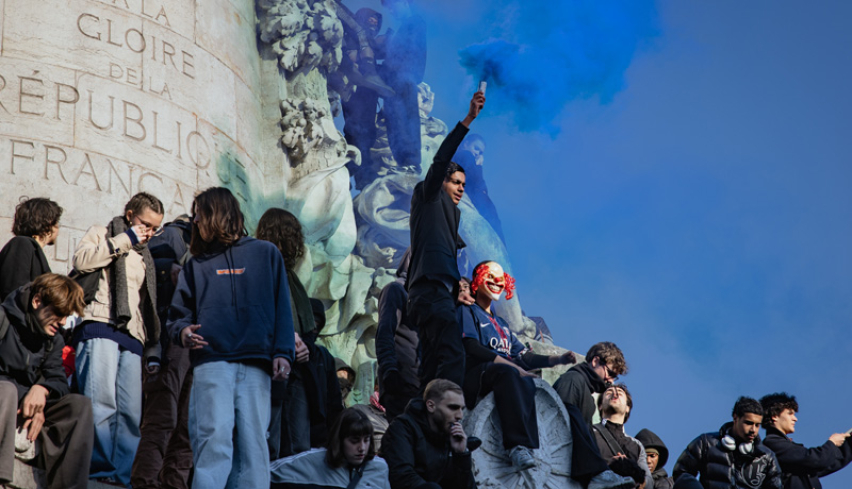
I was reluctant to write this because I am not a social scientist and I am not French. But I have lived in France for 16 years, and seen my share of protests, strikes, and rallies. I do not claim to fully understand what unfolded on October 17th, but I do live on the street in Lyon that was most affected: every shop window broken, stores looted. So perhaps there are a few things I could share about French culture (from my outsider’s perspective) that might shine some light on what the world is seeing.
A French way of life
Demonstrating, striking, and protesting are practically a national pastime in France.
First of all, demonstrating, striking, and protesting are practically a national pastime in France. Public demonstrations are typically registered, scheduled, and approved by local authorities. Citizens can easily track where they will be and what they are about.
Here in Lyon, there is a website called “Rebellyon,” which is a collaborative site for ALL types of marches and protests. Upcoming events include a “Rally Against the Ban on the Inter-College Demonstration”, which was basically a protest against the cancelling of a protest!
Protesting is usually linked with passion and/or frustration.
Second, protesting is usually linked with passion and/or frustration, but it is not considered unpatriotic or malicious. It is often considered justified, and even noble. Many parents support their student’s protesting because the students really want to learn and there are genuine concerns about their learning environments and lack of teaching staff. The French government is listening and responding to these reasonable demands.
Third, the general public tolerates these disruptions with more patience than US Americans because they are so common. I am not saying that the violence and vandalism are acceptable. People here are mad about that because it’s not supposed to happen.
They rarely turn into the bedlam we recently witnessed.
The large crowds got out of control, and bad actors incited large scale chaos. But what happened on October 17 was the exception, not the rule. As I said, there are protests or rallies going on literally every single weekend in most cities in France, and they rarely turn into the bedlam we recently witnessed.
Not Islamist led
Disturbed by the amount of false information.
I am extremely disturbed by the amount of false information that I have seen blaming the October 17 riots on religious radicals and immigrants, as this is most certainly not true.
Some US American sources have turned these unusual events into opportunistic propaganda to support their own political agendas. Most of the demonstrations that turned violent and destructive were demonstrations against the high cost of living.
There are many complexities and nuances, but none of them are related to religion or immigration. French President Emmanuel Macron said this:
“For me, there is no visible foreign interference in the events that took place. On the other hand, there was foreign manipulation of information afterwards, yes, and that gave rise to unacceptable and stupid comments from many people, including foreign leaders... We had people claiming that we had been invaded by hordes of migrants and Islamists, which is completely false.”
The BBC article above here is worth reading in it’s entirety. The BBC also reported that many of the images shared on social media were AI generated. I live in France as a foreigner and know just how hard it is to obtain the privilege of living here.
Check your facts... and your hearts.
The borders here are not wide open, it is time-consuming and expensive to gain access to the right to live and work in France. And I know of one immigrant who was outraged at the events of October 17, saying “These French people don’t know how good they have it!” Please, friends, be careful what you share. Check your facts. And more importantly, check your hearts.
The degree of danger
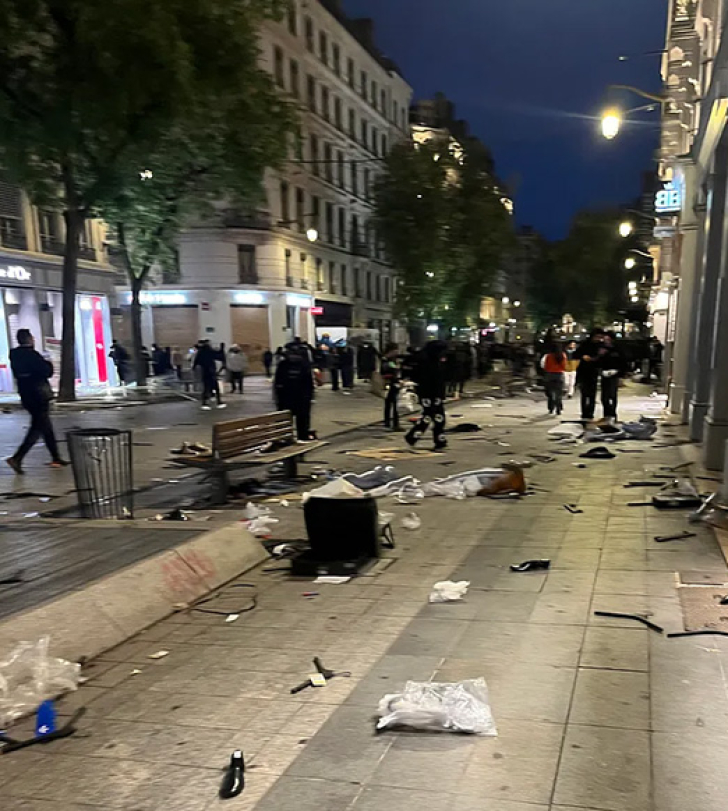
My husband took a photo (left) right outside of our apartment building in Lyon on the evening of October 17 when he went out to walk the dog. People were looting stores right before his eyes, carrying off stacks of shoe boxes and armfuls of clothes from H&M.
He was disgusted at their destructive behavior, but not in danger. There were people injured on October 17th, many by police who used tear gas and water canons. The police were also the victims of attacks all across France. But I can’t find any information about protesters injuring other civilians.
Again, this does not condone their pillaging and starting fires and defacing of public property. I just want to emphasize that we never felt unsafe.
Writing for Reuters, Elizabeth Pineau noted on October 17, “While hundreds of thousands protested peacefully in street marches in scores of cities, violent fringe groups targeted public buildings, looted luxury boutiques and supermarkets, and attacked police vehicles and officers.”
I feel safe... at all hours.
The fact of the matter is that I feel safe in most parts of Lyon at all hours, and in Paris, too. Violent crime rates are significantly lower in France than they are in the United States. France has a homicide rate of roughly 1.3 per 100,000 inhabitants, compared to the the United States’ 6.3 per 100,000. So while you might be more likely to be pick-pocketed in Paris than New York, you're much more likely to be shot in the US than in France.
Praying for the peace of Christ to rule.
While I genuinely appreciate my friends who have reached out to ask how I am doing, I want to assure you that even living right in the middle of the action, we are fine. We spoke with most of our neighboring shopkeepers during the unrest to express our condolences and our support. And we continue to go about our life, praying for the peace of Christ to rule.
How should we respond?
The Bible is full of commandments to care for the poor and the vulnerable. Many who are demonstrating fall into those categories and are seeking some sort of justice. We pray for wisdom and peace to rule in these demonstrations.
Pray for our own eyes to be open.
Furthermore, we pray for our own eyes to be open to ways that we (both individually and as communities of Christian faith) might also commit to seeking justice and showing compassion for those who are in need. Most importantly, we continue to pray for opportunities to share the hope that we have found in Jesus.
Originally published on Jenn's Missions With substack. Republished with permission.
Jenn Williamson is the Director of Leadership Formation for Missio Nexus. She is passionate about equipping and encouraging Christian leaders to guide their organizations to greater effectiveness by developing and employing strategies and systems that reflect and reveal the Kingdom of God. She is a co-host of the podcast, GOING: Where God is at Work, discussing global missions. Originally from the US, she has lived and worked in Lyon, France since 2010 where she participates in church planting, mentoring pastors and emerging leaders, and training cross-cultural workers.