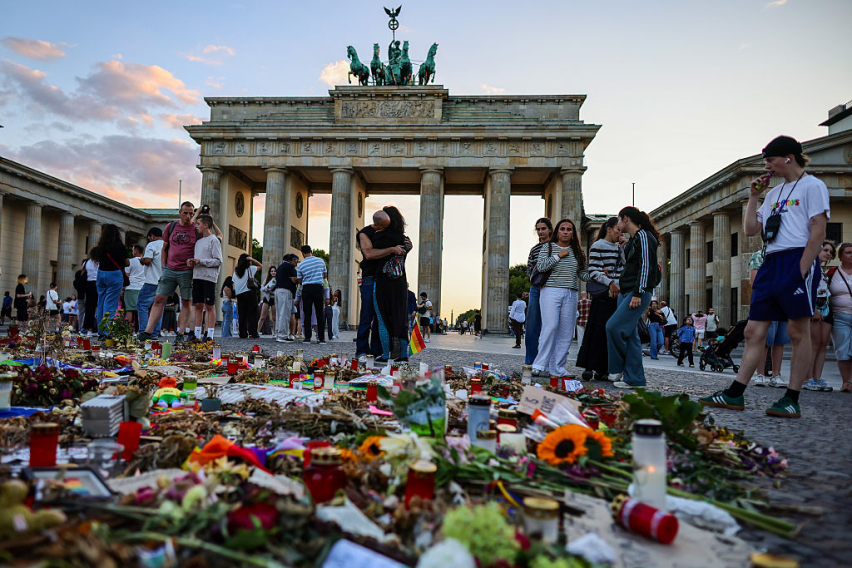
Two prominent voices on Islamist radicalization in Germany are warning that the recent deadly attack on a Berlin Pride parade reflects a crisis far deeper than the actions of a single attacker — one in which, according to a Christian charity worker, the majority of young Muslim men in Germany's most troubled neighborhoods quietly support those intent on overturning the country's democratic order.
Wolfgang Büscher, spokesman for Die Arche, a Christian organization that runs youth and children's programs in Germany's most disadvantaged urban districts, told broadcaster WeltTV on Tuesday that radicalization is already everyday reality in those communities. He estimated that 80 to 90 percent of young men from certain immigrant backgrounds either radicalize themselves or actively support those who do, according to the German evangelical magazine PRO.
The attack occurred Saturday, July 25, when a 21-year-old man drove a minivan into a crowd on the fringes of Berlin's Christopher Street Day parade, killing one woman and injuring 29 others. The suspect, Abdul Ballout — a German citizen born in Berlin to a family of Lebanese origin — was shot and killed by police the following day. Federal Interior Minister Alexander Dobrindt said Ballout had been known to domestic intelligence as an Islamist since age 16 and had attempted to join the Islamic State.
"We just have to go into the youth clubs of the cities, into the troubled districts," Büscher said. "There we encounter countless young people who are radicalized — countless people who want a different Germany. They egg each other on. They go on TikTok. They listen to radical preachers every day." He named the Salafist preacher Pierre Vogel as an example of the online figures with pervasive reach among this cohort.
Many of these young men want to "destroy our DNA, destroy our country," Büscher said. "They want a different republic — we have to finally understand that." He said sharia, not democracy, is on their agenda, and that their values are "completely different from ours."
Büscher said he has largely given up hope of rapid integration. "I personally do not believe that we can manage to integrate these people within our democracy," he told WeltTV. "That will not work."
He also described families as a compounding factor. Parents and grandparents frequently deepen radicalization rather than counter it, he said, and forced marriages occur "practically every day" in the communities Die Arche serves. Young people returning to their families find households that replicate the norms of Syria, Afghanistan or Ethiopia. "They want to live in Germany, but they want to retain a piece of their country, their values. And those values are radical."
Ahmad Mansour, a German-Israeli psychologist and extremism researcher who is himself Muslim, offered a parallel analysis in comments to the newspaper Bild, also reported by PRO. He said years of institutional paralysis had allowed radicalization to deepen unchecked.
"On the topic of Islamism, we have slept through many years," Mansour said. "We had fear — in parts of the population, but also in parts of politics — to address the topic and above all to offer solutions." He attributed that paralysis to a discourse environment in which criticism of Islamism was routinely dismissed as anti-Muslim racism, a charge he said had been repeatedly leveled at him personally.
Mansour, who has spoken publicly about his own radicalization as a young man, described what draws young people to Islamist ideology: clear purpose, a sense of group belonging, and release from personal responsibility. "I was myself radical," he said. "And I know that I found it super attractive that others told me which way to go — that I should not take on responsibility. And the most attractive thing was: I had the feeling of belonging to an elite."
He identified the Oct. 7, 2023, Hamas attack on Israel and its aftermath as a decisive accelerant. Islamist networks have used footage from Gaza, he said, to pull young people away from German mainstream society and build grievance into anger. "From there, the path to radicalization is very, very short." What he has witnessed in German schools since then is, he said, without precedent in nearly two decades of work in the field.
Mansour called for a legal system that functions as a genuine deterrent, PRO reported. "As long as the punishment does not function as a deterrent, the threshold to violence is very, very small."