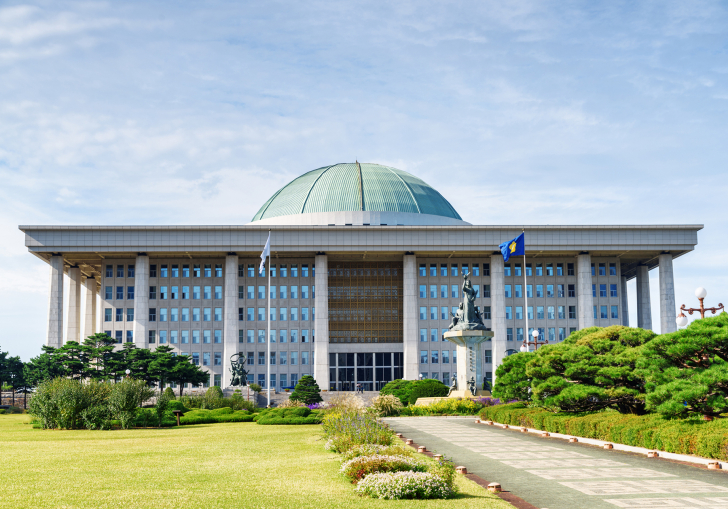
The World Evangelical Alliance (WEA) has recently issued a strong statement opposing the Civil Code amendment bill currently pending in the Korean National Assembly, following statements by the Christian Council of Korea (CCK) on Feb. 3 and the Communion of Churches in Korea (CCIK) on Feb. 5. The WEA expressed concern that the amendment could excessively expand administrative authority over religious organizations, and that it could conflict with the freedom of religion guaranteed by the Korean Constitution and with international human rights norms.
The WEA made this known through a two-page statement released on June 1. The statement was signed by Rev. Adv. Botrus Mansour, Secretary General of the World Evangelical Alliance, and Godfrey Yogarajah, WEA Ambassador for Religious Freedom.
The bill the WEA has raised concerns about is the partial amendment to the Civil Code (Bill No. 2215932), introduced in January 2026. The WEA pointed out that the bill would grant administrative authorities broad powers to investigate religious organizations, suspend their activities, and dissolve them. It also noted that the bill includes provisions allowing the transfer of religious organizations' assets to the national treasury.
The WEA pointed out that the criteria used in the bill—such as "political involvement" and "violation of the separation of church and state"—are not clearly defined. It stated that the "breadth and imprecision" of such provisions give rise to "serious questions" in light of the Korean Constitution and international human rights obligations.
"Freedom of religion is not a privilege granted by the state"
Godfrey Yogarajah, WEA Ambassador for Religious Freedom, emphasized that freedom of religion or belief is not a privilege granted by the state. He said, "When nations bound by international covenants begin treating the regulation of faith communities as a matter of administrative convenience, they undermine the very pluralism that makes democracy possible."
The WEA stated that it respects the "long and distinguished record" that Korea has maintained as a democratic nation valuing the rule of law, human rights, and the development of civil society. However, regarding the bill currently under discussion in the National Assembly, it expressed "deep concern," pointing out that the bill has the potential to conflict with Korea's constitutional order.
Ambassador Yogarajah said, "Every democratic nation, regardless of its dominant religious tradition, has a solemn obligation to uphold FORB not just in name, but in the substance of its laws and institutions."
The WEA explained that Article 20 of the Korean Constitution guarantees freedom of religion and stipulates the principle that "church and state are to be separated." It also mentioned that Article 16 of the Constitution protects the freedom of residence, and that seizure or search requires a warrant issued by a judge.
The WEA pointed out that the bill contains provisions enabling compulsory administrative inspections of religious facilities without a court-issued warrant, and that this "appears directly at odds" with constitutional protections. It went on to state that "should the Bill be enacted, a constitutional challenge would appear inevitable."
"Inverting the meaning of the principle of separation of church and state"
One of the core concerns raised in the WEA statement lay in the bill's justifying logic. The WEA held that the bill's sponsors are justifying state authority to audit, suspend, and dissolve religious organizations on the basis of "separation of church and state." However, it argued that this approach inverts the meaning of the principle of separation of church and state.
In its statement, the WEA said, "This inverts the principle entirely." It went on to emphasize, "In every democratic constitutional tradition, including South Korea's own, the separation of church and state is a protection of religion from the state—not a license for the state to supervise, discipline, or extinguish religious communities."
It further criticized that "legislation that claims to enforce this separation while conferring unlimited administrative control over religious life does not implement the principle; it abolishes it."
The WEA also emphasized that Korea is a State Party to the International Covenant on Civil and Political Rights (ICCPR). Article 18 of the Covenant guarantees freedom of religion or belief, including the right to manifest one's faith in worship and community life. The UN Human Rights Committee has also held that restrictions on religion must be clearly prescribed by law, must be necessary and legitimate, and must be proportionate to their aim.
The WEA argued that the bill fails to meet the foreseeability and precision required under these standards. In particular, it expressed concern that if terms such as "political involvement" and "violation of the separation of church and state" are used without definition, they could encompass even ordinary religious activities—such as pastors' public statements, churches' civic participation, and the expression of conscientious views.
"Could lead to self-censorship by religious organizations"
The WEA warned that the bill's imprecise criteria could produce a chilling effect on religious organizations. Stating that "the inevitable result is a chilling effect," it said that religious organizations would be compelled to self-censor and to withdraw from legitimate civil society activities out of fear of the possibility of administrative action, regardless of whether such action is ever actually taken.
It also analyzed that the bill could grant authorities powers such as compulsory investigations, the summoning of religious leaders, revocation of legal status, and seizure of church property. In this regard, it pointed out that in the absence of robust judicial oversight and clearly defined due process protections, "serious and well-founded questions" arise.
The WEA also expressed concern with respect to Article 22 of the ICCPR, which guarantees freedom of association. It explained that religious organizations constitute associations in the fullest legal sense, and that the UN Human Rights Committee has required compelling justification, independent judicial process, and strict proportionality for the dissolution of an association.
In this regard, the WEA stated, "An administrative dissolution power exercised on vague political grounds, without judicial determination, falls well short of this standard."
That said, the WEA acknowledged that governments may have a legitimate interest in preventing the misuse of corporate structures for criminal, financial, or anti-social purposes. However, it emphasized that holding wrongdoing to account is already sufficiently possible within the existing legal framework.
The WEA explained that "such accountability is most appropriately and effectively pursued through existing mechanisms of criminal law, electoral regulation, and civil oversight," noting that these systems provide defined standards, judicial oversight, and due process protections.
"New powers can be justified only when existing tools are insufficient"
The WEA argued that introducing broad new administrative discretion in a situation where remedies already exist fails to meet the necessity requirement under Article 18(3) of the ICCPR. It stated, "New powers are not justified simply because a problem exists," and "they are justified only when existing tools are demonstrably insufficient."
The WEA asked the Korean National Assembly to give "careful and thorough consideration" to the constitutional issues and international human rights standards. It also emphasized that the Assembly should explore other means of achieving the legislation's objectives, and should consider more narrowly tailored measures together with independent judicial review and transparent due process protections.
In addition, it stated that the Korean government should pursue open and inclusive dialogue with the religious community. It added that communication is particularly needed with Korea's major Christian bodies, which have themselves raised constitutional concerns.
The World Evangelical Alliance also requested that the UN Special Rapporteur on Freedom of Religion or Belief and relevant intergovernmental bodies communicate constructively with the Korean authorities. It emphasized that such discussions should take place "in a spirit of dialogue and shared commitment to international norms."
At the close of its statement, the WEA said it respects Korea's sovereignty and democratic processes. It went on to express hope that the outcome of this discussion would lead in a direction that reaffirms Korea's "proud tradition" of protecting freedom of religion or belief for all citizens and all communities of faith.
The full statement is available on the WEA website.
Originally published by Christian Daily Korea.