South Africa remained relatively calm on June 30th as an unofficial ultimatum from anti-immigration groups expired without the violence many had feared. Save for a few isolated incidents, major cities avoided the looting and destruction seen in past protests, thanks to a robust police deployment and the government’s firm stance against lawlessness.
The outcome of the protest was an answered prayer. The Association of Evangelicals in Africa (AEA), the Evangelical Alliance of South Africa (TEASA), and the Africa Church Transformation Forum (ACT Forum) had appealed to their members to pray and fast on June 28 following a joint fact-finding mission in Johannesburg and KwaZulu-Natal from June 16 - 19.
The joint prayer appeal acknowledged that the anti-immigration crisis had spread beyond undocumented migrants to those holding valid documentation, including asylum-seeker permits, refugee status, and permanent residency. Churches across KwaZulu-Natal and Gauteng have converted their facilities into emergency shelters for displaced persons.
AEA Secretary General Dr. Master Matlhaope wrote to AEA member alliances and networks across 51 countries where it is present requesting participation in the prayers. Bishop Never Muparutsa, AEA Vice President and Global President of the African Forum on Religion and Government, who led the fact-finding mission, said: “This is a continental issue and the church’s response must demonstrate that we understand its complexity. We must be fair, accurate, and balanced and Africa must respond as one family.”
The appeal addressed eight areas of intercession: peace on and after the June 30 protests, dignity of those in displacement camps and fear, and the church’s own responsibility. Members were also urged to pray for the government as it handles the legitimate frustrations of South African citizens, direction and wisdom in immigration governance and the rule of law, the nations of origin and their diaspora communities; and the Africa God wants. Congregations were asked to dedicate at least 15 minutes of Sunday service to intercession, to fast from sunrise to sunset, and to identify one practical act of solidarity.
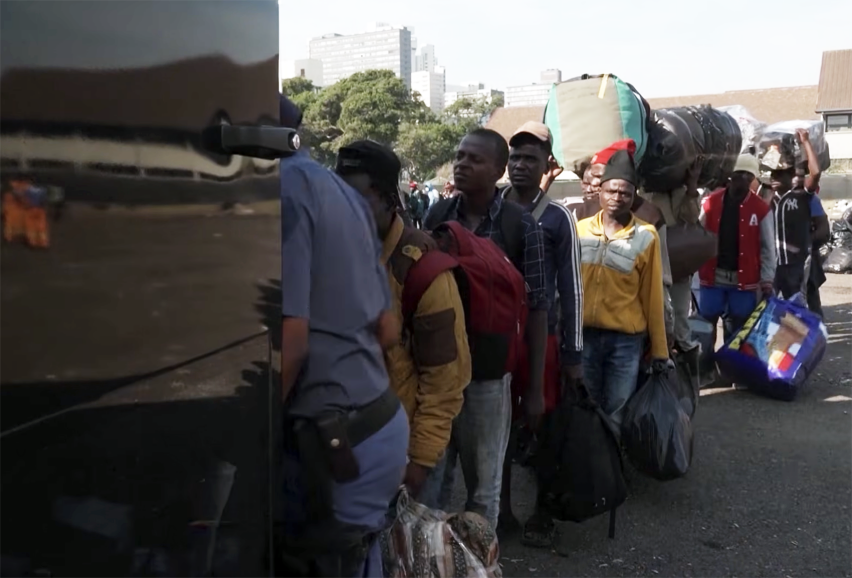
While violence was largely averted, the impact of the unofficial ultimatum continues to be felt by nearly 25,000 who have left the country while many more have sought refuge in community centres, churches and makeshift camps.
Human Rights Watch documented vigilante attacks targeting African and Asian foreign nationals from April 2026, noting that in some instances police response was insufficient. A Malawian national died after being attacked by a mob in Pietermaritzburg following a protest, with police opening a murder case.
South Africa has a documented history of anti-immigrant violence. In 2008, 62 people were killed and more than 100,000 were displaced in attacks that spread from Alexandra township in Johannesburg. The Institute for Security Studies warned that the scale of violence in the current crisis risks approaching that of 2008 if it is not contained.
Repatriation
A Reuters report published by CNBC Africa noted that a surge in attacks on foreign nationals was damaging the country’s global image, with Justice Minister Mmamoloko Kubayi calling on South Africans to reject vigilantism and allow the government to handle immigration through proper channels.
Several African governments have launched emergency repatriation operations for their nationals. Malawi, Ghana, Nigeria, Zimbabwe, and Mozambique are among those that have moved to bring citizens home. NPR reported that in Durban thousands of Malawians fled their homes and camped in the open in winter conditions, begging their government to send buses.
In a televised address on June 7, President Cyril Ramaphosa emphasised that the responsibility for enforcing immigration laws rests with the state. “No other person is allowed, for example, to confront someone in the street to demand proof of nationality.” He added the government would act against those exploiting immigration concerns “to further their own political, personal or criminal agendas.”
AmaZulu King Misuzulu kaZwelithini appealed to the Zulu community to refrain from violence against foreign nationals. “South Africa, we are not looking good in the whole of Africa right now,” he said, warning that attacks were damaging the country’s continental standing and could put South Africans living elsewhere in Africa at risk. He said he had spoken directly to anti-immigrant protest figures urging restraint. “I am asking you, Zulus, let no blood be shed. Do not hit these people. Suffering brought them here. Just as we suffer,” he said.
Several church leaders in South Africa reminded Christians that they are first believers of Jesus before citizens of the country. In a video posted on the Evangelical Alliance of South Africa facebook, the leaders referenced Micah 6:8, urging their members to “act justly, love mercy, and walk humbly before God.”
Rev. Rene August of the Anglican Church of South Africa said “when we welcome a stranger, we welcome Christ” in reference to Matthew 25:35.