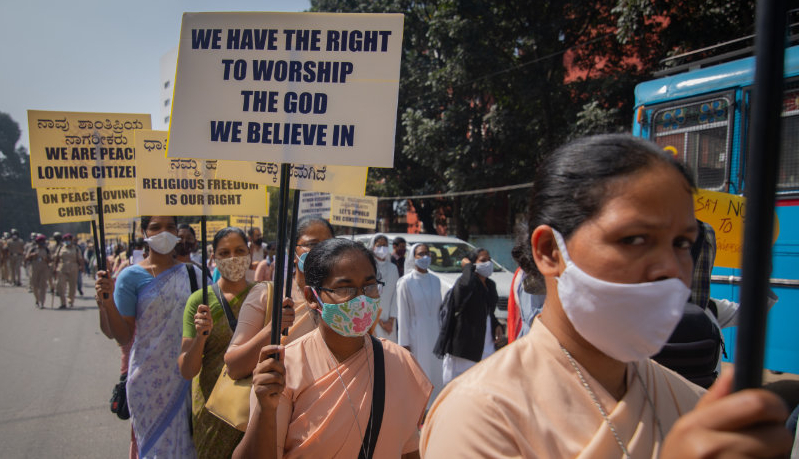
A devastating wave is crashing over South Asia, wreaking havoc on those who choose to follow a faith other than the majority. It is a wave of anti-Christian sentiment. So-called “Freedom of Religion” and “Anti-Blasphemy” laws fuel it, generating a powerful undercurrent of distrust and disdain toward Christians.
They suppress one of the most basic human rights: the right to worship without government interference. India and Pakistan stand out as countries where this hostility results in unsubstantiated accusations, unjust arrests, and violence.
Sovereign states almost universally agree on protecting an individual’s right to choose their faith.
Sovereign states almost universally agree on protecting an individual’s right to choose their faith and peacefully practice and share it as they see fit. In fact, 175 of the 193 United Nations members are parties to the UN International Covenant on Civil and Political Rights.
This instrument, designed by the UN to protect citizens from the treacherous waves of religious persecution, includes India and Pakistan among its bound members. Still, religious freedom violations persist in South Asia.
Six pastors and one Christian have recently been sentenced to five years’ imprisonment.
Thirteen of India’s 28 states have “Freedom of Religion” laws. Under Madhya Pradesh’s state “Freedom of Religion” law, six pastors and one Christian have recently been sentenced to five years’ imprisonment. The pastors attended a child’s birthday party hosted by a Christian family. An uninvited neighbor showed up intoxicated and began to cause a commotion, inciting over 100 people to rage against the Christian family.
A guest called police to restore order. The neighbor consequently filed charges against the pastors. The charges led to convictions, despite testimony from the party host disputing any wrongdoing.
In Pakistan, anti-Christian sentiment has recently resulted in a large mob trapping between 10 and 15 Christian families in their homes.
In Pakistan, anti-Christian sentiment has recently resulted in a large mob trapping between 10 and 15 Christian families in their homes after an anonymous package containing a burned Quran was mailed to a shopkeeper, alleging that a Christian had desecrated the Quran. The accused and his family had to be evacuated with the aid of an armored police escort.
We applaud the government for stepping in to help. Still, one has to wonder whether it would have been necessary if the government had reformed the laws that fuel anti-Christian sentiment and, in doing so, rescued the country as a whole.
As Christians, we stand against conversion by coercion, fraud or force.
Following Jesus is a choice that each person must make on their own. As Christians, we stand against conversion by coercion, fraud or force. We believe that governments have an obligation to protect their citizens from all manner of exploitation, even religious exploitation. Laws protecting people from coercion, force and fraud are one thing. Laws that prohibit people from hearing about or choosing another religion are a completely different matter.
One enforces human rights; the other violates them. Ironically, the so-called “Freedom of Religion” laws place people in bondage by restricting their free speech and their ability to proclaim and live out their faith freely.
A reason to sound the alarm.
Depending on the country and the charge or allegation, penalties can range from years in prison to life imprisonment or worse. Pakistan’s blasphemy laws can carry the death penalty. For Christians determined to obey Jesus’ command to make disciples, these laws carry devastating consequences. That is why they are a reason to sound the alarm.
In the Bible, blowing the ram’s horn, also known as a shofar, was an important and powerful signal. It called for God's people to give immediate attention and often to rally them for battle. In the same way, anti-Christian sentiment and the laws used to spread it warrant repeated, loud trumpet blasts.
A call to drop to our knees in prayer.
The body of Christ needs to pay attention and to do battle on behalf of believers in India, Pakistan and all of South Asia. The call is not to pick up arms or mirror the violence. It’s a call to drop to our knees in prayer and be spiritual warriors who unceasingly pray on behalf of our brothers and sisters in the faith. Our battle, as Paul tells us, is not against flesh and blood (Ephesians 6:12). It is a spiritual battle against darkness and one we must engage in.
Thankfully, other waves are reaching South Asia. Radio waves broadcasting hope. Ministries transmit them and remain committed to reaching hearts and souls with the enduring, life-changing message of Jesus Christ.
True freedom is found in Jesus Christ.
Broadcast in the native heart language of local people, these waves carry the gospel across borders and beyond political barriers, even reaching those living under the worst anti-Christian regimes. Unlike governments, economies, or institutions, true freedom is found in Jesus Christ, for “if the Son sets you free, you will be free indeed” (John 8:36).
As hostility toward Christians persists around the world, many believers wonder how best to support those facing persecution. They can pray, advocate, and support ministries that use the airwaves to carry the gospel into some of the world’s most dangerous, hard-to-reach places.
Safe access in their local language to hear about Jesus’ love.
Local Christians threatened by so-called “Freedom of Religion” laws can find comfort in daily broadcasts that bring encouragement through Bible teaching, worship music, and, in a way, a sense of community, reminding them they have not been forgotten. For those looking to hear the good news for the first time, these broadcasts provide easy and safe access in their local language to hear about Jesus’ love for them.
Robb Hand is the marketing and communications coordinator for The Tide®. Robb has served in domestic and international ministry, living in East Asia and participating in evangelistic projects in Central America, South America, Southeast Asia and Europe. Robb is passionate about ensuring everyone can hear of Jesus’ love for them and respond to the gospel.