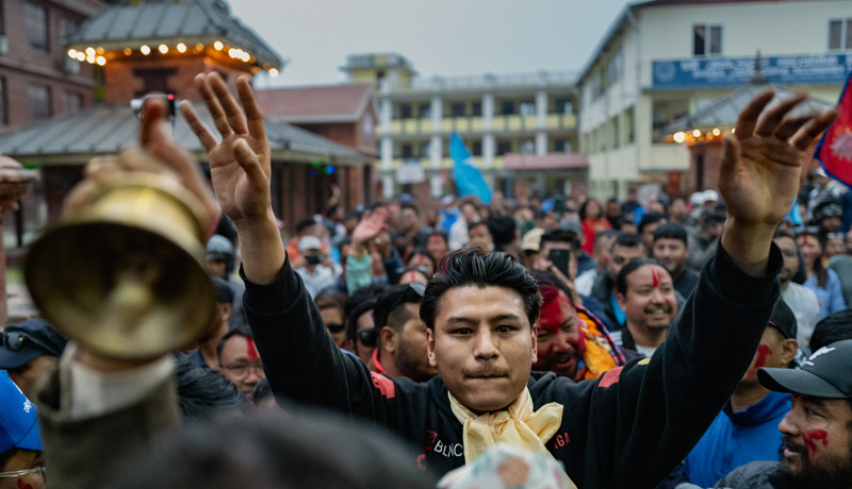
Nepal has a new government after a relatively new party secured a near supermajority in their elections, held after a Gen Z-led uprising brought down the previous administration. The new leadership has generated expectations of better governance, especially among young people.
Rastriya Swatantra Party (RSP) has not been an advocate for Nepal Christians in the past.
One of the tests this government now faces, both at home and internationally, is whether it will resist the growing influence of Hindu nationalism, which has increasingly targeted the country’s small Christian minority. Local sources tell Christian Solidarity International the leadership of the Rastriya Swatantra Party (RSP) has not been an advocate for Nepal Christians in the past.
The RSP, which emerged from the youth protests that ended former Prime Minister K.P. Sharma Oli’s government in September 2025, has become the most popular party since Nepal became a secular federal republic in 2008, ending two centuries of Hindu monarchy.
For Nepal’s estimated 600,000 Christians, who account for nearly two percent of the country’s 30 million people, the question is whether that mandate will extend to genuine protection of religious freedom or reproduce the pressures that minority communities have faced under successive governments.
No explicit commitment to reforming the anti-conversion law.
The RSP won the election on a 100-point Citizens’ Covenant pledging reforms in governance, economic growth and social inclusion. There was no explicit commitment to reforming the anti-conversion law, and no mention of providing burial grounds for Christians who are denied access to land in many municipalities. Nor is there a pledge to end the selective enforcement of laws that have resulted in the prosecution of Christians for peaceful religious activity.
Nepal’s anti conversion law prohibits any attempt or “abetment” to convert another person, as well as any act that “undermines” or “jeopardizes” another person’s religion or belief, provisions that are untenable in international law.
Further, enforcement agencies have interpreted the law to include carrying Bibles, speaking with local families about their faith and organizing prayer meetings. Police have made several arrests for such acts, according to media reports, while foreign Christian visitors have faced deportation.
His cabinet appears geared toward good governance, the past record of some RSP members raises concern.
While the selection of the prime minister and members of his cabinet appears geared toward good governance, the past record of some RSP members raises concern.
The RSP’s founder, Rabi Lamichhane, previously served as home minister and instructed Chief District Officers to stop Christian activities and to refuse permission for the organization of religious meetings and trainings, CSI has learned. He also allegedly required foreign travelers to obtain permission from local district administration offices before entering certain areas of the country, a requirement that in practice restricted the movement of Christian missionaries and relief workers.
Several other RSP members who have won seats in parliament have spoken publicly against Christianity. Some among them have called for amending Nepal’s constitution to restore the country’s identity as a Hindu nation.
Christian leaders in Nepal appear to be cautiously hopeful.
Christian leaders in Nepal appear to be cautiously hopeful after the formation of the new government. As part of this change, the community expects equal access to burial grounds, an end to prosecutions under the anti-conversion law for peaceful religious activity, and formal recognition of their right to religious assembly.
Originally published by CSI (Christian Solidarity International). Republished with permission.
Founded over 40 years ago, CSI (Christian Solidarity International) is an international Christian human rights organization, campaigning for religious liberty and human dignity, and assisting victims of religious persecution, victimized children and victims of catastrophe. CSI delivers emergency food assistance, medical treatment, and other lifesaving aid to victims of religious persecution and natural disasters in Iraq, Syria, Egypt, Nigeria, South Sudan, Pakistan, and other hotspots around the globe. CSI is currently the only organization working to liberate Christians and other South Sudanese forced into slavery by government-backed forces during the Sudanese civil war. For more information visit https://csi-usa.org.