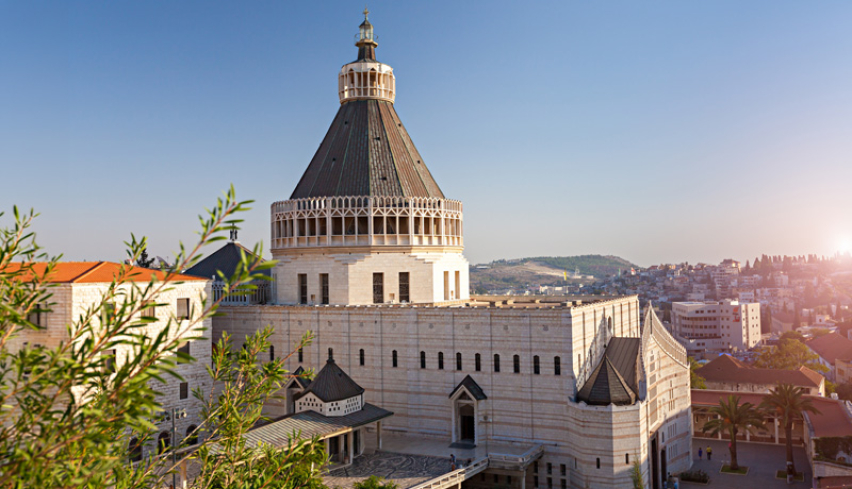
An angel appeared to a teenage girl in a small hillside village, and the world changed. According to the Gospel of Luke, that is what happened in Nazareth roughly two thousand years ago. Nine months later, that girl would give birth in Bethlehem, but the Christmas story began here, in Nazareth.
A small, ancient Christian community still calls this town home.
Today, pilgrims from around the globe file through the doors of the Basilica of the Annunciation, built on that same spot, where archaeologists have traced Christian worship back to the earliest centuries of the church. To the outside world, Nazareth carries on as an Arab city of nearly 80,000 residents, bustling with markets, traffic, and calls to prayer. Inside, a small, ancient Christian community still calls this town home. I am part of that community.
Nazareth is living proof that this story never left home.
It is worth saying plainly that Christianity did not start in the West. It began in a Middle Eastern village, among a Middle Eastern family, speaking Middle Eastern languages. Nazareth is living proof that this story never left home. Our community is not an artifact; it is alive, still worshiping and raising children in the same hills where the story began.
An ancient community, still here
Christians number... just 1.8% of Israel’s population.
Nazareth is home to roughly 80,000 Arab residents—about 20,000 Christians and 60,000 Muslims, making Christians a quarter of the city. Nationally, Christians number around 180,000, just 1.8% of Israel’s population. We are a minority within a minority.
Yet Christian churches and organizations here own and run schools, kindergartens, hospitals, guest houses, and monasteries serving the whole population, Christian and Muslim alike. For over a century, Nazareth Hospital has been a constant presence of healing and reconciliation as people come together from all backgrounds and beliefs to provide care in the midst of conflict.
Church anchors our week.
My own days look ordinary: work, family, the market, friends. The difference is that my commute passes places people travel thousands of miles to see. Church anchors our week. Many of us attend two or three times, alongside youth groups and parish life.
A rhythm of worship built into the land and into our daily lives.
Our calendar is a pilgrimage circuit tied to the Gospels themselves: Bethlehem at Christmas, Jerusalem for Palm Sunday and Easter, the Jordan River at Epiphany, Mount Tabor for the Transfiguration, and Nazareth itself on Annunciation Day. It is a rhythm of worship built into the land and into our daily lives.
Reading scripture where it happened
Living where Jesus lived... shapes how we read the Bible.
Living where Jesus lived also shapes how we read the Bible. The geography and culture here are still, in many ways, the geography and culture of the Gospels. Take Matthew 5:45: “He causes his sun to rise on the evil and the good, and sends rain on the righteous and the unrighteous” (NIV). Because rain is rare and precious in this region, we read it as God sending rain as a blessing on the righteous and unrighteous alike. Readers from places where rain is unwelcome might hear the same verse as describing a punishment.
The Christmas story works the same way. In Luke 2:7, Mary lays her newborn in a manger “because there was no guest room available for them” (NIV). Western readers often picture a cold stable and an innkeeper turning the family away, though Luke mentions neither.
A crowded home making room for a child.
In traditional village homes here, families and their animals often lived under one roof, and a manger could sit inside the house itself. Many scholars read the story not as rejection, but as a crowded home making room for a child.
Scripture is not a distant text to be decoded but a living word spoken into the land.
Parables about vineyards, shepherds, wells, and olive trees are still our daily life; in some communities, we still use tools like the ones the Bible describes. What others must study in commentaries from afar, we see from our windows and hold in our hands. Here, Scripture is not a distant text to be decoded but a living word spoken into the land where we live, and that land helps us hear it as its first listeners did.
Assumptions about Christianity
Local Christians have lived here continuously for centuries.
It is easy for those raised in Europe, North America, or elsewhere to assume everyone here is Jewish, or that Christianity disappeared from this region long ago and is now a Western religion. Many are surprised that local Christians have lived here continuously for centuries and that we remain today.
That assumption exists partly because Christianity spread so successfully in Europe and America, and partly because centuries of Muslim rule here reinforced the idea that the faith had “moved” west. But Acts 2:11 names Arabs among those who heard the apostles speak in their own language at Pentecost. Arabic-speaking Nazarene Christians are not converts from the West. We are part of an ancient tradition.
Our remaining presence continues alongside our neighbors of other faiths.
Our remaining presence continues alongside our neighbors of other faiths. Most of our daily life together is ordinary. We share schools, business, and friendship—though political tension surfaces at times. Many of us celebrate each other’s holidays and support one another in hard times. You can see it at Christmas. Every year, local youth and church leaders march through the city to the Basilica of the Annunciation, and tens of thousands of people, Muslims, Jews, and Christians, line the streets to watch.
What our presence here costs
Our continuity here is not guaranteed.
Tragically, our continuity here is not guaranteed. Our numbers have declined as young people emigrate for education and opportunity, even as our churches remain active. Economic pressure, political tension, and emigration are real, ongoing challenges to sustaining a Christian presence here.
A strong faith, close-knit families, resilient churches, and a deep connection to the land... carried us.
With war in Gaza, Nazareth cancelled its Christmas parade, and streets that usually fill with music and lights were quiet. Last year, the celebrations returned, and the crowds came back with them. That is our story. We have outlasted empires, wars, and political upheaval before, and we will keep doing so. What has carried us through is a strong faith, close-knit families, resilient churches, and a deep connection to the land.
Faith can... endure many hardships.
Our community in Nazareth is a living reminder of our faith’s origins. We call ourselves “living stones” to reflect this, after 1 Peter 2:5. I hope Christians abroad come to see that faith can remain strong as a minority, and it can endure many hardships.
If I could invite you to experience one thing here, it would be to meet our people. More than 2,000 years ago, a journey to Bethlehem began in this town, and Jesus grew up here before going on to transform the lives of those around him. This Christmas, we are still here, following in his footsteps as a beacon of healing, hope and hospitality in his hometown.
Amer Nicola serves as an educator, tour guide, and the Research and Curriculum Development Manager at Nazareth Village, a living-history, open-air museum operated by The Nazareth Trust. His work focuses on historical research, educational programming, and interpreting first-century Galilean life for international visitors and pilgrims.