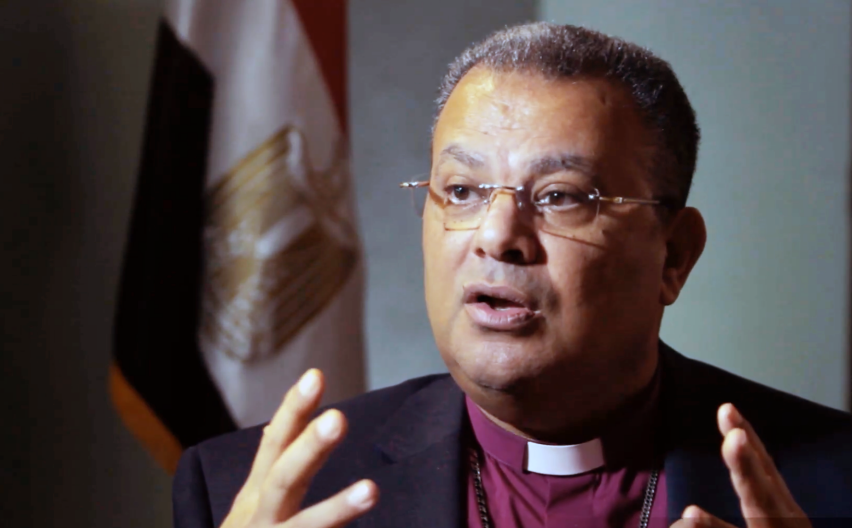
The number of evangelical churches in Egypt has grown by about a quarter over the past 15 years, and its relationship with the state has improved “dramatically in a positive way” over the past decade, according to the Rev. Dr. Andrea Zaki, president of the Protestant Community of Egypt.
In an exclusive interview with Christian Daily International, Zaki, who also serves as general director of the Coptic Evangelical Organization for Social Services (CEOSS), described a community that sees itself as an integral part of Egyptian society, engaged in national development and working alongside Orthodox, Catholic and Muslim institutions. Yet, he also acknowledged that the situation is not without difficulty, saying that relationships are good but that this does not mean the picture is entirely “rosy.”
‘Second largest church in the whole Middle East’
Egypt’s evangelical community is “not always known” beyond the country’s borders, Zaki noted. It comprises about 19 denominations under the General Council of evangelicals in Egypt. The council is elected by the denominations, and it in turn elects the president and vice president of the Protestant churches.
The community counts around 1,500 local churches. “We are not only local churches, but also churches with education like schools and health services like hospitals and clinics,” Zaki said, adding that it also runs nurseries and social development projects.
Alongside the churches is the Evangelical Fellowship of Egypt, a member of the World Evangelical Alliance. According to Zaki, the fellowship brings together 150 ministries and organizations, which employ a combined 2,000 full-time staff and draw on several thousand volunteers.
Zaki estimated the number of evangelicals in Egypt at between 2 million and 3 million. “We are considered the second largest church in the whole Middle East after the Coptic Orthodox,” he said.
‘Part of the Egyptian fabric’
“In terms of what we are doing, we are doing fine,” Zaki said. “We are part of the Egyptian fabric. We are part of the development of Egypt, and we supported the revolutions of 2013.”
He said evangelicals believe “Egypt should be a country that serves as an umbrella for Muslims and Christians together,” and that they work closely with other religious institutions, including Orthodox and Catholic Christians and Muslims.
Asked whether Egypt stands out in the region on Christian-Muslim relations, Zaki said the relationship is “very good” in terms of coexistence, citizenship and peacebuilding, and that the situation has improved markedly over the past decade.
He pointed to concrete measures. Over the past 15 years, he said, the government has granted the evangelical community more than 56 plots of land free of charge to build churches in Egypt’s new cities. The government also created an evangelical endowment body to oversee all Protestant endowments in the country.
Evangelicals are also working with the Orthodox and Catholic churches on a personal status law. Zaki said it is now being discussed in parliament “for the first time in the history” and is expected to be approved by the state in the near future.
As Christian Daily International reported earlier this year, the Egyptian government referred the Personal Status Law for Egyptian Christians to parliament on May 4, together with a separate personal status bill for Muslims. Both bills cover family matters such as regulations related to marriage and inheritance, and their provisions can still be amended during parliamentary committee review.
Fewer tensions, closer ties between churches
Zaki acknowledged that tensions persist. “From time to time, you have radicals in certain communities who are creating some problems,” he said.
What has changed, in his view, is how the authorities respond. He said the government now approaches such incidents through the concept of citizenship, “encouraging reconciliation, encouraging accepting of the others, encouraging coexistence.”
“We had in the past a lot of problems,” he said. “Today we have few of them, and they are dealt with by the government in a very positive way.”
Zaki also described relations with Egypt’s other Christian traditions as “very good,” particularly among church leaders.
“We have a lot of communication,” he said. He called Coptic Orthodox Pope Tawadros II “our friend” and said the relationships with the Coptic Catholic Patriarch Ibrahim Isaac Sidrak is “also very good.”
“In terms of leadership, there is mutual respect and love and understanding,” he said.
At the local level, relationships are currently good as well, Zaki said, and he credited the Egypt Council of Churches with “doing a good job.”
A growing church investing in the next generation
Zaki described Egypt’s evangelicals as “a solid conservative evangelical community.” Over the past 15 years, he said, the number of local churches has grown by about 25%, from around 1,200 to more than 1,500.
He cited campaigns, conferences, meetings, youth activities and worship teams as signs of that growth. “We are flourishing, and we are a stable, solid evangelical community in Egypt,” he said.
As churches in many countries struggle to engage younger generations, Zaki said Egypt’s evangelicals are “very concerned about young people.”
“We know that sometimes the church speaks a language that is not understandable for the young people, or uses methods of worship that do not fit with their characters and their ambitions and challenges,” he said.
One response is a student leadership training program run by tC Egypt, a ministry of the Evangelical Fellowship, together with Student Leadership University in the United States. The four-year program trains hundreds of young people aged 15 to 20, and its first group graduated this year.
According to Student Leadership University, its partnership with tC Egypt began in 2023 and takes Egyptian Christian students through four levels, SLU 101 to SLU 401. SLU reports that nearly 800 students went on to the second level and more than 200 to the third, with participants from Cairo, Alexandria, Minya, Assiut and the Nile Delta.
“We encourage young people to take on a role, and we encourage them to be in leadership positions,” Zaki said.
Serving the wider community
Egyptian churches are also active in addressing social needs. Zaki said churches are “connected to the realities and the needs of the people,” with social programs running effectively in certain local communities.
That work is carried out both by organizations, such as Think and Do, a ministry of the Evangelical Fellowship of Egypt, and by local churches.
Founded over thirty years ago, Think and Do focuses on developing poor communities in Egypt, offering integrated spiritual, psychological, physical and material support. Its work began in the villages of Upper Egypt and later expanded to poor areas of Cairo, including support for vulnerable women, micro loans and vocational training.
“Programs are developed according to the needs of the people,” Zaki said, with the fellowship’s 150 member organizations “serving the whole community.”
A voice beyond Egypt
Asked about the role of Egypt’s evangelical church in the wider region and globally, Zaki said it has “very strong, committed leaders, scholars, potential leaders” serving through the Evangelical Fellowship, civil society organizations and local churches.
“We are building capacity of church leaders in a way that they are globally recognized, and some of them are taking a global role,” he said, noting that several of the community’s key leaders speak at conferences and in communities around the world.
“I am proud of my church,” Zaki said. “It’s dynamic, strong, conservative, open to society, open to challenges and changes.”