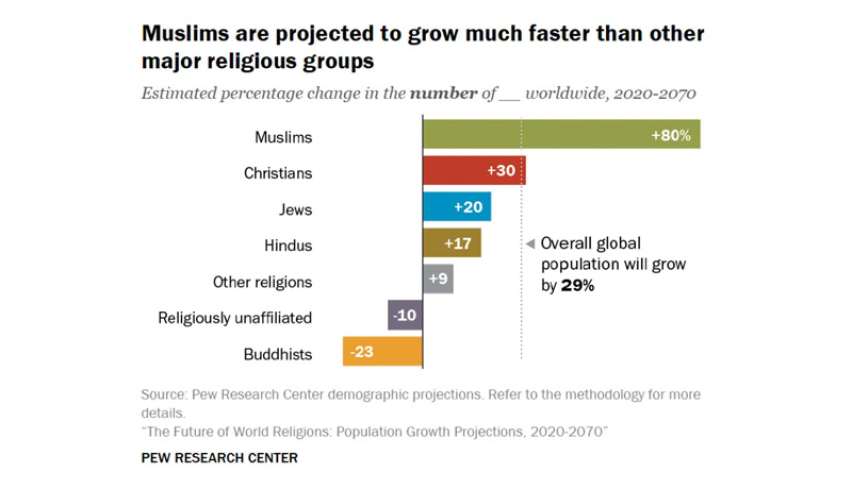
There is a whole group of missions people that argue strongly against church planting movements. I won’t mention them. You know who they are if you’re at all looking in on the movement discussion. There are numerous angles of attack, but I do notice one consistent theme: they really don’t like the concept of “rapid growth.”
Matt Rhodes’ book, “No Shortcuts to Success” is an example of this, and the title contains the premise that church planting is necessarily a long and arduous process (you can read a positive review and a not-so-positive review here).
Pew... wants to publish any article that speaks down on Christianity.
Pew's report claimed that by 2035 Islam would be the world’s largest religion. I tend to be a bit of a critic of Pew because they seem to always want to publish any article that speaks down on Christianity. If you prefer a summary, Associated Press does a good job of summarizing it here.
About that Pew report
How is the total global population going to be 29% larger in 2070?
This is a slight digression from my overall point, but the Pew report is, in my view, sensationalized. Pew is projecting a 29% growth in the total global population by 2070. Really? Consider that 2.1% is the fertility rate necessary for a stable population. The current global fertility rate is sitting at about 0.9%. How is the total global population going to be 29% larger in 2070?
I’m not a professional demographer, and this is not my area of expertise, but I did stay at a Holiday Inn express last night (a riff on the Holiday Express ad "Stay Smart"), so let me suggest that there may be some major assumptions in this report that are not correct.
Fertility rates... drop when women are educated and when urbanization happens.
Fertility rates seem to drop when two things happen in a culture: when women are educated and when urbanization happens. Both of those are continuing to rise globally (and both are happening in Islamic cultures).
I would also suggest that post-modernism is also playing a role in shrinking populations and it is also affecting Islamic cultures. The hyper-individualism of post-modernism causes us to lose our zeal for life and family, we have more abortions and suicides, we delay marriage, and we have fewer babies. These kinds of trends all affect the projections in the Pew report.
Past trends... not likely to continue into the future.
The Pew report needs to be understood as a projection of past trends that are not likely to continue into the future.
While “rapid growth” and this Pew report are two seemingly unrelated topics, let’s put them together and ask a couple of questions.
Percentage of a population versus rates of growth
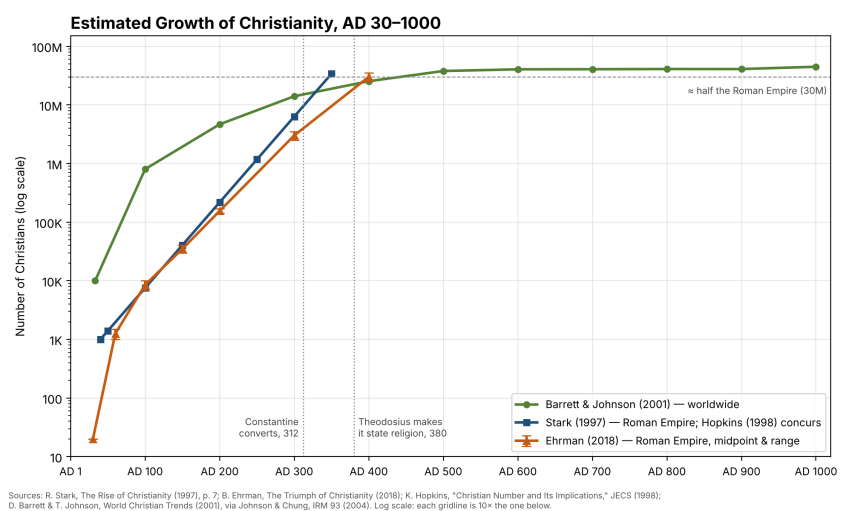
If you were attending a church in the first century, did it feel like the church was growing rapidly? I took some sources from Rodney Stark. Ehrman, and Barret and Johnson’s material, fed it into an AI, and asked it to chart out the growth of the first 400 years of church history:
Another way to look at this is via the growth rate:
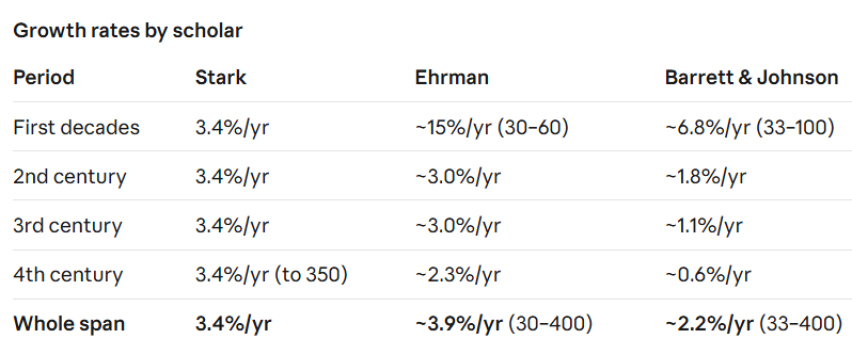
This all sums up to a per decade growth rate of 3.4% through the first 400 years.
A growth rate compounds.
Christians did not reach 2% of the Roman Empire until about 250 AD. I realize that the “Roman Empire” is not a people group per se, but if we want to understand movement dynamics, the era in which Christianity grew into a global force seems like one to consider. 250 years is a long time to get to 2%, but the rate of growth is what we should be looking at. A growth rate compounds.
Question #1: Did the early Church experience rapid growth?
I understand this is a bit of a naughty question.
For the folks adamantly opposed to rapid growth in church planting movements I ask this: did the early church experience rapid growth? If they did, then why are you so worried about it. If they did not, then what is reasonable growth? Is 3.4% per year rapid growth?
Pew believes Islam is growing about 12.5% per decade.
Let’s tie this to population growth. The Pew research study suggests that Muslims will be the majority religion because of demographic growth. Pew believes Islam is growing about 12.5% per decade, or 1.2% per year. Does that seem fast to you? It does to me, particularly since Christians in the West are struggling to maintain, let alone grow, our presence.
Based on any of those numbers, I don’t know anybody who would say that the early church did not experience rapid growth. If you are opposed to rapid growth, you are making an argument against what happened in the first 400 years of the church.
Question #2: Is there a better way to think about missions goals?
For decades now, missiologists have used the 2% number in an unreached people group (UPG) to describe the point at which we would no longer consider them unreached. I (and many others) have written about the arbitrary assignment of the 2% number. But you have to have something, and 2% was picked.
“How much growth in the church is necessary to keep pace with and exceed population growth?”
Perhaps we should be thinking a bit more broadly and frame our efforts around the question, “How much growth in the church is necessary to keep pace with and exceed, population growth?” If that number could be attained, then the church would grow. Both in UPGs and everywhere else.
Maybe we should be aiming for a conversion + demographic growth rate for the Church in any specific culture. The 2% is fine… but the rate of growth should also be considered important as well.
Comparing Islamic growth to the First Century
Islam’s projected 1.2% per year is just under one-third of the early church’s 3.4% growth rate.
Islam’s projected 1.2% per year is just under one-third of the early church’s 3.4% growth rate. The two kinds of growth are also different in character.
Pre-Constantine Christianity grew in a flat population, mostly through conversion and families raising children in the faith. Islam’s projected growth comes almost entirely from births outpacing deaths in young, high-fertility regions. Even in low-fertility regions Islam is projected to grow. From the report:
"North America, meanwhile, is projected to see the fastest Muslim growth. The number of Muslims living in that region is expected to more than triple, from 6 million to 20 million, by 2070."
Where is this growth coming from? Certainly, immigration will play a large role in this growth rate. Do you think that the population of Muslims tripling between now and 2070 qualifies as rapid growth? I certainly would.
The only way that this is going to be countered is for there to be rapid growth among Christians.
The only way that this is going to be countered is for there to be rapid growth among Christians. We in the North American Church need to be up for the task of doing serious outreach to Muslims (I have written more on this here).
Is rapid growth bad?
Why has rapid growth become the boogeyman of the anti-movement crowd? I think it might be because the method of institutional church planting rarely lends itself to rapid growth. This is the only kind of church planting most Westerners know and understand.
The institutional model of church planting is directing the outcomes rather than the other way around.
Almost by definition, it discounts the ability of a church to multiply at any rate or pace that might be on par with the first 400 years of the church. The institutional model of church planting is directing the outcomes rather than the other way around.
In some places the traditional method is the only method that is working. It is working slow but movements don’t just happen if we pull the right levers, so we need the traditional model. Hear me: I’m for all forms of church planning.
The Bible does not forbid rapid growth.
There are places and people where the traditional model is appropriate. But this doesn’t mean we shouldn’t lift our eyes up and see the advantages of a church planting approach which promises a faster growth rate. By the way, this is not pragmatism. This is common sense. The Bible does not forbid rapid growth.
There is a huge Church in North America. Can this Church get serious about conversion (and demographic growth!) in a way that offsets the growth that we are going to see in Islam in North America? How about the church in Africa? There’s a huge church there as well. Are they going to push back on the encroaching Islamic Saharan belt that is pushing southward?
We need to get our growth rate up!
Unless we want to see a future in which Islam is the world’s dominant religion, we better get busy. We need to get our growth rate up!
Originally published on Ted's Substack, TedQuarters. Republished with permission.
Ted Esler is the President of Missio Nexus, an association of agencies and churches representing hundreds of mission agencies and churches. Ted worked in the computer industry and then served in the Balkans during the 1990s. He then held various leadership roles with Pioneers. He was appointed the President of Missio Nexus in 2015. He is the author of The Innovation Crisis. Ted has a PhD in Intercultural Studies (Fuller Theological Seminary, 2012).