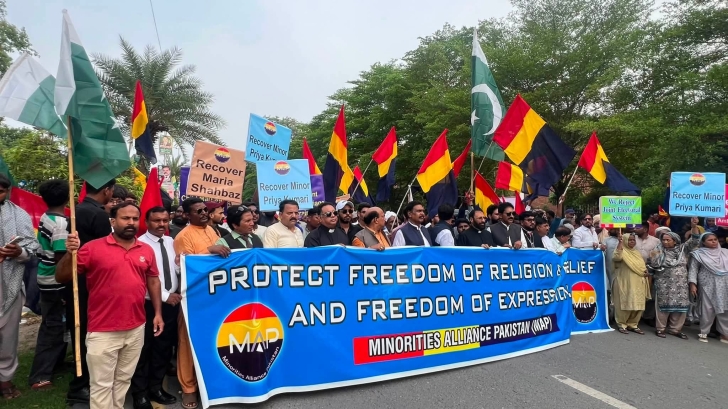
Rights advocates criticized a resolution passed in the Punjab Provincial Assembly on Tuesday (Nov. 24) calling for harsher punishment for blasphemy against the wives, family members and companions of Islam’s prophet.
Strengthening Pakistan’s controversial blasphemy laws could fuel further false accusations against citizens, including Christians, critics said of the resolution unanimously passed in the assembly.
The resolution, introduced by opposition lawmaker Rana Aurangzaib, described the existing punishment under Section 298-A of the Pakistan Penal Code (PPC) as insufficient for acts that allegedly hurt religious sentiments.
Section 298-A prescribes up to three years’ imprisonment, a fine, or both for derogatory remarks against the wives and family members of Islam’s prophet, Muhammad, the four Islamic caliphs and his companions. The provision covers expressions made verbally, in writing or through visual representations, as well as direct or indirect insinuations concerning the personalities protected under the law.
The resolution urged the federal government to take up the matter as a high priority and introduced legislation increasing the punishment under Section 298-A. It also called for effective lawmaking and implementation to safeguard religious sanctities and maintain social peace and harmony.
The move revived concerns over previous attempts to toughen the provision. In August 2023, Pakistan’s parliament passed the Criminal Laws (Amendment) Bill 2023, which proposed increasing the maximum punishment under Section 298-A from three years to a minimum of 10 years, with the possibility of life imprisonment. The bill however, did not become law after then-president Arif Alvi returned it to parliament without signing it.
Human rights organizations had strongly opposed the proposed amendments, warning that harsher penalties and changes to bail provisions would further jeopardize the rights of people accused under the law.
The Human Rights Commission of Pakistan (HRCP) particularly warned that the amendments would remove the statutory entitlement to bail for those accused under Section 298-A, making their release dependent on judicial discretion.
The commission also highlighted the broader pattern of abuse surrounding Pakistan’s blasphemy laws, noting that complaints are sometimes registered under pressure from religious groups, over personal disputes or amid fears of mob violence following allegations of blasphemy.
Although the Punjab Assembly unanimously supported Tuesday’s resolution, any amendment to Section 298-A would require legislation at the federal level, said a Christian attorney who has successfully defended several people falsely accused of blasphemy.
“Rather than strengthening the legislation, the federal government should legislate against false accusations of blasphemy that continue to put innocent lives at stake,” the attorney told Christian Daily International-Morning Star News on condition of anonymity. “There is an urgent need to bring a deterrent law to protect people from organized groups and individuals who are using false accusations as a means to extort money from people.”
Official figures presented to a Senate committee in July further underscored concerns about the misuse of blasphemy allegations. On July 8, provincial home secretaries and senior police officials told the Senate’s Functional Committee on Human Rights that a majority of 333 blasphemy cases registered across Pakistan’s four provinces over the previous five years were fabricated. The cases included allegations against Christians and members of other religious minorities.
During the meeting, chaired by Sen. Samina Mumtaz Zehri in Islamabad, officials presented data showing that Punjab recorded the highest number of cases under Section 295-C, which criminalizes insulting Muhammad. A total of 116 cases were registered under the provision during the five-year period.
According to the data, 56 percent of those accused were Muslims, while 14 percent belonged to religious minority communities.
Sindh Province recorded 96 cases under Section 295-B, which criminalizes desecration of the Quran, and 29 cases under Section 295-C. Khyber Pakhtunkhwa Province recorded more than 90 blasphemy cases during the period, while Balochistan reported the fewest, with 28.
Provincial officials acknowledged that personal vendettas, family disputes and other private conflicts frequently motivated blasphemy allegations. In many cases, investigations failed to uncover evidence supporting the accusations, resulting in their dismissal.
A June 2025 report by Human Rights Watch (HRW) also documented the exploitation of Pakistan’s blasphemy laws to dispossess vulnerable communities and intimidate religious minorities.
“Blasphemy accusations are increasingly weaponized to incite mob violence, displace marginalized groups and seize their property with impunity,” HRW stated in its 29-page report, “A Conspiracy to Grab the Land: Exploiting Pakistan’s Blasphemy Laws for Blackmail and Profit.”
The report documented cases in which blasphemy allegations were used to target business rivals and coerce people into transferring property, warning that the laws’ vague and sweeping provisions facilitate abuse even in the absence of credible evidence.
HRW also criticized Pakistan’s criminal justice system for failing to hold perpetrators of mob violence accountable. Police frequently fail to protect people accused of blasphemy or conduct proper investigations, the organization stated, while political and religious figures accused of inciting violence often escape arrest or prosecution because of intimidation and a lack of political will.
Tehmina Arora, director of advocacy for Asia at Christian legal advocacy organization Alliance Defending Freedom International, said Pakistan should repeal its harsh blasphemy laws rather than introduce further restrictions.
“Given how easily it is in Pakistan to file cases on the charges of blasphemy, such laws have a chilling effect on the practice and propagation of one’s faith,” Arora said. “Blasphemy laws not only create a culture of violence and discrimination, they are also violative of international law and must be repealed.”
She also urged the international community to closely monitor blasphemy cases in Pakistan and press the government to ensure accountability.
“Organized groups that exploit blasphemy accusations to target innocent people undermine the rule of law and put Christians and other vulnerable communities at grave risk,” she added.
Pakistan continues to rank among the countries where Christians face the most severe persecution. It placed eighth on Open Doors’ 2026 World Watch List, which ranks the 50 countries where it is most difficult to be a Christian.