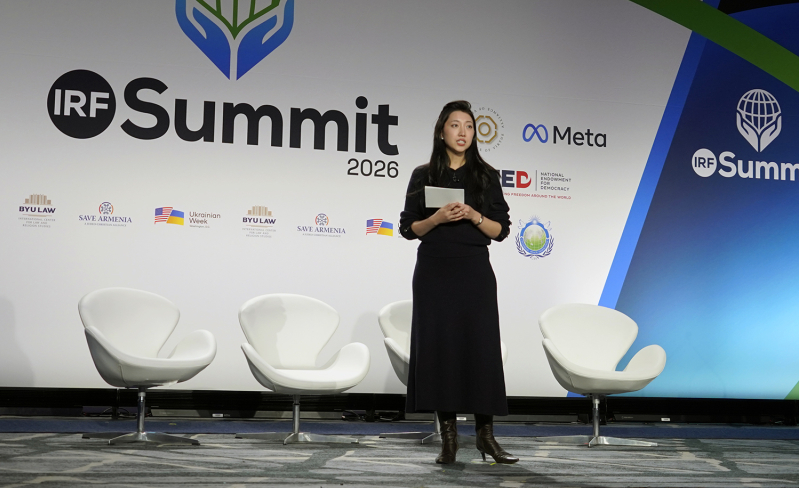
The daughter of a pastor imprisoned in China told the sixth annual International Religious Freedom Summit in Washington, D.C. on Monday (Feb. 2) that she may never see her father again but maintains hope and faith in God.
Grace Jin Drexel told how her father, Pastor Ezra Jin, was arrested alongside 27 other church leaders on Oct. 10 in “one of the largest takedowns of the independent Christian congregation in China since the Cultural Revolution, a sweep so brazen it has drawn strong international condemnation.”
Jin Drexel, who moved to the states with her mother during an earlier crackdown, said she has not seen her father in seven years.
“He was not there at my wedding to walk me down the aisle, and he has never met his grandchildren,” she said.
A Senate staff worker, her advocacy had also led to transnational oppression, she said, with her family receiving threatening phone calls and being followed in Washington. Pastor Jin’s wife, Chunli Liu, and their three children, all U.S. citizens, have lived in the U.S. since 2018.
Zion Church was first targeted in 2018, when leaders refused government demands to install facial recognition cameras. Authorities then seized the Beijing church building and barred Pastor Jin from leaving the country.
Pastor Jin and his congregation adapted, developing a hybrid online and offline model. When COVID-19 forced the halt of all gatherings in 2020, the church’s online services exploded, attracting up to 10,000 people daily across 40 cities nationwide.
Under a new wave of persecution, imprisoned church leaders are reportedly subjected to brutal conditions, including sleeping on cold mats, sleep deprivation and endless interrogation, Jin Drexel said. Many, including Pastor Jin, suffer from severe health concerns.
Of the 28 church leaders initially detained, 18 remain in prison.
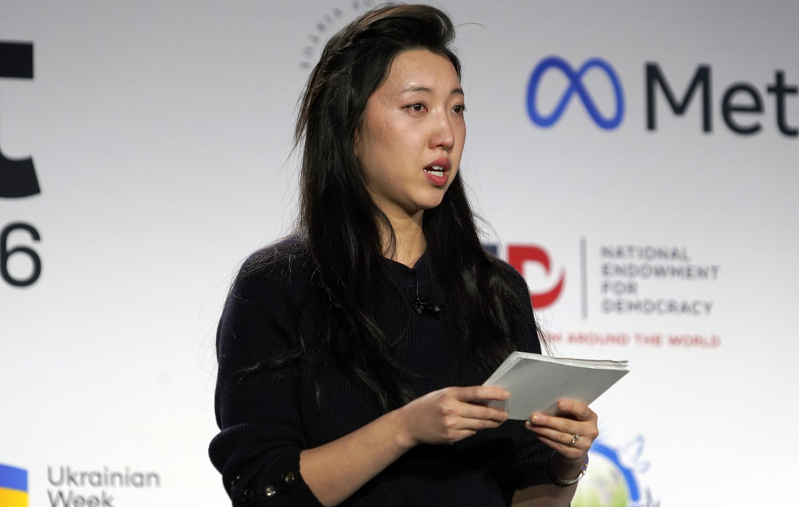
Jin Drexel urged summit attendees to “take courage” and “use your voice and influence” to advocate for the release of all religious prisoners. “Do not accept Chinese trampling of universal human rights, which if left unchecked will cause a wave of repression and reverberate around the world,” she said.
She said she is seeking to expose and hold accountable those who repress religion in China.
“As a Christian, I believe that we’re asked to take courage and to speak the truth that the God who created Heaven and earth will stand by our side,” Jin Drexel said. “Similarly, I urge all of you if today to take courage, to use your voice and influence in whatever sphere.”
Pastor Jin, 56, was detained in Beihai, Guangxi Province. He founded Zion Church, a nondenominational evangelical congregation that began in 2007 and grew to be one of China’s largest underground churches. The crackdown on Zion Church, which included others in Beijing, Shanghai and Shenzhen, came as part of China’s systematic “Sinicization” campaign under President Xi Jinping, a push for total state control over religious life.
Jin Drexel said Sinicization has included practices like removing crosses, replacing hymns with revolutionary party songs, rewriting sermons to align with socialist values, installing facial recognition cameras in sanctuaries, and even leveling churches. This campaign also targets other religions.
“Sinicization is not about making religion more Chinese; it is repression plain and simple,” she said.
Jin Drexel called on advocates to urge the release all church members immediately and unconditionally, along with other religious prisoners of conscience.
“I also believe in miracles,” she said. “I draw strength in knowing that my God is a good God, and that even these bleakest moments might be used to serve a greater purpose. Our prayers are not in vain. As my dad wrote in a letter from prison, God has indeed used His power to uphold us. I believe that God is also testing us during this time…God will not abandon us.”
The U.S. administration previously called for Pastor Jin’s immediate release, noting his children are U.S. citizens. Pastor Sean Long, a Zion Church leader based in the U.S., has said Pastor Jin is expected to face charges related to online dissemination of religious content, an offense now strictly regulated.
At the summit, Jin Drexel introduced a video message from former President George W. Bush, who expressed solidarity with those oppressed for their beliefs.
“The freedom to worship according to one’s heart is enshrined in our constitution because our founders knew it was so special to human dignity,” Bush said.
In opening statements at the summit, former U.S. Ambassador-at-Large for International Religious Freedom (2018-2012) Sam Brownback told attendees they represent “the heart of freedom,” a movement “feared by dictators around the world.”
Religious freedom is a “paramount global security concern for all freedom-loving nations” against an “axis of communist, authoritarian, and totalitarian regimes,” Brownback said.
While China’s Constitution nominally guarantees freedom of religion, the officially atheist Communist Party recognizes only state-approved religious organizations. Tens of millions of Chinese Christians attend unregistered house churches, often facing harassment.
Even state-approved groups like the Three-Self Patriotic Movement for Protestants and the Chinese Patriotic Catholic Association are subject to surveillance and control, with some facing closures for resisting political directives. Under President Xi Jinping, scrutiny of unofficial religious groups has intensified, labeling some as cults and encouraging citizens to report them.