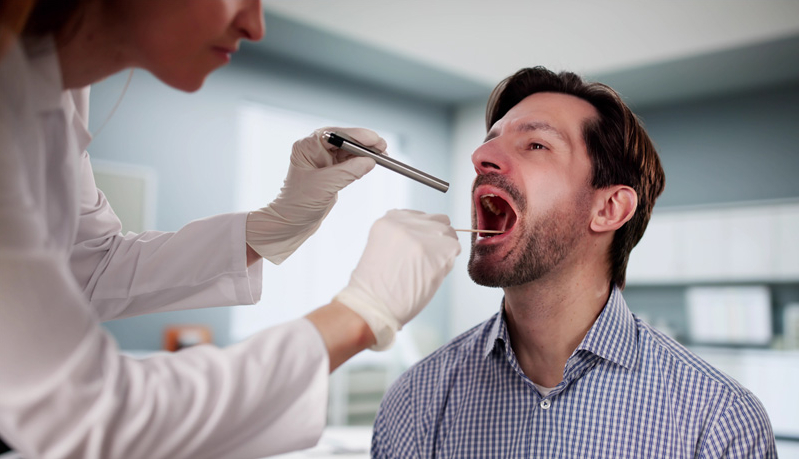
Two weeks ago I woke up with a mouth full of ulcers. Not one discreet little ulcer hiding in the corner—oh, no—a full committee meeting! Every syllable felt like sandpaper.
Preaching with mouth ulcers is like attempting Handel’s Messiah while chewing gravel. So I rang the GP’s surgery. The earliest appointment? "A week away". There’s a sentence that stretches both your patience and your theology.
My mouth tasted like the North Sea.
In the meantime, I turned to the time-honored British remedy: salt-water rinses. Then more salt-water rinses. By day four my mouth tasted like the North Sea and the ulcers were still thriving.
Eventually, the appointment arrived. My wife, Killy, came with me, partly for moral support, partly to ensure I remained Christian in the waiting room.
"What do you want?"
We entered the doctor’s office. No warmth. No welcome. No "How are you?" Just: "What do you want?" It felt less like a consultation and more like a cross-examination. He glanced in my mouth—and when I say glanced, I mean one second. I’ve had longer eye contact from a pigeon.
Tap. Tap. Tap on the keyboard. "Go to the pharmacy. Pick up your prescription. Goodbye."
Ninety seconds. We were in and out faster than a Formula 1 pit stop. He wasn’t offensive. He was efficient. Just distant. Detached. Disinterested. You know the sensation: you’re not a person, you’re a problem to be processed.
The prescription didn’t work. The ulcers and pain worsened. So I rang again. To the surgery’s credit, they offered another appointment three days later with a different doctor.
"Hello! Come in! Take a seat."
We walked into the second consultation. "Hello! Come in! Take a seat." And immediately, something shifted. He examined my mouth properly. Checked my ears. Took my blood pressure. Asked questions. We even had a little banter about football and life.
Ten minutes. Same surgery. Two doctors. Two atmospheres. Two prescriptions. Two outcomes. The second doctor’s prescription cleared the ulcers within three days.
But this isn’t really about ulcers. It’s about us.
A culture running on empty
Somewhere along the way, efficiency has started to replace empathy.
We are living in an age of relentless pace. The NHS (British National Health Service) is under enormous strain. Staff are exhausted. Patients are anxious. Systems are stretched thin. Efficiency has become a survival strategy. But somewhere along the way, efficiency has started to replace empathy.
The first doctor treated a mouth. The second doctor treated a person. That distinction may sound small. It is not. We underestimate the power of tone. We underestimate the ministry of manners. We underestimate how much kindness costs and how much coldness costs more.
Attention is one of the purest forms of love. To give someone your full focus for even a few minutes says, "You matter." And in a distracted society, that message is priceless.
Humanity clears ulcers.
The first consultation was quick. The second was human. Efficiency clears diaries. Humanity clears ulcers.
The invisible aches
Here is what troubles me most. There are people walking around Britain (and all over the world) today with invisible ulcers. Ulcers of grief. Ulcers of anxiety. Ulcers of loneliness. Ulcers of disappointment. They sit across desks. They stand in queues. They scroll through phones late at night.
You cannot see their pain in a scan. But it is there. And when they come into our orbit, at work, at church, in the supermarket, at home, we face a quiet choice. Ninety seconds. Or ten minutes. A glance. Or a careful look. Efficiency. Or empathy.
Loneliness has become a public health crisis.
We are arguably the most technologically connected generation in history, yet loneliness has become a public health crisis. We speak constantly, but listening is becoming rare. And listening is not passive. It is powerful.
The Example of Jesus
Whatever one’s personal faith, the figure of Jesus remains compelling in this regard.
"What do you want me to do for you?"
Read the gospel accounts and you notice something striking: he was never hurried with hurting people. There were crowds. There was pressure. There was urgency. Yet when someone in pain stood before him, he stopped. A blind man by the roadside. A woman suffering silently. A grieving family. He asked, "What do you want me to do for you?"
It is almost the same question my GP asked. But tone transforms meaning. Presence changes everything.
The small things that shape a nation
We tend to think society is shaped only by major policies and grand speeches. But often it is shaped just as profoundly by the smaller omissions: No smile. No warmth. No eye contact. No curiosity. These are not dramatic failures. They are quiet absences. Yet they accumulate.
They form the emotional climate of a workplace, a family, even a country. The second doctor did not perform a miracle. He simply practiced attentive care. And that changed both the experience and the outcome.
In a hurried world, slowness can be quietly radical.
Kindness is not weakness. Patience is not passivity. Warmth is not wasted time. In a hurried world, slowness can be quietly radical.
The prescription we all carry
Most of us will never sit behind a GP’s desk. But every one of us carries something just as powerful: our tone. Our attention. Our presence. Our extra two minutes.
You may be the only gentleness someone encounters today. The only pause in their chaos. The only moment they feel seen rather than scanned. Same office. Different spirit.
The lesson of my ulcers is simple but searching: sometimes the greatest healing does not come from what we prescribe, but from how we treat people.
We can decide what kind of presence we bring into a room.
We cannot fix everything. We cannot solve every systemic problem. But we can decide what kind of presence we bring into a room. And in the end, that may be one of the most powerful prescriptions of all.
Originally published by Philo Trust. Republished with permission.
J.John is an evangelist, minister, speaker, broadcaster and writer. He has been in ministry for four decades. He has spoken in towns, cities and universities in 69 countries, establishing Philo Trust in 1982 to organize his various evangelistic ministry offerings. J.John’s weekly podcast, The J.John Podcast, features a range of interviews with Christians from all walks of life and talks by J.John. Click here to listen. J.John’s books are available to order via jjohn.com or through other online or physical bookshops.
Philo Trust was established by J.John in 1982 to organize evangelistic events and projects, equip Christians to naturally share their faith, mentor evangelists, and produce books and resources to help people in their journey of faith.