
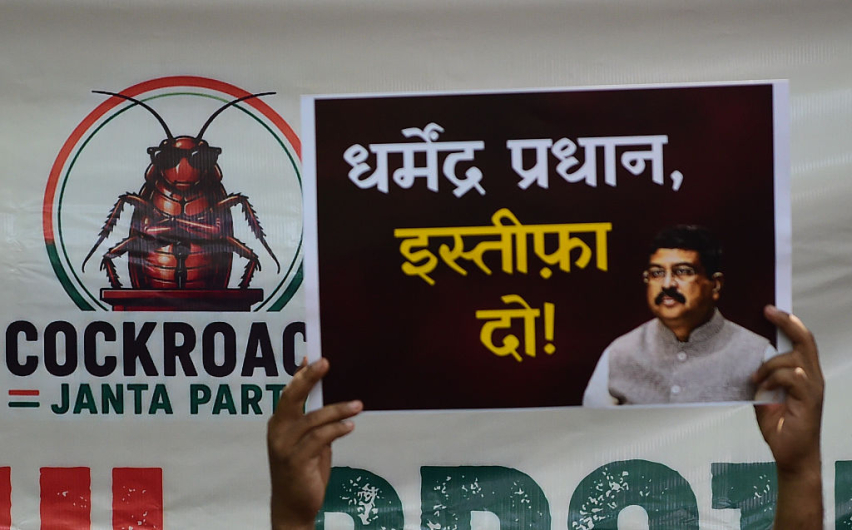
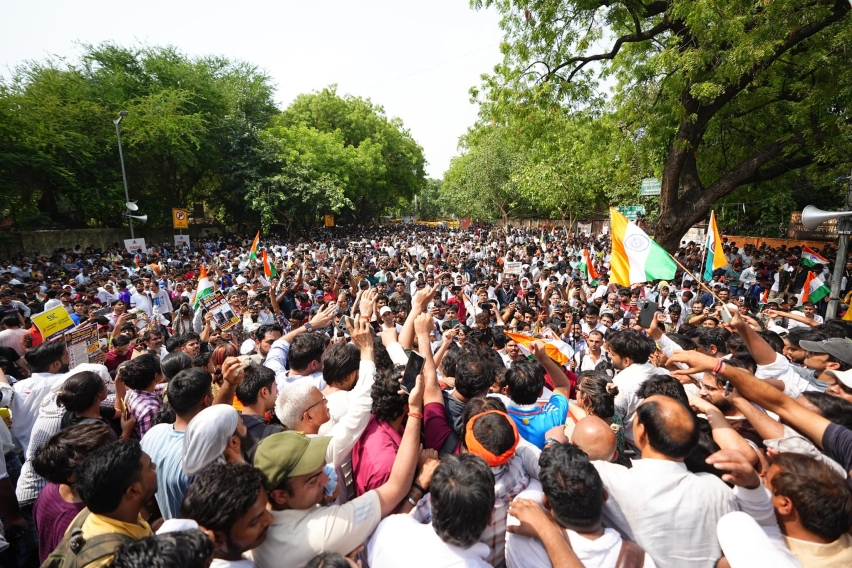
They arrived waving Indian flags and clutching schoolbooks. Many wore cockroach masks. The placards were satirical; the anger was not. On June 6, crowds gathered at Jantar Mantar as what many commentators are calling India’s first Gen Z political uprising moved from smartphone screens onto a street. Jantan Mantar is New Delhi’s designated public protest zone, historically the gathering point for the country’s largest anti-corruption and farmers’ demonstrations.
The protest had been organized by the Cockroach Janta Party, a social media movement that did not exist three weeks ago. Delhi Police deployed more than 1,000 personnel across the capital and granted permission for the demonstration from 10 a.m. to 5 p.m. Six protesters were detained during the day. A police contingent stood outside the home of the movement’s founder in the western state of Maharashtra.
None of that dampened the crowd, which chanted “Dharmendra Pradhan Istifa Do,” Hindi for “step down,” directed at India’s Union Education Minister, a senior BJP leader under whose watch a medical entrance exam paper was leaked and a new school-leaving exam system collapsed in full public view. Another chant expressed a generation’s frustration: “We asked for ‘Make in India,’ you gave us ‘Leak in India.’“
In under three weeks, the Cockroach Janta Party had grown into the largest political movement by Instagram following in India. June 6 was its first test of whether that following would show up in person.
How it started
The story begins at the Supreme Court on May 15. Remarks attributed to Chief Justice of India Surya Kant, who was presiding over a contempt petition related to fraudulent professional credentials in the legal profession, spread rapidly through Indian social media within hours of the hearing. According to court proceedings cited by The Wire, Al Jazeera, and multiple other outlets, he said: “There are already parasites of society who attack the system and you want to join hands with them? There are youngsters like cockroaches, they don’t get any employment, they don’t have any place in profession. Some of them become media, some of them become social media, some of them become RTI activists [RTI refers to India’s Right to Information law, a citizen’s tool for demanding government records], some of them become other activists, and they start attacking everyone.”
Kant issued a clarification the very next day. He said sections of the media had misquoted him, and that his remarks were aimed solely at individuals entering professions like law using fake or fraudulent degrees, not at unemployed youth generally. “It is totally baseless to suggest that I criticised the youth of our nation,” he said. Young Indians had, by then, already heard enough.
The remarks followed Kant to Britain. On June 4, a student at Birkbeck, University of London, tried to raise them during a lecture the chief justice was delivering. The moderator shut the question off as off topic. Another attendee pressed the point, raising what she called widespread concern among legal observers about the suppression of dissent in India. Videos circulated online. India’s High Commission in London issued a statement condemning the disruption.
A party named after an insult
The day after Kant’s court appearance, Abhijeet Dipke, a 30-year-old political communications strategist from Maharashtra and a recent public relations graduate of Boston University in the United States, posted a question online: What if all the cockroaches come together? Before leaving for Boston, he had worked as a volunteer with the Aam Aadmi Party (AAP), a Delhi-based anti-corruption opposition party, reportedly running meme-based digital campaigns during the 2020 state elections.
Thousands responded within hours. Dipke set up a Google form. Within days, more than 350,000 people had signed up. He launched the Cockroach Janta Party, or CJP, on May 16.
The name is a direct satirical echo of India’s ruling Bharatiya Janata Party, the BJP. In Hindi, “Bharatiya” means Indian and “Janta” means people, making the BJP the “Indian People’s Party,” the party of Prime Minister Narendra Modi’s Hindu nationalist government. The CJP swaps “Indian” for “Cockroach,” producing the “Cockroach People’s Party.” It is not a subtle joke.
Dipke used artificial intelligence to generate a cartoon insect mascot and built a website under the tagline “Voice of the Lazy and Unemployed.” The membership criteria were designed to be absurd: to join the CJP, one needed to be unemployed, lazy, chronically online, and able to “rant professionally.”
Dipke is Dalit, a member of communities historically placed at the lowest rung of India’s caste hierarchy and subjected to centuries of discrimination. When he revealed his identity on social media during the controversy, he faced an immediate wave of casteist abuse online.
A social media following bigger than the party it mocks
The CJP’s Instagram account crossed 10 million followers in under five days, overtaking the BJP’s 9 million on that platform. It has since grown to more than 22 million, surpassing both the BJP and the main opposition Indian National Congress, which has 13 million Instagram followers. The BJP has existed for over 40 years.
Those numbers have a context. India produces more than eight million graduates a year, yet the unemployment rate among them stands at 29 percent, nine times higher than for those who never attended school. More than a quarter of India’s population belongs to Gen Z. Many young Indians felt they had been dismissed as “cockroaches” by the country’s top judge.
The CJP’s original X account was withheld inside India. According to a senior government official quoted by The Indian Express, the move was attributed to the Intelligence Bureau raising national security concerns. The party launched a replacement account called @Cockroachisback. Dipke claimed the government had also taken down the CJP’s website, on which 600,000 people had signed a petition demanding Pradhan’s resignation. Dipke said his Instagram account had been hacked and that Meta had removed the CJP’s backup account.
“Why is the government so scared of cockroaches?” Dipke posted. “You can’t get rid of us that easily.”
The personal cost became visible quickly. Dipke shared screenshots of WhatsApp messages threatening to have him killed in the United States if he did not close the CJP down. One video message showed an unidentified man claiming to know the locations of his family members and demanding he join the BJP instead. Media also reported him receiving a separate message offering money to shut the account, or face death. His parents told reporters they feared for their son’s safety.
For every account disabled, new ones emerged across states. As The Print observed, the party behaved like the ‘mythical Hydra’: cut one head, two appeared. BJP leaders then shifted approach, describing the movement as anti-national activity, according to The Week, with some attempting to link its followers to Pakistan. Dipke released account analytics showing 94.7 percent of followers were from India, most aged 17 to 28. The data, he acknowledged, was the party’s own and could not be independently verified.
The exam system that broke a generation’s trust
Behind the cockroach humor is a specific, documented crisis.
The National Eligibility cum Entrance Test, known as NEET, is the single nationwide gateway to medical colleges. This year’s exam, held on May 3 for 2.27 million students, was cancelled on May 12 after investigators found the physics paper had been leaked beforehand. The Central Bureau of Investigation arrested the headmistress of a Pune school who had recalled the physics questions from memory, shared them with a student, and then burned her handwritten notes. The exam has been rescheduled to June 21. Reports of student suicides followed news of the leak.
India’s Central Board of Secondary Education added a second crisis. It introduced a new digital evaluation system this year, called On-Screen Marking (OSM), for its school-leaving examinations, and simultaneously abolished post-result verification of marks. What unraveled afterward was documented not by regulators or journalists, but by three teenagers.
Vedant Shrivastava, 17, applied for a re-evaluated copy of his physics answer sheet and received a stranger’s paper. He posted the evidence on X and faced a coordinated smear campaign of accounts calling him a “Pakistani”. The board eventually provided his correct sheet.
Nisarga Adhikary, 19, an ethical hacker who had sat the same board exams, found a hardcoded master password sitting in the OSM portal’s publicly accessible code in February, reported it to India’s Computer Emergency Response Team without satisfactory response, and published his findings in May.
Sarthak Sidhant, 18, audited the CBSE tender and found 15 alleged discrepancies suggesting the contract favored a specific vendor. He published his analysis, then testified before the Parliamentary Standing Committee on Education. Two senior CBSE officials were subsequently transferred. Opposition leader Rahul Gandhi met Sidhant publicly and posted the photograph on social media.
The national pass rate this year fell to 85.20 percent, the lowest in seven years. Dharmendra Pradhan presided over all of it.
The CJP’s stated demand for June 6 was Pradhan’s resignation. The party’s wider manifesto goes further. It demands 50 percent women’s representation in Parliament and Cabinet, greater independence for India’s media, and a ban on a practice that draws particular attention given the events that started this movement: the custom of rewarding retiring Supreme Court judges with appointed seats in India’s upper house of Parliament, a patronage arrangement critics say compromises judicial independence.
Building toward the street
As Dipke prepared to return from Boston, the CJP announced three spokespersons on June 3: investigative journalist Saurav Das as chief spokesperson, political researcher and filmmaker Vijeta Dahiya, and Ashutosh Ranka, a former McKinsey consultant and graduate of IIT Kanpur and the London School of Economics.
“There has to be accountability in the system,” Das told a press conference in New Delhi. “The system has collected so much rot. The people have been very vocal.”
Sonam Wangchuk, the Ladakh activist and Ramon Magsaysay Award winner who spent six months in detention in 2025 after protests demanding regional autonomy turned deadly, had already declared himself an “honorary cockroach” and pledged to join the June 6 demonstration. At Jantar Mantar, crowds chanted that he should replace Pradhan. Wangchuk called the minister’s resignation “only the beginning.”
Before flying home, Dipke posted: “My friends and family are scared that I could get arrested at the airport. But how long can I fear jail? This country belongs not just to one party, but to all of us.” He walked through New Delhi arrivals carrying a copy of the autobiography of B.R. Ambedkar, himself Dalit and the jurist who drafted India’s Constitution. He was not arrested. Delhi Police handed him a written permission order for the protest.
At Jantar Mantar he addressed the crowd directly: “Let us tell them we will no longer be afraid of their politics of fear. Stop the politics of religion! Stop the politics of ‘Hindu-Muslim’!” He also spoke of his mother: “In this country, every mother feels this fear when their child raises their voice against this government.”
When the demonstration ended, CJP spokesperson Ashutosh Ranka told reporters the government had seven days: Pradhan resigns, or protests spread across India. Rohit Pawar of the Nationalist Congress Party (Sharadchandra Pawar), a regional opposition grouping, and Sagarika Ghose of the Trinamool Congress, which governs West Bengal and sits in the national opposition, have both backed the campaign.
A generation tired of watching
South Asia has recent precedent. Gen Z uprisings overturned governments in Sri Lanka, Nepal, and Bangladesh in recent years. India, home to more young people than any country on earth, has watched those from a distance.
“We have to understand that five years ago nobody was ready to speak up against Modi or the government. The times are changing,” Dipke told the Associated Press.
What June 6 demonstrated is that a generation that formed around memes and satirical posts can also organize enough to occupy a street.








