
When India’s Election Commission declared results on May 4 across four states and one Union Territory, the numbers told one story. The pattern behind them told another.
The Bharatiya Janata Party (BJP), the Hindu nationalist party that governs India nationally under Prime Minister Narendra Modi, won West Bengal for the first time in its 46-year history. It retained Assam for a third consecutive term. Its allies returned to power in Puducherry. In the southern state of Tamil Nadu, a political newcomer with an explicitly secular platform delivered one of the country’s most stunning electoral upsets. In Kerala, voters returned a Congress-led alliance to power after a decade in opposition.
Neither Tamil Nadu nor Kerala moved in the BJP’s direction. But taken together, the five verdicts represent the most significant consolidation of BJP
and allied political power since the 2024 national elections, when the party lost its outright parliamentary majority and was forced into coalition for the first time in a decade.
The state election results suggest its Hindu nationalist agenda has not been checked but recalibrated, with the party deepening its grip at the regional level where anti-conversion laws are enacted, and eviction drives are ordered.
For India’s roughly 28 million Christians, about 2.3 percent of the population, the consequences of who governs at the state level are immediate and concrete.
John Dayal, a veteran journalist and human rights activist who serves as spokesperson of the All India Catholic Union, one of India’s oldest Catholic lay organizations, told Christian Daily International (CDI) that the election results leave Christians reading two different signals. The United Democratic Front’s (UDF) return in Kerala protects the operating space of church-run institutions, he said, but BJP gains across the other states sharpen existing fears about laws restricting religious conversion, tightening controls on overseas funding and rising violence against minorities.
West Bengal
West Bengal, a densely populated eastern state of roughly 100 million people sharing a long border with Bangladesh, had never returned a BJP government before May 4. The party won 207 of the 293 seats declared, against the Trinamool Congress’s 80. Voter turnout reached 92.93 percent, the highest ever recorded in the state.
The BJP’s campaign was built on an explicit religious framework. Modi told a rally in the Muslim-majority Murshidabad district that a BJP government would “not allow Bengalis to become a minority in the state.” He promised to fast-track the Citizenship Amendment Act, a law offering Indian citizenship to non-Muslim refugees from neighboring countries, while warning that Muslim “infiltrators should start packing their bags.”
Before a single vote was cast, the electoral rolls had become a battleground. The Election Commission conducted a Special Intensive Revision of West Bengal’s voter registrations in the months before polling, striking off roughly nine million names, about 12 percent of the electorate. Opposition parties and Muslim groups accused the Commission of systematically removing voters unlikely to support the BJP, pointing to data showing that Muslims, who make up 27 percent of the state’s population, accounted for 34 percent of the deletions.
The Election Commission called it a routine cleanup of deceased and duplicate entries.
But the BJP also tapped into a deeper well of anti-incumbency. A scholar based in Kolkata who spoke to CDI and asked not to be named described what he had heard from ordinary voters.
“There was a lot of corruption and violence against those who did not toe the TMC’s line, especially in rural areas,” he said. He cited syndicate networks requiring businesses to buy materials only from TMC-affiliated suppliers, a rigged school teachers’ recruitment examination that courts annulled entirely, and the rape and murder of Dr. Moumita Debnath, a trainee doctor at RG Kar Medical College and Hospital in Kolkata in August 2024, whose case the government mishandled.
“There is corruption at every level,” he told CDI. “People wanted a change. However, there is no alternative. It was like one evil replacing the other.”
Chief Minister Mamata Banerjee lost her Bhabanipur constituency in South Kolkata to BJP’s Suvendu Adhikari by 15,105 votes. Despite losing, she refused to resign, claiming the mandate had been “looted.” The West Bengal Legislative Assembly was dissolved on May 7 under Article 174(2)(b) of the Constitution after her refusal left the state with no legal path forward.
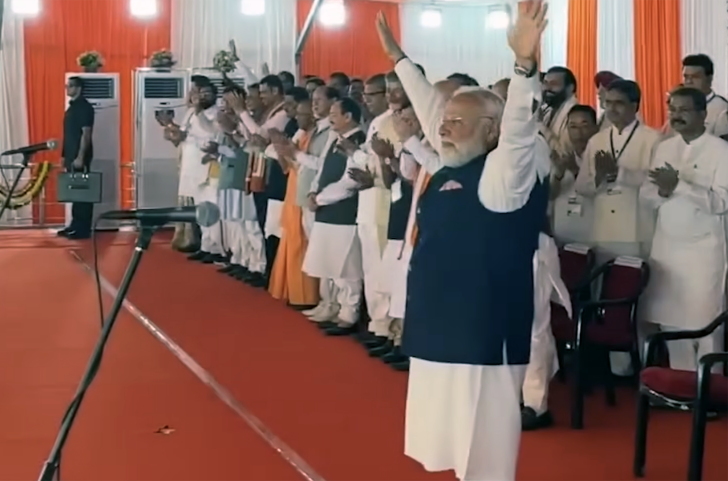
On May 9, Adhikari was sworn in as West Bengal’s first-ever BJP chief minister at a ceremony at Brigade Parade Ground in Kolkata. Prime Minister Modi and Union Home Minister Amit Shah attended. The ceremony was held on Rabindra Jayanti, the birth anniversary of Nobel laureate Rabindranath Tagore.
Adhikari had made no attempt to soften the victory’s meaning. He told reporters that “Hindu ne TMC ko muh tor jawab de diya” (Hindus of Bengal gave a befitting reply to the TMC). He said Hindus had been “discriminated against and tortured” under Banerjee’s government, and claimed that the “entire Muslim vote bank” had moved to the TMC in Bhabanipur and vowed: “I will work for those who voted for me, the Hindus.”
Violence broke out across the state within hours of the results. According to media reports, at least four people died in post-poll clashes. Among them was Chandranath Rath, personal assistant to Adhikari, who was shot dead near Kolkata airport on Wednesday (May 6). More than 430 people were arrested and over 1,000 detained preventively.
Adhikari called Rath’s killing “heart-wrenching.” “This is a cold-blooded murder,” he told reporters.
TMC offices across several Kolkata neighborhoods were vandalized. A bulldozer was used to partially demolish a TMC office during a BJP victory procession, with a BJP flag subsequently raised over the structure. Muslim communities in Kolkata’s Topsia neighborhood reported targeted intimidation during BJP victory celebrations. Traders in leather-producing areas reported pressure to stop dealing in cow leather, a livelihood issue for many Muslims and particularly sensitive ahead of Eid-al-Adha.
The scholar based in Kolkata who spoke to CDI noted that political violence after elections has a long history in Bengal on all sides.
“Victorious BJP goons are now beating up TMC goons,” he said. “It is just that the role has reversed. In 2021, TMC goons beat BJP goons. Unfortunately, this is the culture.”
Assam
In Assam, a landlocked northeastern state sharing borders with Bangladesh, Bhutan and four other Indian states, the BJP alone won 82 of 126 seats, with allies bringing the National Democratic Alliance’s total to 102.
Chief Minister Himanta Biswa Sarma, who has led Assam since 2021, was confirmed as the NDA’s choice on Sunday (May 10) and is set to be sworn in on Tuesday (May 12) for a historic second consecutive term, making him the first non-Congress chief minister of Assam to serve two terms in a row.
Sarma’s tenure was defined by a documented pattern of rhetoric and policy. Between 2021 and 2026, his government demolished over 22,000 structures in drives critics say disproportionately targeted Bengali-speaking Muslim settlements. In 2025 alone, 40,000 individuals were evicted from their homes. In December 2025, he urged Hindu families at a public gathering to have more children while suggesting Muslim families should limit their size.
In February 2026, the BJP’s Assam unit released an AI-generated video merging real footage of Sarma handling firearms with images depicting Muslims as targets. The party’s own unit president called it “unauthorized” and “immature,” and a social media official was dismissed.
When rights activist Harsh Mander filed a hate speech complaint against Sarma, the chief minister said he would file “at least 100 cases” in retaliation. The Gauhati High Court, Assam’s highest court, issued him a formal notice over the remark.
Allen Brooks, spokesperson of the Assam Christian Forum, an umbrella body representing Christians across denominations in the state, and a former chairman of the Assam State Minority Commission, spoke to CDI after the results.
Brooks described the BJP’s durability as resting on “a layered strategy that combines aggressive polarization on the basis of religious identity, extensive welfare delivery, and co-opting of indigenous and tribal identities.” The Church, he said, needs to look beyond seat tallies to understand what is actually happening.
“You have to see how they have effectively integrated themselves into the local social and cultural fabric,” he told CDI.
For Christians in the state, Brooks said, daily life is shaped by pressures that rarely reach national headlines. He cited the Anti-Conversion Law, the Healing Practices Act, which rights groups say restricts Christian prayer and healing services by equating them with magical practices, restrictions on land transactions outside one’s own community, and the threat of losing Scheduled Tribe status, a constitutionally protected classification that reserves government jobs and university places for historically excluded communities, because of one’s faith. In Assam’s tribal areas, converting to Christianity has in practice placed that status at risk.
Brooks challenged the government’s development narrative. “The gap between the portrayal of ‘Sab Ka Sath, Sab Ka Vikas,’ ‘Together with all, development for all,’ the BJP’s signature slogan, and actual ground realities is wide,” he told CDI. “Locals are grappling with anxieties over land security, identity, displacement, employment and price rise.”
“The tension isn’t just Hindu versus Muslim or Christian,” he added. “It’s a complex struggle to protect indigenous culture from demographic shifts and legislative contradictions.”
He was precise about why discontent has not found political expression.
“Anti-incumbency is not absent in Assam but has been effectively neutralized through a combination of targeted governance, polarization and strategic political messaging,” he told CDI. “While pockets of discontent exist, they have largely failed to find unified political expression.”
Kerala
In Kerala, on India’s southwestern coast, the Congress-led United Democratic Front won 102 of the state assembly’s 140 seats, returning to power after a decade in opposition. The Communist Party of India (Marxist)-led Left Democratic Front, which had governed for two consecutive terms since 2016, was reduced to 35 seats. Chief Minister Pinarayi Vijayan resigned the same evening.
Kerala’s Christian population, at roughly 18 percent of the state’s 35 million people, is among the highest in peninsular India. Catholic, Orthodox and Protestant churches run a significant share of its schools and hospitals. The UDF’s return signals continuity for those institutions. The BJP won three seats, historically significant for a party that has rarely opened its account in the state.
The race for chief minister remained unresolved at this writing, with the Congress high command yet to announce its decision despite the election win coming a week earlier. V.D. Satheesan, the outgoing Opposition Leader, has hardened his position, demanding the top post or nothing, while the high command is reported to favor AICC General Secretary K.C. Venugopal. Former Opposition Leader Ramesh Chennithala is also in contention. UDF allies have warned that the prolonged impasse risks dividing the very coalition that delivered the election win.
Two Kerala-based Christian leaders, including a bishop, who spoke to CDI but asked to remain anonymous, pointed independently to the same issue as decisive for Christian voters: the Foreign Contribution Regulation Act (FCRA), a central government law governing overseas donations to Indian organizations that has been used to suspend or cancel licenses of church-run schools and hospitals. When the BJP-led central government moved to tighten the Act through a 2026 amendment bill, Congress MPs from Kerala staged a sit-in protest outside Parliament. Both sources said the protest resonated deeply among Christians.
“The FCRA bill badly affected BJP’s dream,” one told CDI. “Otherwise, the BJP could have achieved more seats.”
The result produced one outcome that resonated particularly within Christian communities. V.S. Joy, a lawyer and Congress politician who is a member of the Assemblies of God, a Pentecostal denomination, won the Thavanur constituency in Malappuram District, one of Kerala’s most Muslim-majority districts, by 14,647 votes, defeating former minister K.T. Jaleel, who had held the seat for a decade.
Kerala’s Pentecostal community celebrated the win as a historic first, with a congratulatory graphic circulating widely declaring him the first Pentecostal Christian elected to the Kerala Legislative Assembly. He would not be the first Pentecostal Member of Legislative Assembly in India overall. His victory was built in part on close ties with the Indian Union Muslim League, the principal Muslim political party in Kerala.
The Rev. Jacob Ninan, senior pastor of Trinity Highland Tabernacle, a Full Gospel church in Kochi, told CDI that the Pentecostal vote in Kerala was divided but that anti-incumbency ultimately drove most toward the UDF. He noted that the LDF had formally recognized Pentecostals as a legitimate Christian denomination during its tenure, a gesture that retained some voters in central Travancore, a region in southern Kerala with a historically dense Christian population.
“The prevailing sentiment was something along the lines of: it was about time,” he told CDI. “The authoritarian rule had to go.”
He also described a theological dimension circulating widely within Pentecostal circles. A video from May 2022 in which a pastor prophesied to then-Opposition Leader Satheesan that God would lead the UDF to around 100 seats, and that a record number of sitting ministers would lose their seats, has been widely shared since results day.
“For Pentecostals, the fulfillment of this prophecy is not a political story,” Rev. Ninan told CDI. “It is a spiritual one.”
Dayal told CDI that the Kerala result matters well beyond the state’s borders. For Congress and its national leader Rahul Gandhi, he said, it provides a stable base and a working demonstration that their approach to politics can still win.
Tamil Nadu and Puducherry
In Tamil Nadu, a southern state whose politics have been defined for six decades by two alternating regional parties rooted in Tamil cultural identity and the politics of social justice for lower castes, actor-politician Joseph Vijay’s Tamilaga Vettri Kazhagam (TVK) won 108 seats in its debut election in the 234-member assembly.
No party crossed the majority mark of 118, producing a hung assembly, the first in the state’s history. Chief Minister M.K. Stalin lost his own constituency and resigned on May 5.
Over five days of intense negotiations, Vijay secured the support of Congress, the Communist Party of India, the Communist Party of India (Marxist), the Viduthalai Chiruthaigal Katchi, a party representing Dalit communities, and ultimately the Indian Union Muslim League. On Sunday (May 10), Gov. Rajendra Vishwanath Arlekar administered the oath of office to Vijay at Jawaharlal Nehru Indoor Stadium in Chennai before thousands of supporters, many of whom wept openly as their actor-politician took the state’s highest office. Congress leader Rahul Gandhi was present on the stage.
Tamil Nadu enacted an anti-conversion law in 2002 under the late Chief Minister J. Jayalalithaa of the All India Anna Dravida Munnetra Kazhagam, but widespread opposition from Christian and Muslim communities forced its withdrawal in 2004. No such law is currently in force. Vijay, who is of Christian heritage, built his party’s founding ideology on secularism, social justice and explicit opposition to the BJP’s Hindu nationalist platform. Whether the new government maintains that posture will be closely watched by the state’s Christian communities, who form roughly 6 percent of the population.
In Puducherry, a Union Territory of 30 elected assembly seats on India’s southeastern coast, the National Democratic Alliance led by the All India NR Congress, a longstanding BJP ally, won 18 seats, a comfortable majority in a House that also includes three nominated members. Chief Minister N. Rangasamy of the AINRC resigned on Thursday (May 7), staked claim to form the next government and following his formal appointment by President Droupadi Murmu is set to be sworn in for a fifth term on Wednesday (May 13).
Between Caution and Calling
The warning from the scholar in Kolkata who spoke to CDI was precise.
“The established churches will not be touched,” he said. “They will try to hit the villages and rural areas.” For Christians on the margins of West Bengal’s political life, the change of government is not an abstraction.
Brooks, asked what posture the Church in Assam should adopt in the years ahead, did not call for confrontation.
“The Church must adopt a posture in accordance with the Constitution,” he told CDI, “along with strategic caution while continuing its service to the people and the nation, while navigating an increasingly restrictive political climate.”
Dayal, whose engagement with India’s minority rights landscape spans more than five decades, told CDI that what happened in Kerala shows that a different kind of politics is still within reach in India. Whether it finds expression beyond Kerala’s borders is the question that will define the years ahead for India’s minorities.








