There is a question everyone should ask themselves when they open a retouching app: who decides what my face should look like? Increasingly, the answer is an algorithm, and that has consequences that go far beyond vanity.
Artificial Intelligence-powered beauty filter apps have amassed staggering numbers of users. A single platform such as FaceApp has surpassed 200 million downloads worldwide, and that does not include the dozens of similar apps or the filters built into social media platforms such as Instagram or TikTok.
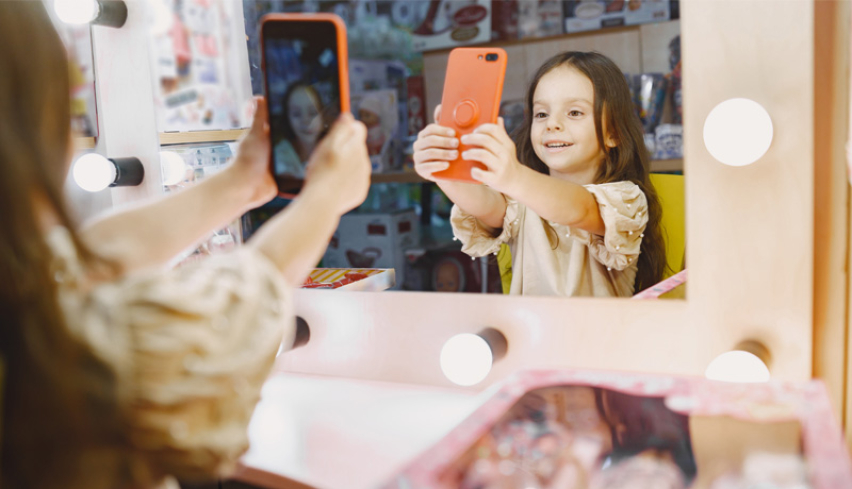
80% of girls under the age of 13 had already used some kind of filter or retouching app.
A study conducted in the United States in 2021 found that 80% of girls under the age of 13 had already used some kind of filter or retouching app to alter the appearance of their photos. This is not a marginal phenomenon: it is a widespread, normalized practice, and for many people it is not even recognized as a problem.
The technical mechanism is, on the surface, simple. These tools use computer vision to detect facial features and overlay an invisible template made up of dozens of points that form a mesh.
An “improved me” is... a version constructed according to someone else’s aesthetic rules, encoded into an algorithm.
Using this mesh, the software can add digital makeup, slim the nose, enlarge the eyes, smooth the skin, or alter the structure of the face according to parameters defined by the filter’s creator. What the user perceives as an “improved me” is, in reality, a version constructed according to someone else’s aesthetic rules, encoded into an algorithm.
The clinical problem has a name. British doctor Tijion Esho coined the term “Snapchat dysmorphia” to describe a phenomenon he began observing in his cosmetic surgery practice: patients were bringing in heavily edited selfies and asking for procedures that would make them look like those images. They were not trying to resemble a celebrity or an external ideal, but rather their own digital version—the filtered self the algorithm had created for them.
Photographs cannot be reproduced in real life.
Surgeons report that many of these patients are genuinely surprised when the doctor explains that those photographs cannot be reproduced in real life, because what an app can do in milliseconds has no surgical equivalent.
The psychological harm has been documented. Dr Renee Engeln, a psychology professor at Northwestern University and a researcher specializing in body image and the media, points out that before Snapchat and Instagram, retouched photographs were largely confined to celebrities and models in advertisements or magazines, and the public generally knew those images were not real. Filters fundamentally changed that.
In her book Beauty Sick: How the Cultural Obsession with Appearance Hurts Girls and Women (2017), Engeln argues that the more often a person sees an image of themselves that does not actually exist, the more alien the person in the mirror begins to feel and the less satisfied they become with their appearance. This is because the comparison is no longer with outside models, but with a false version of oneself that is displayed every day on social media.
This self-comparison produces greater body dissatisfaction.
A study published in Computers in Human Behavior in 2025, involving 187 participants, confirmed this mechanism: the harm comes not primarily from seeing other people’s idealized bodies, but from the specific act of applying a filter to one’s own face. This self-comparison produces greater body dissatisfaction, reinforces negative attitudes, and increases openness to cosmetic surgery.
This does not happen in a vacuum. It takes place in an environment where influencers and celebrities present heavily retouched images with an appearance of authenticity that the average user cannot always detect. The distinction between a retouched photograph and a “real” one becomes unreadable, and the brain learns to accept this impossible standard as its reference point.
Anxiety and depression can emerge.
This is where anxiety and depression can emerge—not because the individual is fragile, but because the environment of comparison has been constructed around a technical illusion. The result, as research by the Universidad Europea notes in a systematic review, is that women are more affected than men across all the variables analyzed: body dissatisfaction, symptoms of dysmorphia, and predisposition towards cosmetic surgery.
Some countries have begun to act. Norway passed a law in 2021 requiring influencers and public figures to explicitly disclose when a photograph has been retouched. France came close to approving similar regulations that would also cover videos. The United Kingdom is working on legislation along similar lines. The argument made by the French politician who promoted that initiative was straightforward: to limit the destructive psychological effects of these kinds of filters.
Users have lost their point of reference for distinguishing what has been altered.
Regulation alone, however, is not enough. The problem is not simply that images have been retouched, but that users have lost their point of reference for distinguishing what has been altered. A label stating “modified image” can easily go unnoticed when consumption is compulsive and the surrounding culture has normalized retouching as a condition of being presentable.
Education in the critical interpretation of digital images is becoming as urgent as any legal regulation. What these filters introduce, with unsettling subtlety, is the idea that one’s own face needs to be corrected before it can be shown. That an unprocessed face is not enough.
That premise, repeated thousands of times from adolescence onward, is not neutral: it shapes the relationship a person develops with their own body for years. And no algorithm, however sophisticated it may be, has any legitimate authority to define that.
Originally published in Spanish by Diario Cristiano. Republished with permission.
Julio César Cháves was born in Chacabuco, Buenos Aires Province. He is a writer with a sustained career in opinion journalism, having published hundreds of articles in media outlets in his city and on his own digital platforms. He has studied theology, public speaking, film appreciation, photography, and literature. He is a graduate of the Instituto Teológico por Extensión (INSTE). He is currently studying Psychopedagogy at the Paulo Freire Institute in Chacabuco.
He is the author of the books La conquista de la libertad [The Conquest of Freedom] (Editorial de las Tres Lagunas), Cómo manejar exitosamente las circunstancias [How to Successfully Manage Circumstances] (RC Editora / Emanuel), Dios con nosotros [God with Us] (Editorial Autores de Argentina), and La Marca [The Mark], a work written together with his brother Benjamín. His writing explores the intersection of Christian faith, psychology, contemporary culture, and social criticism, with a voice shaped by both academic study and life experience.
He is married to Alejandra Biazotti and is the father of three children: Matías, Max, and Merlina. He lives in Chacabuco, where he works as a writer and technician while also pursuing university studies. You can follow him on his Facebook page.