
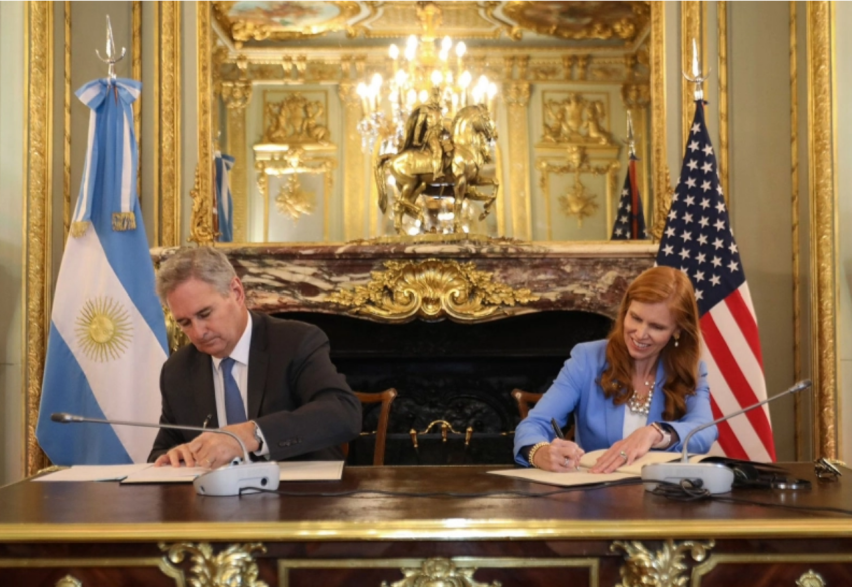
Argentina joined the Geneva Consensus Declaration on Promoting Women’s Health and Strengthening the Family on Aug. 13, becoming part of an international initiative that says there is no international right to abortion and that each country retains sovereignty over its own abortion policies and laws.
The decision was announced by the government of Javier Milei at an event attended by U.S. Ambassador to Argentina Peter Lamelas and Bethany Kozma, director of the Office of Global Affairs at the U.S. Department of Health and Human Services. According to EFE, Lamelas said more than 40 countries are part of the initiative.
Argentine Foreign Minister Pablo Quirno presented the move as an opportunity for Argentina to contribute its leadership, diplomatic influence and regional presence to an agenda centered on human dignity and national sovereignty. The Foreign Ministry also emphasized the protection of human life and the family as central principles of the declaration.
What the Accession Means
The Geneva Consensus Declaration was introduced in 2020. Among its principles, it affirms that every human being has an inherent right to life, that abortion should not be promoted as a method of family planning, and that abortion-related policies should be determined at the national or local level through each country's own legislative processes.
The declaration says there is no international right to abortion and no international obligation for states to fund or facilitate abortion. It also recognizes each nation's authority to establish and implement policies and programs in accordance with its own laws.
Argentina's accession does not change the country's abortion laws. Law 27.610, which regulates access to voluntary termination of pregnancy, remains in force, and any change to the national legal framework would have to follow the procedures established under Argentine law.
That distinction is important. The Geneva Consensus is a declaration of principles, not an international treaty requiring participating countries to amend their domestic laws. It expresses a set of political principles shared by participating countries and establishes a common position in international discussions concerning life, the family, health and national sovereignty.
Four Voices on the Scope of the Geneva Consensus
Political scientist Marcelo Díaz told Diario Cristiano Internacional that the decision “does not change the legislation,” but instead represents an expression of support for the issues addressed by the Geneva Consensus. In his view, the move amounts to “a kind of putting on the pro-life jersey as a state.”
Pastor Martha Rogín de Rodríguez, a leader with Youth With A Mission (YWAM) and Women of Faith and a longtime figure in Argentina's pro-life movement, expressed a similar view. She told Diario Cristiano that the Geneva Consensus “is a document signed by some states, precisely in Geneva, Switzerland, where the foundations are laid for defending the values that we defend.”
Rodríguez noted that Argentina had not previously joined the initiative and emphasized the significance of its decision to do so now. “It is a declaration of principles, but it is not binding,” she said.
Dr. Carlota López, a lawyer and coordinator of ACIERA's Lawyers' Association, also emphasized the declaration's nonbinding nature in comments to Diario Cristiano Internacional. According to her analysis, the Geneva Consensus is a “Declaration of Principles in Favor of Life and the Family” that “is not legally binding and does not create legal obligations” for participating countries.
López said the declaration expresses a position on issues including “abortion, the rights of the unborn child, the protection of women and the family,” while also affirming national sovereignty.
For Miriam Donati Brusco, a lawyer and representative of Women for the Nation, the sovereignty component is one of the most important aspects of Argentina's accession. In comments to Diario Cristiano Internacional, she explained that the Consensus “raises the issue of each country's sovereignty to decide its public policies” and maintains that “there is no right to abortion.”
Donati was also asked whether joining the Consensus could have a practical impact on efforts to oppose abortion. Her response was more cautious: “It is more a matter of international policy.” In her view, the document could provide a foundation and an argument if debate over the current law — including a possible repeal — were to emerge in the future.
Her comments highlight a distinction between the immediate effect of Argentina's accession and its potential political significance. The Consensus does not change Argentine law, but its principles could be invoked in future domestic debates over abortion, national sovereignty and public policy.
The declaration also places significant emphasis on the family. It describes the family as the natural and fundamental unit of society and says that motherhood and childhood are entitled to special care and assistance. It also calls for improvements in the health and well-being of women and girls.
Argentina's accession therefore comes while Law 27.610 remains in force. The immediate effects of the decision are primarily political and diplomatic rather than legislative.
A Political Signal That Reopens the Debate
For Ana Valoy, a political science graduate, Argentina's decision could have implications beyond foreign policy. In her column for this publication, she argues that “Argentina is once again saying on the international stage that it has the right to decide sovereignly what its political position is regarding life and motherhood.”
Valoy believes that a decision of this kind can influence the direction of a political debate even when it does not immediately change the law. “A law can close a parliamentary vote without closing a social debate,” she writes.
She also uses a traffic-light metaphor to describe the political moment created by the accession: “Perhaps the traffic light is not green yet. But it has turned yellow again.” For Valoy, that yellow light represents renewed attention and debate over an issue that some had considered settled.
The Geneva Consensus maintains that abortion-related policies should be determined by each state through its own legislative processes. The declaration says states have no international obligation to fund or facilitate abortion and connects that position to national sovereignty.
That helps explain why Argentina's accession has attracted attention among figures involved in the country's pro-life movement. For Díaz, it is a way of expressing a political identity. For Rodríguez and López, its primary significance lies in its role as a declaration of principles. For Donati, it could become an argument if Argentina's legislative debate over abortion is reopened in the future.
The Milei government's decision does not repeal Law 27.610 or immediately alter Argentina's abortion laws. It does, however, bring Argentina into an international initiative that supports the protection of human life and the family, emphasizes national sovereignty, and says it does not recognize an international right to abortion.
The immediate effects of the accession are likely to be felt primarily in the political and diplomatic arenas. Argentina's domestic abortion law remains unchanged, but the government has joined an international initiative advancing a defined position on life, the family and each nation's authority to establish its own policies.
For the figures interviewed by Diario Cristiano Internacional, that distinction is fundamental: the Geneva Consensus does not change Argentine law, but it changes the position from which the Argentine government participates in international debates over abortion, life and the family.
Original reporting by Diario Cristiano, Christian Daily International's Spanish edition.








