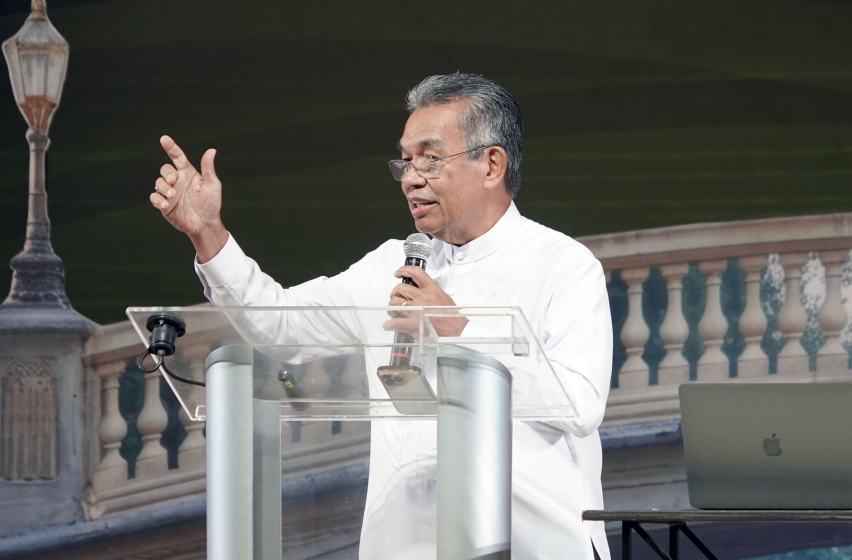
On the evening of June 9, 2026, as 210 evangelical leaders from 25 nations gathered in Manila, the second keynote address of the Asia Conference on Church & Mission (ACCM) 2026 opened with challenging pictures illustrating church decline and moving towards a call for revival by returning to the Church’s key task of disciple making.
Bishop Efraim Tendero, former Secretary General of the World Evangelical Alliance and now WEA Global Ambassador and Executive Director of the Galilean Movement, followed the evening session’s theme "Revive Us Again, O Lord," drawn from the prayer of the prophet Habakkuk in chapter 3, verse 2.
He opened with images of six historic churches that were converted to mosques or residential houses. Six buildings, six congregations that had once proclaimed the gospel, now repurposed because the churches died.
"Why did they die?" he asked the room. "Because they did not disciple."
Churches full of leaves, but where is the fruit?
Citing Lifeway Research data from 2024, he noted that in that year alone, 3,800 new churches were planted across the United States — but in the same year, 4,000 closed their doors. More churches were dying than being born. Across two decades of data, the pattern held. And globally, a study by the Joshua Project had found that only 11 percent of the world's population could be counted as committed followers of Christ, with nearly two-thirds still having no personal relationship with Jesus.
"After almost 2,000 years, we have fallen behind and still have much more to do," he said. "Do we say we need a revival today? I think we need a revival today."
Tendero turned to John 15 where Jesus says that true disciples will bear fruit and then compared the passage to the image of the barren fig tree from Matthew 21: Jesus approaching it hungry, finding nothing but leaves, and pronouncing judgment. "Our churches today are full of leaves, full of activities, full of many events, full of many programs," Tendero said. "But Jesus is asking: where's the fruit? Where are the disciples?"
The early church had what today's church has lost
Against that diagnosis, Tendero pointed to the explosive missionary vitality of the first-century church. In Acts 8, when persecution scattered believers from Jerusalem throughout Judea and Samaria, those who were scattered went everywhere preaching the word.
In Acts 19, the apostle Paul, rejected at the synagogue in Ephesus, moved his daily teaching to the Hall of Tyrannus, and kept at it for two years. Some manuscripts of the text note that he taught from eleven in the morning until four in the afternoon each day. The result: the whole province of Asia heard the word of the Lord, and seven churches took root.
"Despite persecution," Tendero said, "the early church spread out rapidly."
He also quoted Tertullian's second-century declaration that Christians had penetrated every level of Roman society: the army, the navy, the marketplace, the palace. They were, in his words, everywhere. "After almost 200 years, they were able to reach almost the entire Roman Empire. In fact, even the persecution of the churches during that time never stopped the Christian church to spread."
It was the early church's fire, Tendero argued, its commitment to making disciples, not merely making attenders, that generated that kind of movement. And it is precisely that fire which today's church, burdened by programs and events, has lost.
Three movements toward revival
Tendero went on to offer a three-part framework for what revival would require of church leaders gathered in Manila.
First: repent of the great omission. Tendero reached into Ephesians 4:11–12, where Paul describes apostles, prophets, evangelists, pastors, and teachers given to the church — and names their primary purpose: to equip the believers for the work of ministry. That equipping, he argued, has been systematically neglected. The result is a church that functions like an army where only two percent of the soldiers know how to shoot, while the rest are spectators.
"We neglect the equipping of believers for the work of the ministry," he said. "Let us repent of this great omission."
Second: resolve to fulfill the Great Commission. Tendero returned to the text of Matthew 28:19–20, building on the grammatical observation Godfrey Yogarajah had made earlier in the evening — that among the verbs in the passage, only one carries the weight of a command. Not "go." Not "baptize." Not "teach." The imperative is "make disciples." Going, baptizing, and teaching are the means; disciple-making is the mandate.
He recalled a statement he had heard from another Asian leader at a gathering two years earlier: that disciple-making is not one of the strategies given by Jesus. It is, rather, the only strategy given by Jesus.
"Let us fulfill the only strategy given by Jesus to his disciples," he said.
Third: realign with the Holy Spirit. Citing Acts 1:8, Tendero pressed on the connection between the Spirit's power and the church's witness. Churches today, he observed, often have power — the power of amplification, production, and institutional momentum — but lack the power to become witnesses for Christ. That boldness, he argued, is the fruit of discipleship, not of organizational capacity alone.
He pointed to Acts 4, where Peter and John, threatened by the authorities and forbidden to preach, returned to the gathered community of believers. The response of that community was not strategic deliberation. It was immediate, instinctive prayer — and the room was shaken, the believers filled with the Holy Spirit, and they continued to speak the word with boldness. When difficulties come, Tendero asked the delegates, what is the church's first instinct? Strategy, or prayer?
Both the World Evangelical Alliance and the Lausanne Movement, he noted, had in recent years identified the greatest gap in global mission as discipleship. "The Holy Spirit is calling the church today to go back to the main thing that Jesus wanted us to do."
Divine authority, divine presence
Tendero closed by returning to Matthew 28, beginning at verse 16. Eleven disciples stood on a mountain in Galilee. They saw the risen Jesus, and some worshiped but others doubted.
Those who choose to worship, to submit to the Lordship of Christ, receive both a command and a promise. The command is singular and non-negotiable: make disciples of all nations. The promise is double: all authority in heaven and earth has been given to Christ, and he will be with his people to the end of the age.
"With the divine authority and the presence of Jesus," he said, "we can fulfill the only plan of Jesus — and that is to make disciples of all nations."
The Asia Conference on Church & Mission 2026 runs June 9–12 at GCF South Metro in Alabang, Metro Manila, organized by the Asia Evangelical Alliance in partnership with the Philippine Council of Evangelical Churches. The conference carries the theme "Disciple or Die 3.0" and is oriented toward a concrete goal: that by 2033, 20 percent of evangelical churches represented by AEA member alliances across Asia will become disciple-making churches.