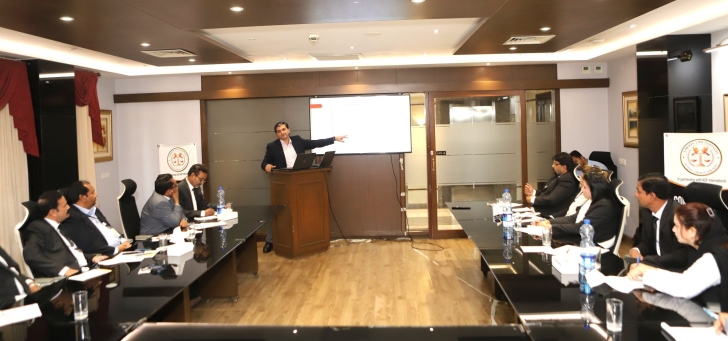
Christian lawyers from across Punjab Province recently received specialized training for cases of child marriage, abduction and forced religious conversion in order to strengthen implementation of the province’s amended child marriage law.
The two-day workshop in Multan on Aug. 21-22, brought together Christian lawyers from several districts of southern Punjab to strengthen their understanding of the legal framework and practical skills for representing children and their families.
Organized by Liberty Law Partners with support from legal advocacy organization ADF International, the training followed the implementation of Punjab’s Child Marriage Restraint Act 2026 on May 11, which raised the minimum legal age of marriage to 18 for both girls and boys.
The new law represents a significant change from the previous legal framework, but its effective implementation remains a challenge, particularly in cases involving minority girls, said workshop organizer Lazar Allah Rakha, an attorney.
“Such cases can involve multiple and overlapping allegations, including abduction, coercive religious conversion, child marriage and sexual violence, requiring lawyers to pursue criminal, constitutional and other legal remedies simultaneously,” Rakha said.
He added that the workshop was designed to help lawyers bridge the gap between legislative reform and its implementation in courtrooms and during criminal investigations.
Muhammad Saqib Jillani, a prominent advocate of the Supreme Court of Pakistan, led four of the workshop’s six substantive sessions, covering the legal framework governing child marriage, practical case handling, evidence and litigation strategy, and legal practice and case management.
During the sessions, Jillani examined constitutional protections available to children and religious minorities, along with federal and provincial legislation relating to child marriage. Particular attention was given to determining and proving a minor’s age and addressing claims concerning religious conversion.
Jillani urged lawyers to challenge the validity of disputed conversion claims in cases involving minors and to draw on relevant constitutional jurisprudence in their petitions. He referred participants to a landmark 2014 Supreme Court judgment on minority rights authored by then-Chief Justice Tassaduq Hussain Jillani.
“The judgment treats protection of religious minorities as a constitutional obligation of the state,” Jillani said. “The Supreme Court emphasized that Article 20 of the Constitution protects freedom of religion and applies to every citizen, religious denomination and sect.”
He said the judgment’s interpretation of Article 20, including protections relating to freedom of conscience, thought, belief and faith, was relevant to cases involving alleged violations of the rights of religious minorities.
Jillani is representing the family of Maria Shahbaz, a Christian girl whose family says she was abducted and forcibly converted and married when she was 13. The Federal Constitutional Court on Feb. 3 ordered Maria into the custody of the Muslim her family identifies as her abductor and upheld her conversion and marriage.
Jillani subsequently filed a review petition challenging the ruling. The court admitted arguments on the petition on July 24, and a further hearing is expected in September. The legal sessions were complemented by discussions on the broader context of forced conversion and child marriage and the role of Christian lawyers in advocacy.
Rakha led a session examining the intersection of abduction, religious conversion, marriage and sexual violence, as well as patterns of alleged forced conversion and the vulnerabilities of minority girls and women.
Participants from several districts said the training had strengthened their legal knowledge and provided practical guidance for handling cases involving vulnerable children.
“The knowledge, guidance, and professional insights shared during the training sessions will greatly assist us in our legal practice and in contributing positively toward society,” said Yousaf Doulat Choudhry, an advocate from Layyah District.
He described initiatives of this kind as important for strengthening lawyers’ capacity to advocate for human rights and the rule of law.
Sahil Munir, a lawyer from Mian Channu in Khanewal District, said the sessions were “extremely useful” and highlighted the opportunity to exchange experiences with Christian lawyers from different districts of southern Punjab.
Zikria Gill, an advocate from Multan, praised Jillani for sharing his professional experience and said the senior lawyer had addressed the issues at a grassroots level.
“The training has significantly enhanced my understanding of the legal framework and my ability to provide effective legal assistance in matters related to child marriage,” said Qamar Iqbal, a lawyer from Rahim Yar Khan District. He said the case-based discussions and interactive format helped connect legal principles with challenges faced by lawyers in practice.
Tehmina Arora, ADF International’s director of advocacy for Asia, said the workshop was intended not only to strengthen individual lawyers’ capacity but also to build professional networks among Christian lawyers working across southern Punjab.
“The initiative is timely as lawyers and rights advocates continue to confront difficulties in cases where allegations of forced conversion and child marriage intersect with questions of age, consent, religious identity and the reliability of statements made by minors,” Arora said. “With Punjab’s new legislation now establishing 18 as the minimum legal age of marriage for both sexes, effective enforcement will depend not only on the existence of the law but also on the ability of police, prosecutors, courts and lawyers to apply its provisions consistently.”
Asher John, a journalist with Christian Daily International, conducted a session on media advocacy. The session addressed the potential benefits and risks of publicizing sensitive cases, responsible communication, digital security and the protection of confidential information involving victims and their families.
The training took place against the backdrop of concerns over the scale of forced conversion and child marriage involving minority girls in Pakistan.
A report titled “Stolen Girls”, released by advocacy organization Jubilee Campaign at the European Parliament on July 14, documented 210 verified cases involving abduction, forced religious conversion, child marriage and sexual violence against Christian and other minority girls between 2019 and 2025.
According to the report, 186 of the cases, or 88.6 percent, occurred in Punjab, while 22 cases were recorded in Sindh Province and two in Khyber Pakhtunkhwa Province.
More than 83 percent of the victims were under 18. The report identified 134 victims between 14 and 17 years old, 41 younger than 14, and 35 adults. It said the average age of victims was 12.8 years, compared with 35.8 years for alleged perpetrators.
The report described the cases as part of a broader pattern in which fraudulent documentation, manipulation of legal processes and institutional failures can contribute to perpetrators avoiding accountability.
The findings are consistent with broader concerns raised by international organizations about the protection of Christians and other religious minorities in Pakistan.
Open Doors ranked Pakistan eighth on its 2026 World Watch List of the 50 countries where Christians face the most severe persecution. The organization cited systemic discrimination, mob violence, forced conversions, bonded labor and gender-based abuses, and said weak law enforcement and impunity contribute to the vulnerability of Christians.