
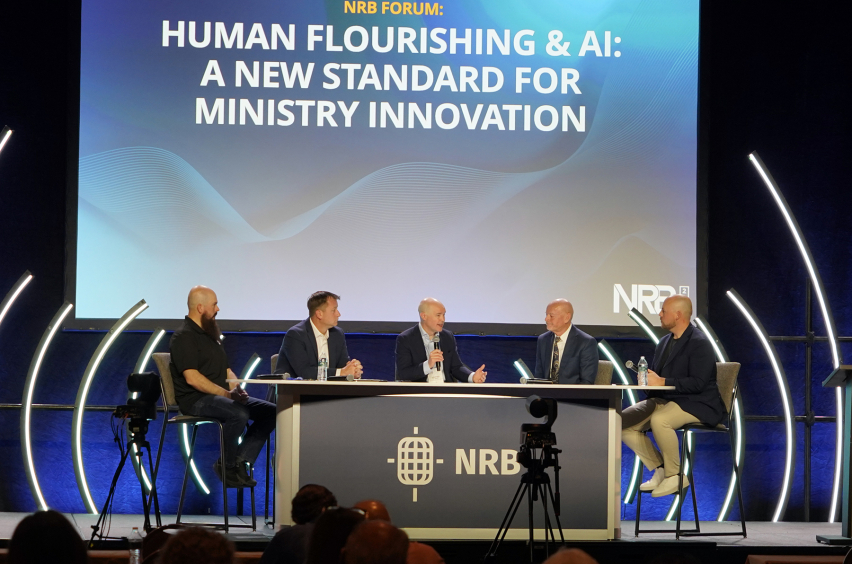
As artificial intelligence continues to reshape media, ministry and daily life, Christian leaders recently gathered at the NRB 2026 International Christian Media Convention in Nashville to wrestle with a defining question: Can AI accelerate ministry innovation without undermining the human person it seeks to serve?
During a panel titled “Human Flourishing & AI — A New Standard for Ministry Innovation,” held Feb. 18, scholars and technology executives urged Christian communicators to adopt a rigorous theological and empirical framework for evaluating emerging AI tools — one rooted not in speed or scale, but in measurable human flourishing.
Moderated by Steele Billings, president of Gloo AI at Gloo, the discussion featured Dr. Byron Johnson of Baylor University, Jonathan Teubner of Harvard University’s Human Flourishing Program, Nick Skytland, vice president of AI at Gloo, and John Anderson, senior director of the Bible Technology Team at Biblica.
From prison reform research to Bible translation algorithms, the conversation moved between global data and deeply personal questions about intimacy, suffering and spiritual formation.
“What do we mean when we say human flourishing?”
Before turning to AI, Billings pressed the panel to define their terms.
“We’re going to talk about human flourishing and AI,” he said. “We should probably level set with our audience. What do we mean when we say human flourishing? What are we actually measuring?”
Johnson, a distinguished professor of the social sciences at Baylor and co-director of the Global Flourishing Study, acknowledged the complexity of the task.
“Let me just say that we haven’t figured it out,” Johnson said. “We entered this as a dialogue. We want to talk about what flourishing looks like, what we’re finding in the data, but also we want to approach it with a bit of humility.”
The Global Flourishing Study is following more than 200,000 individuals across 23 countries over five years, making it one of the most comprehensive longitudinal studies ever undertaken on well-being. The project has already produced more than 100 studies in a single year, examining loneliness, anxiety, suffering and the role of faith in shaping outcomes.
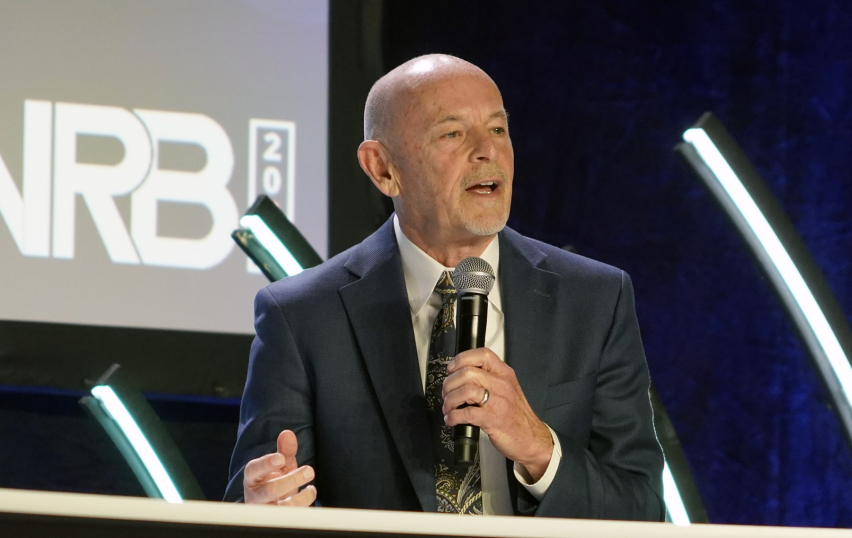
Johnson outlined a multidimensional framework for flourishing, describing it as “a state in which you’re doing well in all the domains of life.” Those domains include physical health, mental health, close personal relationships, financial and material stability, and character and virtue.
The framework moves beyond simplistic happiness rankings, Johnson said, referencing global reports that measure national satisfaction levels with a single scale.
“We ask about 109 questions beyond that to get a much more holistic view of what it means to flourish,” he explained.
Teubner, a research associate at Harvard’s Human Flourishing Program and leader of its AI initiative, added that flourishing cannot be reduced to individual metrics.
“Flourishing is highly dependent upon the context in which we live,” he said. “How are other people doing? How is our community more generally doing?”
He noted that AI intersects with flourishing not only through personal productivity but through its effects on social relationships, workplaces, churches and families.
Suffering, prisons and resilience
Both scholars challenged the assumption that flourishing means the absence of hardship.
Johnson described research conducted in maximum-security prisons, including work with inmates serving life sentences and those on death row.
“Flourishing is not the absence of suffering — quite the opposite,” Johnson said. “It’s suffering that actually could be the gateway.”
He recounted walking alongside an inmate facing execution who, by study metrics, demonstrated signs of flourishing through faith and relational depth.
Such findings complicate simplistic narratives about well-being, panelists said, and raise important questions about how AI systems — particularly those used in therapy-like contexts — should engage human pain.
Teubner echoed that concern, noting that adversity and suffering are often integral to growth and meaning. Designing AI systems that prioritize frictionless happiness, he suggested, may inadvertently strip away formative experiences.
Johnson highlighted what he described as one of the most concerning findings of the Global Flourishing Study: declining well-being among young adults worldwide.
“Young people are struggling all over the world,” he said, noting rising anxiety, isolation and lower flourishing scores among those ages 18 to 24.
In that context, the panel turned to AI-driven companionship tools, including chatbots marketed as virtual friends or romantic partners.
Nick Skytland described a shift from the “attention economy” of social media to what some observers are calling the “intimacy economy,” in which AI systems mediate or simulate close relationships.
“It’s a lot easier to talk to my AI girlfriend than it is to argue with my wife,” Skytland said, describing the subtle but significant risks of outsourcing emotional labor to machines.
Teubner cautioned that data on the prevalence of AI “relationships” remains limited and sometimes flawed. Still, he warned that replacing human-to-human intimacy with AI interaction could have long-term consequences for relational health.
Johnson reiterated that close personal relationships are among the strongest predictors of flourishing in global data.
“If I’m not flourishing, I’m not flourishing if my neighbor’s not flourishing,” he said, emphasizing the communal dimension of well-being.
“A moral imperative” to shape AI
The conversation also explored the responsibility of Christians to influence AI development.
“At Gloo, we often say that God is not surprised by AI,” Billings said. “It is a moral imperative that we have. It is a mandate that we have to steward well these technologies.”
Skytland agreed, arguing that AI models inevitably reflect the values embedded in their training data.
“When we use AI, we are adopting values whether we recognize it or not,” he said.
He illustrated the point with a hypothetical scenario involving financial advice. An AI trained primarily on secular internet data may prioritize personal gain, he suggested, whereas a biblically informed system would frame money in terms of stewardship and generosity.
“I think we have a moral, ethical, theological responsibility as Christians to shape technology for good,” Skytland said.
Anderson described Biblica’s efforts to apply AI responsibly in Bible translation initiatives, particularly for difficult-to-reach language communities.
He emphasized that AI must remain a tool, not a substitute for discernment.
“There is an important distinction that has to be drawn when we’re considering a tool that has been created by man that’s trying to shepherd a man who was created in the image of God,” Anderson said.
AI systems, he argued, should be designed to point users toward real community when facing complex spiritual or relational questions.
“For someone to be able to walk with you,” he said, describing the role of pastors and faith leaders. “The tool … can never actually bring relationship, can it?”
Speed versus trust
As the panel progressed, discussion shifted to broader tensions between rapid AI development and safety concerns.
Skytland acknowledged that AI advancement is unlikely to slow, particularly amid geopolitical competition.
“We are not slowing down,” he said, adding that the church must avoid retreating into fear.
Teubner reflected on the growing influence of technology companies in shaping policy debates, noting that corporate decisions now carry global consequences.
“There’s a part of me that thinks this is a really good act,” he said of efforts by some companies to slow certain deployments, adding that value-driven decision-making within industry could serve as a hopeful sign.
Still, panelists agreed that Christian leaders must adopt their own evaluative standards rather than relying solely on industry assurances.
Measuring what matters
Teubner encouraged ministries to move beyond marketing narratives and ask concrete questions.
“Are my social relations improving?” he said. “Can I see that?”
Johnson pointed to research showing that regular religious practice strongly correlates with higher flourishing outcomes, suggesting that faith communities remain central to human well-being in an age of technological change.
“The world is more religious today than it has ever been in its history,” Johnson said, pushing back against narratives of inevitable secularization.
In closing, Billings summarized what he described as three criteria for AI aligned with flourishing: safety, accuracy and theological coherence.
“All use and advancement of AI should be looked at through the lens of human flourishing,” he said.
As Christian communicators navigate a rapidly evolving technological landscape, panelists said, the ultimate measure will not be efficiency or scale but whether AI strengthens relationships, deepens character and supports communities rooted in truth.
In that sense, they suggested, the future of AI in ministry will be determined less by algorithms and more by anthropology — by what Christians believe about what it means to be human.








