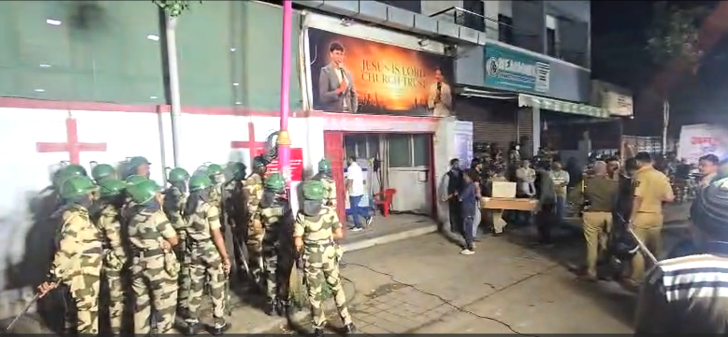
Local authorities in Maharashtra state, India demolished a church building this month as the congregation was awaiting a court decision on a stay order against the destruction, sources said.
“Almost 1,000 policemen marched towards our church after midnight as if they were coming to catch a terrorist,” Jean Silway told Christian Daily International (CDI) from Pimpri-Chinchwad, nine miles northwest of Pune city. “Without waiting for the court orders, the PCMC [Pimpri-Chinchwad Municipal Corporation] came at midnight and demolished the church around 3 a.m.”
The Jesus Is Lord Church (JILC) in the Kalewadi area, which comes under the Jesus Is Lord Church Trust, was thus demolished in the wee hours of Sep. 7.
A hearing on a stay order to delay the demolition was scheduled for Sep. 4, but due to a holiday, it was pushed to Sep. 7, Silway said. The worship building was thus razed before the hearing.
Pastor Paul Silway, 67, and his wife purchased the land for the church site in 2000.
“But because we did not have funds to construct a church building then, we delayed the construction,” said Jean Silway.
In 2008, the couple constructed the compound wall, put up a temporary tin shed, and started the church.
“Unfortunately, the area where the church was situated fell under the blue line – a prohibited flood zone demarcation, marking the 25-year maximum flood level,” she said.
Several other structures adjacent to the now demolished church building site remain unharmed.
“If our church falls on the blue line, so do the other structures,” said Jean Silway, “but none of the other structures are harmed or demolished.”
She highlighted that the church building was “quite a distance from the Pavana River – the water body, while there are several structures and residences between the church and the river, none of which have been affected.”
Adjacent to the church site is a gas station.
Another area Christian, not a member of the church, confirmed on condition of anonymity that “nobody else has received notice or had their property demolished like the JIL Church. There is no doubt that the church was targeted because of their ministry amongst the Sindhi community and the many miracles, including healings, that have grabbed the attention of specific groups of people who oppose the Christian faith.”
An October 2017 article by The Indian Express revealed that the demarcation of the blue and red flood line had been pending since 2009, and constructions were based on assumptions as they were not marked on the development plan map.
“And for all these years, the constructions along the rivers in the Pimpri-Chinchwad Municipal Corporation (PCMC) area were being carried out assuming that a certain blue line and flood line existed,” an official reportedly said. “This was because the blue and red flood lines were not marked on the development plan map.”
The then-PCMC Deputy Director of Town Planning Prakash Thakur had confirmed to media that “the state government had ratified the civic proposal to demarcate the flood lines on the development plan map.”
Sudden Order
The Silway couple along with their two adult children have been holding church services at the site for the past 18 years.
While they led services peacefully in the past, suddenly in June 2025, Etesh Ramchandani, raised a complaint in the PCMC portal that the church structure was unauthorized.
The church at the time received a letter stating that their structure had to be demolished, and they were given 15 days to vacate.
“Within a week we got notice to vacate the place for demolition,” Jean Silway said.
The Silways obtained a court stay order for two to three months. Later, their plea was rejected.
“We fought for more than a year in the Lower Court, then in the Sessions Court, and then in the High Court, where our appeal was scheduled to be heard on Sep.7, but before the court could take a decision, our church was demolished,” said Silway.
The demolition involved heavy machinery, and a nearly 1,000-strong police force was deployed to carry out the demolition and prevent any disruptions.
“We were only given 30-minutes to vacate the church,” Jean Silway said. “So many of our valuable things were taken away, damaged, and destroyed like our LED screen, our surveillance cameras and so much more. We were not given time to safely remove our belongings. We were very positive that the court would have ruled in our favor, but even if it did not, we are law abiding citizens, and we would have followed the decision of the court.”
Planned Move
On April 27, a man walked into the JILC service and started taking photos, including pictures of women without their consent.
“Some church members asked him to leave, but he got angry,” Jean Silway said. “He called for more people who were associated with the Bajrang Dal and the Rashtriya Swayamsevak Sangh (RSS) [both Hindu nationalist groups], and soon they gathered outside the church. They started abusing church members in offensive language.”
A minor scuffle broke out as church members objected, she said. The Hindu nationalists alleged that the church deceived vulnerable individuals with claims of miraculous cures to “lure” them to convert and filed a formal complaint against the church administration.
A First Information Report (FIR) was filed against Pastor Kenneth Silway, son of Pastor Paul and Jean Silway, and seven others by Siddhant Chavan under the Maharashtra Prevention and Eradication of Human Sacrifice and other Inhuman, Evil and Aghori Practices and Black Magic Act, 2013.
Jean Silway objected to Kenneth Silway being named in the FIR, saying “he was nowhere near them when this scuffle took place. He was on the stage and was not involved.”
A rally was organized by individuals and organizations affiliated with Hindutva ideology, a right-wing political ideology of Hindu nationalism, on May 3. The rally was joined by Shankar Jagtap and Gopichand Padalkar, both members of the Legislative Assembly and the Bharatiya Janata Party, political arm of the RSS and the party that leads the ruling coalition governing India. The rally was called a “Grand Public Outrage March” demanding strict action against the church.
On June 14, when Pastor Kenneth Silway was preaching at the Kondwa branch of JILC, Hindu nationalist groups sent two women to attend the worship service. One of them was Bhagyashri Suryakant Mohite, who later filed a written complaint against Kenneth Silway, alleging he was practicing black magic.
An FIR was filed at the Kondwa police station the following day under the Maharashtra Police Act, 1951 alleging violation of an order; disturbance of public order and disobedience of an order leading to an offense.
He was also charged under the Maharashtra Prevention and Eradication of Human Sacrifice and Other Inhuman, Evil and Aghori Practices and Black Magic Act, 2013, which penalizes “curing” through maiming, branding, public display and killing, etc., performed on the pretext of black magic.
Additional charges were filed under the Bharatiya Nyaya Sanhita (BNS), 2023, including voluntarily causing hurt; unlawful assembly, and disobedience of a promulgated order.
Christian leaders in the area believe that the government has further choked the churches by introducing the Maharashtra Freedom of Religion Act, 2026, commonly known as the anti-conversion law, which received President Droupadi Murmu’s assent on July 30.
The Pune Christian Forum organized a peaceful protest march on Aug. 19, alleging misuse of the Maharashtra Freedom of Religion Act. More than 500 Christian representatives from various churches participated in the march that started from the Pune District Collectorate and ended at the Police Commissionerate.
Christian leaders also submitted a memorandum to the Deputy Collector, the Pune Police Commissioner, the Pimpri-Chinchwad Police Commissioner, and the Superintendent of Police (Pune Rural).
The memorandum listed their demands, including constitutional and legal review of the Act, measures to prevent false complaints of conversion, a clear legal distinction between normal religious programs/gatherings and actual religious conversions, and safeguarding against selective or targeted misuse of the law against minority communities.
Pastor Rajesh Kelkar, president of the Pune Christian Forum, said that “this law is affecting the constitutional right to privacy.” He explicitly mentioned the case of Bishop Pankaj Devnoor, who was wrongly booked under the Maharashtra Freedom of Religion Act, 2026, while the law was not legally in force at the exact time the chargesheet was filed.
“We intentionally chose the Pune District Collectorate as the starting point, to bring to the notice of the collector, as to how the Freedom of Religion Act 2026 was misused in the Bishop Pankaj Devnoor case,” Kelkar told Christian Daily International, “and how for the last four years, many false cases have been filed against pastors and Christian leaders in the Pune District and in many surrounding villages. Police are filing FIRs without confirmations in many cases.”
With the 2026 Act, Maharashtra became the 13th state in India to introduce a specific anti-conversion law, besides Arunachal Pradesh (passed in 1978, but rules for enforcement were never framed), Chhattisgarh, Gujarat, Haryana, Himachal Pradesh, Jharkhand, Karnataka, Madhya Pradesh, Odisha, Rajasthan, Uttar Pradesh, and Uttarakhand.