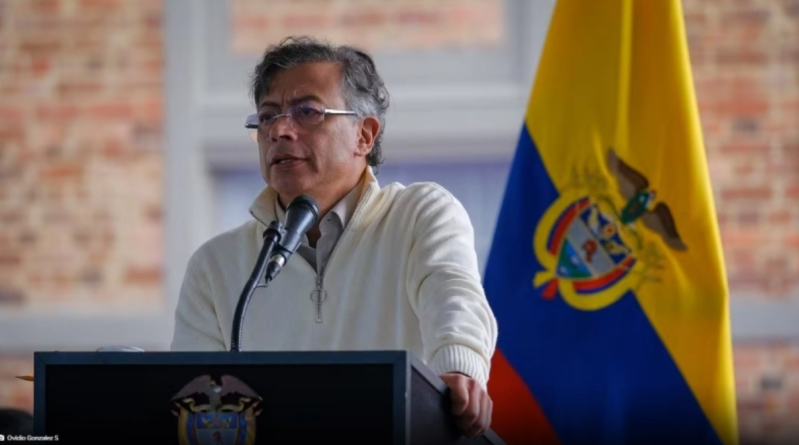
During the reopening of a hospital in Bogotá, Colombian President Gustavo Petro delivered a speech that sent shock waves through the country’s religious community.
In his remarks, Petro said he does not refer to Jesus as “Christ,” arguing that the term is a Greek name used to transform the figure of the Redeemer into a symbol of “power and kingship,” something he said Jesus never represented.
He described Jesus as a “man of light, of truth and a revolutionary,” then went further by speculating about his personal life: “I believe Jesus made love, yes … perhaps with Mary Magdalene, because a man like that without love could not have existed.”
The comments, captured on video, immediately sparked a wave of criticism over what many described as the political instrumentalization of religion and a lack of historical rigor.
The Evangelical Confederation of Colombia, known as CEDECOL, and other Christian groups expressed strong rejection of Petro’s remarks.
CEDECOL, which represents thousands of churches and millions of believers, issued an official statement expressing its “deep concern and rejection.” The organization highlighted several core points in defense of Christian identity:
-
Lack of biblical foundation: CEDECOL said the Bible presents Jesus Christ as holy, morally upright and obedient to divine purpose, and Mary Magdalene as a faithful disciple transformed by grace — not as an object of sexual speculation.
-
Theological identity: The group said the president’s remarks distort historical and theological truth by attacking the central figure of the Christian faith.
-
Constitution and respect: CEDECOL called for respect for religious freedom as guaranteed by Colombia’s Constitution and urged leaders to avoid using sacred figures to promote narratives that harm citizens’ deeply held beliefs.
From the Christian editorial sphere, voices such as Juan Sebastián Cortés said Petro’s words reflect an “alarming disconnect” from New Testament history.
In a column published in Diario Cristiano Internacional, Cortés wrote that the term “Christ” (Christos) is not a distortion but the direct translation of the Hebrew Mashiach (Messiah), a term already used in the Septuagint centuries before Jesus.
He also criticized the president for attempting to dismantle the kerygma — the proclamation of Christ’s death and resurrection — and replace it with what he described as a “worldly and outdated ideology” rooted in a personal interpretation of liberation theology.
For many Christian leaders, the remarks are not a legitimate academic reflection but a trivialization that seeks to replace the transcendence of the Gospel with a framework of political activism.
The backlash reflects a broader concern that, in a pluralistic and democratic society, freedom of expression should not be used to offend the faith of the majority.
As the government seeks to advance its social agenda, such public statements have deepened divisions with evangelical and Catholic communities, which are calling for leaders who uphold truth and respect the nation’s spiritual identity.
Originally published by Diario Cristiano, Christian Daily International's Spanish edition.