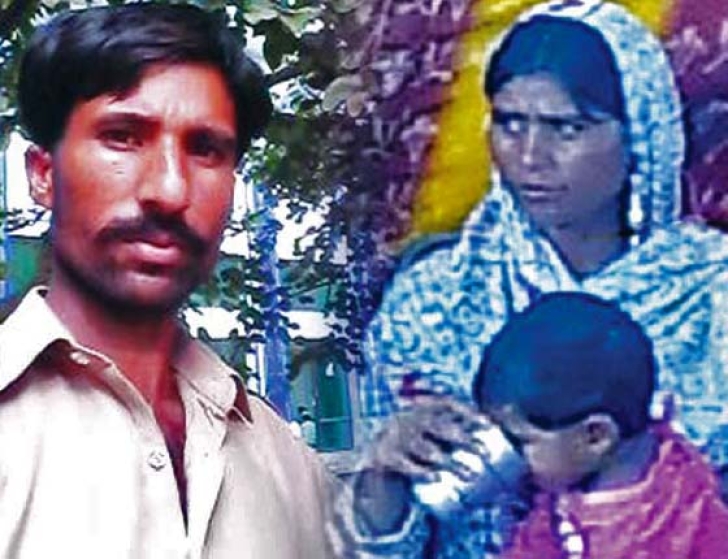
Pakistan’s Supreme Court on Thursday (Aug. 13) provided details on the July 9 acquittal of three Muslims sentenced to death for the 2014 burning alive of a Christian couple.
Citing contradictions and gaps in the prosecution’s case and insufficient reliable evidence to sustain the convictions, the detailed 26-page judgment came in response to the three convicts challenging a May 16, 2019, Lahore High Court ruling that upheld their death sentences delivered by an anti-terrorism court on Nov. 23, 2016.
The three-judge Supreme Court bench of Justice Shahzad Ahmad Khan, Justice Aqeel Ahmed Abbasi and Justice Shakeel Ahmed acknowledged the “shocking and brutal” nature of the crime, but said the prosecution failed to produce convincing evidence establishing the guilt of the petitioners. Emphasizing its duty to ensure justice, the court observed that an innocent person should not be executed in the absence of reliable evidence.
The court also noted that there was no convincing evidence that the Christian couple, Shahzad Masih and his pregnant wife, Shama Bibi, had desecrated the Quran, as alleged before the attack.
The judgment stressed that the severity of the crime could not substitute for proof beyond reasonable doubt. The court noted that none of the deceased couple’s relatives had become complainants in the case.
“Though there is no compulsion that an FIR [First Information Report] should be lodged only by the legal heir/relative of the deceased, usually in our society, the legal heirs/relatives of the deceased become the complainant,” stated the judgment, authored by Justice Khan.
The court further noted that none of the relatives had signed any memo prepared during the investigation as witnesses.
“These facts suggest that, in fact, eye-witnesses related to the deceased were not present at the spot at the time of occurrence,” the judgment stated.
The judges also questioned the omission of primary suspect Muhammad Irfan’s name from the FIR. Witnesses later identified Irfan as the person who pushed the couple into the furnace. The court found it difficult to accept that witnesses would have told police Irfan’s name when it was not recorded in the initial report.
The judgment also pointed to a “lack of independent corroboration” of the allegations against the petitioners. It cited established legal principles that where witnesses falsely implicate multiple suspects, the conviction of others based on the same testimony cannot safely be sustained without independent corroborating evidence.
The court further noted that none of the petitioners had sustained burn injuries and that they were not found wearing the protective wooden shoes and wet clothing reportedly required for people working close to the brick-kiln furnace. These circumstances, the judges said, created “reasonable doubt” about the petitioners’ involvement.
The Supreme Court reiterated that the benefit of doubt is a legal right rather than a concession granted to an accused.
“If a single circumstance creates reasonable doubt in the mind of a prudent person regarding the guilt of an accused, the accused is entitled to the benefit of doubt,” the judgment stated, regardless of the heinousness of the alleged crime.
The court therefore converted the jail petition into an appeal, allowed it and set aside the judgments of the lower courts. The three men were acquitted of all charges and ordered to be released immediately, unless required in another case.
The Supreme Court also dismissed the Punjab government’s petition challenging the acquittal of 102 other suspects in the case. The court said it had found “no material illegality or misreading of evidence” in the lower courts’ decisions to acquit those suspects. It also noted that no appeal had been filed by the legal heirs of Masih and Bibi against those acquittals.
Masih and Bibi, who had three children, were brutally beaten by a mob on Nov. 4, 2014, before being thrown into a brick kiln and burned alive in Kot Radha Kishan, Kasur District, Punjab Province. The attack followed allegations that the couple had desecrated pages of the Quran.
According to the FIR, the mob tore the roof off an office where the couple had taken refuge, dragged them outside and assaulted them before throwing them into the kiln’s furnace. Both were burned to death.
Police who arrived at the scene was reportedly outnumbered and were attacked, while witnesses, including relatives of the victims, were unable to intervene. Officers initially registered a case against 660 named and unidentified suspects.
In November 2016, an anti-terrorism court sentenced five men to death and eight others to two years in prison. On appeal, the Lahore High Court acquitted two of the five death-row prisoners while upholding the death sentences of Muhammad Irfan, Mehdi Khan and Muhammad Riaz Kumbh.
Senior Christian criminal lawyer Lazar Allah Rakha, who previously spoke to Christian Daily International-Morning Star News about the case, said the judgment highlighted longstanding weaknesses in Pakistan’s criminal justice system.
“This verdict should prompt serious reflection on how the prosecution was conducted,” Rakha said. “In a case involving such an egregious crime, meticulous trial preparation, effective examination and cross-examination of witnesses, and a comprehensive legal strategy were essential. Deficiencies in these areas inevitably weakened the prosecution and contributed to the acquittals.”
Pakistan’s blasphemy laws have long drawn criticism from human rights organizations and legal experts, who say they are frequently misused to settle personal disputes, seize property and target religious minorities. Although no one has been executed by the state under the country’s blasphemy statutes, accusations have repeatedly sparked mob violence, extrajudicial killings and prolonged pretrial detention for those accused.
International advocacy organizations continue to raise concerns about the treatment of religious minorities in Pakistan. In its 2026 World Watch List, Open Doors ranked Pakistan eighth among the 50 countries where Christians face the most severe persecution and discrimination.