
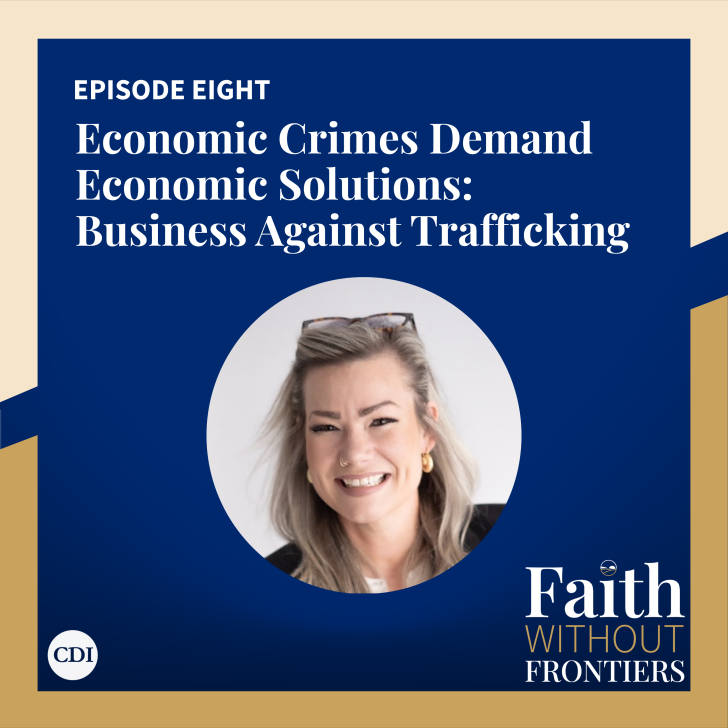
Economic crimes require economic solutions. That is the conviction behind the work of Dr. Lauren Pinkston, chair of the board of the Freedom Business Alliance (FBA), who joined today’s episode of Faith Without Frontiers to discuss human trafficking, trauma-informed workplaces, migration, and the role businesses can play in restoring dignity.
Founded a decade ago, Freedom Business Alliance brings together businesses committed to creating employment opportunities for survivors of exploitation. The organization began by supporting companies that directly employed survivors of trafficking but has expanded its focus to helping businesses develop healing-centered workplace practices.
“If it’s the lack of a job that pushes someone into an exploitative situation, then it’s the need for a job that can help pull them out,” Pinkston told host Gordon Showell-Rogers.
Today, FBA works with around 120 businesses around the world, including companies that employ survivors, organizations that contribute profits toward fighting exploitation, and partners helping connect survivors with sustainable employment.
Pinkston explained that survivors often face significant barriers when rebuilding their lives. Legal status, criminal records resulting from exploitation, trauma, and limited access to employment can make finding stable work extremely difficult.
“Surviving in the first place is a miracle, and then somehow building a new life and beginning to live a stable life is almost impossible,” Showell-Rogers observed.
A key part of FBA’s work is helping businesses understand trauma and create workplaces where employees can heal and thrive. Many workplace struggles may be connected to past trauma that managers do not recognize.
“When you’re not trained to detect trauma, then you really miss what you’re seeing in front of you,” Pinkston said.
She emphasized that trauma affects people far beyond trafficking survivors, and businesses have an opportunity to become places of psychological safety by investing in employees as whole people.
Drawing from her years living in Southeast Asia, Pinkston also reflected on how experiences among marginalized communities reshaped her understanding of faith, migration, and Christian mission. She described learning from believers who faced persecution but demonstrated extraordinary hospitality, humility, and commitment to peace.
Her academic background in international family and community studies, combined with personal experiences as a mother of four children — including an adopted daughter from Uganda — has shaped her approach to justice and human dignity.
Pinkston warned against simplistic approaches to humanitarian work, particularly regarding vulnerable children and communities. She argued that solutions must strengthen families and communities rather than create dependency.
Reflecting on the power of dignified employment, Pinkston said: “A safe, dignified job gives someone such an opportunity to be who they want to be — for their family to be who they want to be and for their community to be who they want to be.”
Listen to today’s episode of Faith Without Frontiers to hear Dr. Lauren Pinkston explore how businesses can become part of the solution to human exploitation by creating workplaces that offer dignity, healing, and hope.








