Voting has concluded across five regions in India’s most closely watched regional elections in years.
The four states of Assam, Kerala, Tamil Nadu and West Bengal, along with the union territory of Puducherry, have all voted, with results to be declared on May 4.
Together they constitute a referendum on the Hindu nationalist Bharatiya Janata Party’s (BJP) push to expand eastward and southward, and on the health of Indian democracy itself. The BJP currently governs at the national level under Prime Minister Narendra Modi.
West Bengal: Most Contested State
West Bengal is where the stakes are highest and the campaign the most charged. The BJP deployed its entire national leadership in a mobilization unlike anything seen in a state election.
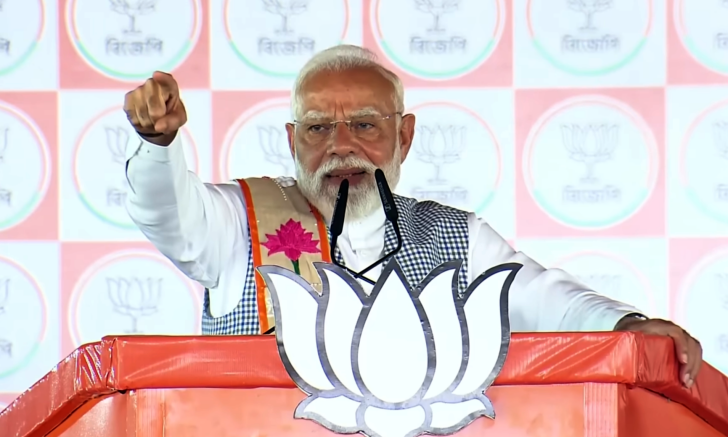
Modi held multiple rallies from April 5 onwards, addressing crowds in Cooch Behar, Tamluk, Haldia, Asansol, Krishnanagar, Jangipur and Siliguri, before a massive roadshow through Kolkata on April 26. Home Minister Amit Shah, Defense Minister Rajnath Singh, Uttar Pradesh Chief Minister (CM) Yogi Adityanath and Assam CM Himanta Biswa Sarma were among the 40 high-profile campaigners the party fielded.
A senior Christian leader in the state who asked not to be named said the scale was unlike anything he had witnessed.
“The entire government is sitting here,” he told Christian Daily International (CDI). “The PM is coming here nearly every day, all to unseat one leader.”
He predicted a victory for sitting Chief Minister Mamata Banerjee, leader of the Trinamool Congress (TMC) who has been in power for nearly 15 years but said that her winning margin may not be as commanding as in 2021. Exit polls released late on Wednesday (April 29), however, projected the BJP on the threshold of a majority, a dramatic reversal from their 2021 performance.
The messaging was sharply ideological. At Jangipur in Murshidabad, Modi promised to implement the Uniform Civil Code (UCC), a proposed single set of civil laws that would replace religion-based personal laws, saying, “We will not allow Bengalis to become a minority in the state.”
At Katwa, he told Matua and Namasudra communities that a BJP government would fast-track citizenship under the Citizenship Amendment Act (CAA), a law that offers a path to Indian citizenship for non-Muslim refugees from three neighboring countries, then added that “infiltrators should start packing their bags.”
The distinction he drew was explicit: Hindu migrants from Bangladesh were refugees deserving citizenship; Muslim migrants were infiltrators deserving expulsion. CM Sarma amplified this, warning that “Hindus will lose majority in West Bengal and Assam within the next two decades.”
That rhetoric did not arrive in a vacuum. Before polling, the Election Commission carried out a Special Intensive Revision (SIR) of electoral rolls that struck off over 91 lakh (9.1 million) names, cutting the electorate by close to 12 percent. Of those removed, roughly 34 percent were Muslims, higher than their 27 percent share of the population.
In Murshidabad alone, the exercise deleted over four lakh (400,000) names. In Nandigram, 2,757 of 2,902 adjudicated deletions affected Muslim voters. The Election Commission called it a standard cleanup of deceased and duplicate entries. The BJP backed it as a purge of illegal migrants. One analyst in the Free Press Journal offered a different reading: the SIR “has effectively blurred the boundary between voter verification and the determination of citizenship.”
Far from suppressing turnout, the deletions appear to have driven voters to the polls. In Phase 1 on April 23, Raghunathganj climbed from 76.4 percent turnout in 2021 to 96.9 percent. Jangipur went from 77.8 to 95.7. Sagardighi and Samserganj both crossed 95 percent.
The BJP also suffered an irony of its own making. Tens of thousands of Matua voters, a key BJP constituency since 2019, found their own names on the deletion lists. Ananda Biswas, a Matua religious leader from the North 24 Parganas area, brought forward his 1964 migration papers and an old ration card as proof of belonging. Neither was enough. His community is now divided between loyalty to the BJP’s CAA promise and a fresh sense of betrayal.
Violence marked polling day early on April 29. The BJP alleged that TMC supporters assaulted one of its agents in Nadia District and vandalized a party camp office in Shantipur.
Despite the exit polls, TMC is expected to go into the count with structural advantages: Banerjee’s welfare infrastructure, consolidated minority support, and the “Bengali Asmita [pride]” counter-narrative against BJP’s outsider image. In 2021, amid loud BJP claims of a wave, the party won 77 seats to TMC’s 215.
Assam: Third Term for Sarma
BJP looks set for a third consecutive term in Assam. Pre-poll surveys project the BJP-led National Democratic Alliance (NDA) winning 87 to 97 seats in the 126-member assembly, against 26 to 36 for the bloc led by the Indian National Congress (Congress), India’s principal opposition party.
Gaurav Gogoi, a senior Congress leader, has accused Sarma of using “communal polarization to consolidate political power” and of attempting to “weaken the constitutional rights of minorities.”
Sarma’s five years in office have included widely reported large-scale evictions of communities living on floodplain land, citizenship verification campaigns targeting Muslim settlers, and unrelenting rhetoric against “Miya Muslims,” an otherwise respectable term in Urdu, that Hindu nationalists have been using pejoratively for Muslims across India.
Kerala: Congress Alliance to Unseat the Left
Kerala is the one contest where the BJP is largely irrelevant to the outcome.
The Congress-led United Democratic Front (UDF), a coalition of centrist and minority community parties, is the frontrunner to end the bid of the Left Democratic Front (LDF), a communist-led alliance currently in power, for a historic third consecutive term.
The Manorama News-C Voter survey of nearly 90,000 respondents projected UDF winning 69 to 81 seats in the 140-seat assembly, with LDF at 57 to 69. A gold theft scandal at the Sabarimala temple, one of Hinduism’s most sacred pilgrimage sites located in Kerala, eroded LDF credibility in the final weeks. The NDA is forecast to win one to five seats, reflecting the party’s limited foothold in the state.
Tamil Nadu: DMK Defends Strong Mandate
Tamil Nadu recorded a historic 85.1 percent turnout in its single-phase election on April 23.
The Dravida Munnetra Kazhagam (DMK), a regional party led by Chief Minister M. K. Stalin, goes in as a strong favorite, backed by the INDIA alliance, an opposition coalition of regional and national parties, that swept all 39 seats in Tamil Nadu in India’s 2024 parliamentary election.
The All India Anna Dravida Munnetra Kazhagam (AIADMK), the DMK’s principal regional rival and formerly a BJP ally, is contesting without alliance partners after breaking from the NDA in 2023. The BJP remains marginal here.
Puducherry: Historic Turnout in Union Territory
Puducherry, the small union territory on India’s southeastern coast, voted on April 9 in a single phase, recording a historic turnout of 89.87 percent.
Exit polls project the BJP-allied All India N.R. Congress-led NDA winning 16 to 20 of the 30 assembly seats, with the DMK-Congress combine at 6 to 8. The contest also marked the electoral debut of Tamilaga Vettri Kazhagam (TVK), a new party led by Joseph Vijay, a popular Tamil film actor of Christian heritage, projected to win 2 to 4 seats.
Bigger Picture
Across these five regions, Hindutva (Hindu nationalism) drove the BJP’s campaign around the same themes: infiltration, demographic anxiety, the Uniform Civil Code (UCC), and what the party frames as minority appeasement.
In West Bengal, that messaging reached beyond rhetoric into a sweeping revision of the electoral rolls.
Whether the combination delivers seats or merely sharpens divisions will be clear on May 4. India’s regional parties are not yielding their ground easily. The political map may be saffron in the Hindi heartland. In the east and south, it remains fiercely contested.
Concern Beyond Ballot Box
For India’s Christian communities, these results carry a specific weight. In 2024, the Assam government passed the Assam Healing (Prevention of Evil) Practices Act. Sarma stated explicitly that the aim was to “curb evangelism” and stop the conversion of tribal people to Christianity.
The Act gives police powers to enter and inspect places of worship on mere suspicion. Both Open Doors International and the U.S. Commission on International Religious Freedom have documented how such legislation creates a climate of fear and harassment for Christian communities.
The Assam Christian Forum warned that the law equates prayer with magical healing, calling it a direct threat to minority religious practice. Critics argue that a third BJP term in Assam would entrench rather than moderate this approach.
The senior Christian leader quoted earlier in this report went further. It is not only Muslims who face this pressure, he told CDI. “First it is the Muslims,” he said. “Then it will be the Christians.”
His warning is not new. The slogan “pehle kasai, phir isai,” which translates as “Butchers [referring to Muslims] first, then Christians,” has been in documented circulation within Hindu nationalist organizations for decades. Writer Joseph Macwan recorded it during the 2002 Gujarat riots in India Seminar, noting that Christian communities in affected villages had not forgotten it. In 2011, journalist Kapil Komireddi cited it in The Guardian as a war-cry of Hindu radical groups, asking pointedly: “What do we make of the war-cry pehle kasai, phir isai: first the butchers, then the Christians?”
Incidents in Chhattisgarh, Odisha, Uttar Pradesh, and the northeast have been documented repeatedly by human rights organizations in the years since. The May 4 results will not resolve that trajectory. But they will signal how much further it is prepared to go.