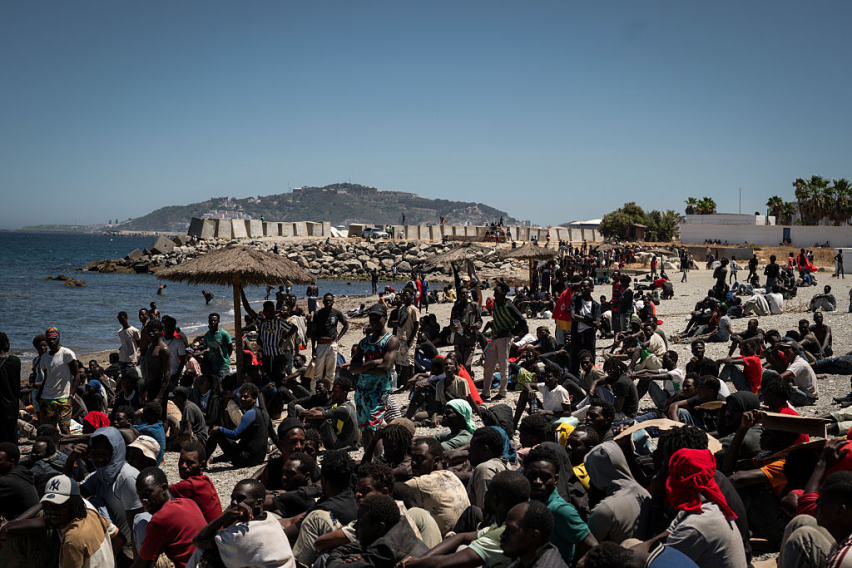
As the Spanish enclave of Ceuta slowly returns to something like normality, an evangelical pastor in the city is urging Christians worldwide to pray — for the migrants who came, for residents caught in the chaos, and for authorities struggling to respond.
The appeal came after more than 50,000 people crossed from Morocco into Ceuta by sea and on foot on July 30 in an unprecedented single-day surge, overwhelming police, health services and the city's entire border infrastructure. By Sunday, most had gone back.
At least 72 people died on the Spanish side of the crossing, Reuters reported, with five more bodies recovered along the North African coast on Sunday. Spanish authorities said more than 1,000 people had been treated by health services. Moroccan officials disputed the toll, saying 11 had died — mostly by drowning — and that they were fact-checking reports from the Spanish side.
Both governments blamed social media for fueling the rush. Viral videos and messages circulated showing thousands breaching the border, drawing people who had no prior plans to migrate. A bakery worker from Fez who gave his name as Brahim told Reuters he had quit his job after watching the clips. "I thought I'd build a better future there," he said. "But I was surprised in Ceuta."
He survived three days on water alone.
Nearly all those who entered returned within 48 hours. Reuters spoke to returnees in Fnideq, the Moroccan city opposite Ceuta, who cited hunger, shuttered shops and hostility from some local residents as reasons for leaving. "Ceuta was like a prison — nothing to do there. Everything was closed," said one man who declined to give his name.
Not everyone left willingly. Mohamed Ahmed, a 43-year-old Sudanese man who said he swam four hours to reach the enclave after a truck dropped him near the border, told Reuters he would not go back. "I'm not going back. I'd rather die trying here."
A Ceuta hardware store owner named Tito, whose shop remained shuttered as the city tried to recover, told Reuters he felt "overwhelmed and, at the same time, helpless" — but also felt sympathy for those who had crossed. "Those young people, they're being completely exploited," he said. "They're being used as bargaining chips."
The crisis drew alarm across Europe. Italy suspended passport-free Schengen travel with Spain for one month, and 22 EU member states called for coordinated border protection measures. Spain deployed its army to Ceuta and installed a 500-metre floating barrier off its coast on Saturday.
For Javier Santolaria, pastor of the Casa de Alabanza evangelical church in Ceuta, the week brought grief and a clear sense of obligation. Speaking to Protestante Digital and reported by Evangelical Focus, Santolaria — whose wife is a nurse who has been working at the border for days — said the city had been pushed to a breaking point. He acknowledged that health workers and security forces were "doing a truly admirable job under very demanding circumstances and, at times, with very few resources."
He was sceptical about political solutions. "There are no simple solutions to such a complex problem," he said, noting that many residents believed there were "hidden agendas behind this whole situation" and were "fed up with the stopgap measures."
Santolaria recalled that Ceuta went through something similar in 2021, but said the current crisis was different in one significant way: this time, residents took to the streets in demonstrations across the city to protest, adding another layer of tension to an already strained situation. The 2021 episode, he said, should have been a warning. "We hope that this whole situation will encourage governments to implement the necessary measures to ensure that such things do not happen again."
As a pastor, Santolaria told Evangelical Focus he had been speaking with congregation members who felt "powerless and do not know how to respond." His direction was clear.
"What we would appreciate most is for you to pray. Pray for our city, for the authorities, and for all the staff working on the front line."
He also asked for prayer for the migrants and for Ceuta's residents. "Pray that the demonstrations remain peaceful and these streets do not turn into a powder keg," he said.
The church's response had been to intensify prayer, he said, "for the city, the authorities, the police, the Civil Guard, healthcare workers, and other institutions involved."
"We hope that the Lord will allow us to be a beacon of hope and support for our city."