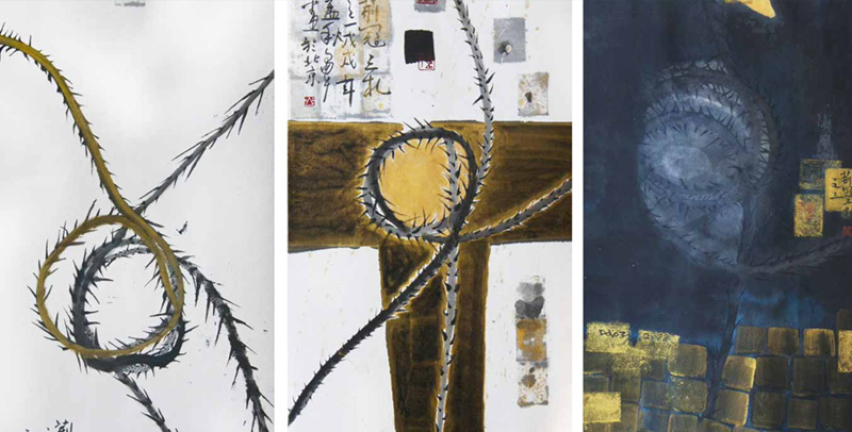
In modern society, people rely on their own wisdom and strength to search for the meaning of life. Christian thinker Francis Schaeffer vividly described this effort as the “Line of Despair”, when people realize that reason alone cannot answer life’s ultimate questions, they often fall into a state of confusion and anxiety, as if reaching a dead end with no hope in sight.
The ivory tower of the Christian artist
Jesus’ mandate is for us to “go into all the world”.
As Christians, are we not also prone to another form of dilemma? Within the Church, we pursue personal spirituality and a stable life, but our vision often becomes blurred—we lose sight of the world beyond, especially the so-called "others", those who are struggling to find meaning. Yet Jesus’ mandate is for us to “go into all the world,” (Matthew 28:18) not merely to build enclaves within the secular realm.
The apostle Paul’s experience in Athens may offer insight for Christians today. Confronted with a city “full of idols,” Paul did not restrict his critique of pagan culture to the synagogue, but instead “reasoned in the marketplace day by day with those who happened to be there” (Acts 17:17).
Upholding the absolute truth of Christ’s resurrection... in ways his audience could understand.
Paul did not mechanically repeat Jewish doctrines. Rather, he cited Greek philosophical texts, engaged with Epicurean and Stoic philosophers, and even cleverly used an altar “to an unknown god” as a point of entry (Acts 17:23). This contextualized evangelism strategy showed Paul’s gospel wisdom—upholding the absolute truth of Christ’s resurrection while expressing it in ways his audience could understand.
Christian artists today face similar challenges. If their work exists only to fulfill aesthetic needs within the church (decorative pieces for sanctuaries or biblical illustrations) it is as if the gospel remains locked in an ivory tower.
Art... clothed in the language of the age... to reach souls in darkness.
True Christian artists must, like Paul, step into the “marketplace”, today’s public cultural discourse. This is not “compromise,” or “following the ways of this world” (Ephesians 2:2), but a strategic incarnation. Just as Christ took on human form, so must art be clothed in the language of the age if it is to reach souls in darkness.
The challenge of the visual Age
Contemporary culture is increasingly visual in its modes of expression. While the power of words is undeniable, the impact and memorability of images often work more subtly yet deeply in shaping the human heart. Philosopher Martin Heidegger once observed that the modern age is marked by the “world as image”—a shift in which the world is not merely represented but is grasped and structured by the human subject.
The world being reduced to image.
Today, this has further devolved into the world being reduced to image as people come to understand life through filtered social media posts and define success through the subtle advertisements embedded in visual culture. Theologian Leland Ryken’s warning becomes all the more urgent: if our hearts are filled with images of luxury homes and expensive cars, even if we know life’s meaning lies elsewhere, our behavior will still slide toward materialism.
Artists... become shapers of cultural sensibilities.
Artists, as creators of images, inevitably become shapers of cultural sensibilities. Their works do not merely mirror social realities; they also subtly shape how people perceive and internalize ideas of beauty, truth, and meaning.
Yet under the disenchanted pressures of modernity, contemporary art has increasingly lost its transcendent dimension, reduced instead to the handmaiden of consumerism and cynicism. Pop art pioneer Andy Warhol’s Campbell’s Soup Cans (1968) deconstructed the mythology of consumption; street artist Banksy, through works like Flower Thrower (2020), used graffiti to expose the absurdity of war; and Japanese artist Yayoi Kusama’s Infinity Mirror Rooms (since 1963) evoke an acute awareness of existential loneliness.
Much of today’s art has gradually lost its critical edge.
Yet in the process of dismantling sacred values, much of today’s art has gradually lost its critical edge. Many biennales (a large-scale international contemporary art exhibitions) are filled with symbolic games masquerading as so-called “postmodern” expression.
One example is Damien Hirst’s installation Mother and Child Divided (1993), in which a cow and her calf are bisected and displayed in large formaldehyde-filled tanks. While such works may deliver a conceptual jolt, they often fall into a kind of “emperor’s new clothes” dilemma. Viewers hesitate to ask questions for fear of appearing ignorant, while artists revel in insider jargon and mutual praise within closed circles.
In this spiritual wasteland... we see an urgent need for art infused with transcendence.
Art exhibitions filled with such symbolic nihilism (a rejection of objective meaning, values, and truth) call to mind the scene described in Exodus 32:6: “The people sat down to eat and drink and got up to indulge in revelry.” Yet it is precisely in this spiritual wasteland that we see an urgent need for art infused with transcendence. If Christian artists are to make a meaningful impact, they must confront this cultural predicament head-on.
From critique to transcendence: artistic praxis
Christian artists must enter deeply into the fabric of society... to shine the light of Christ.
Creating art in or for specific contexts must not be a matter of distant observation or superficial gestures. Christian artists must enter deeply into the fabric of society—not as an act of cultural compromise, but in order to shine the light of Christ, who dwells within them, onto paths obscured by the fog of our times. This calling demands that Christian artists embrace a dual vocation...
1. Prophetic critique.
Art should, like the prophets of the Old Testament, use powerful visual language to expose the sin and darkness of society—to cry out. The prophet Ezekiel once engaged in what we might now call performance art: lying on his side, shaving his head (Ezekiel 4–5), enacting God’s judgment on Israel in a way that stirred the conscience of the people.
Likewise, the Greek cynic philosopher Diogenes of Sinope (412–323 BC) once walked the streets at noon holding up a lantern in broad daylight, a gesture that mocked the hypocrisy of his age. In the same spirit, today’s Christian artists can reclaim such prophetic expression to confront the idols of materialism, the rot of power, and the complacency of culture.
2. Pastoral healing.
Healing art... not only attends to the spiritual needs of individuals, but also speaks to the collective traumas of society.
But art must not stop at unveiling what is broken, it must also take part in the work of mending the world. Through the “chewing of pain” and the sublimation of memory, art can become a support to the “bruised reed” (Isaiah 42:3), offering hope to the wounded and forgotten. This kind of healing art practice not only attends to the spiritual needs of individuals, but also speaks to the collective traumas of society.
In the Chinese-speaking world, we have already seen Christian artists exploring this path.
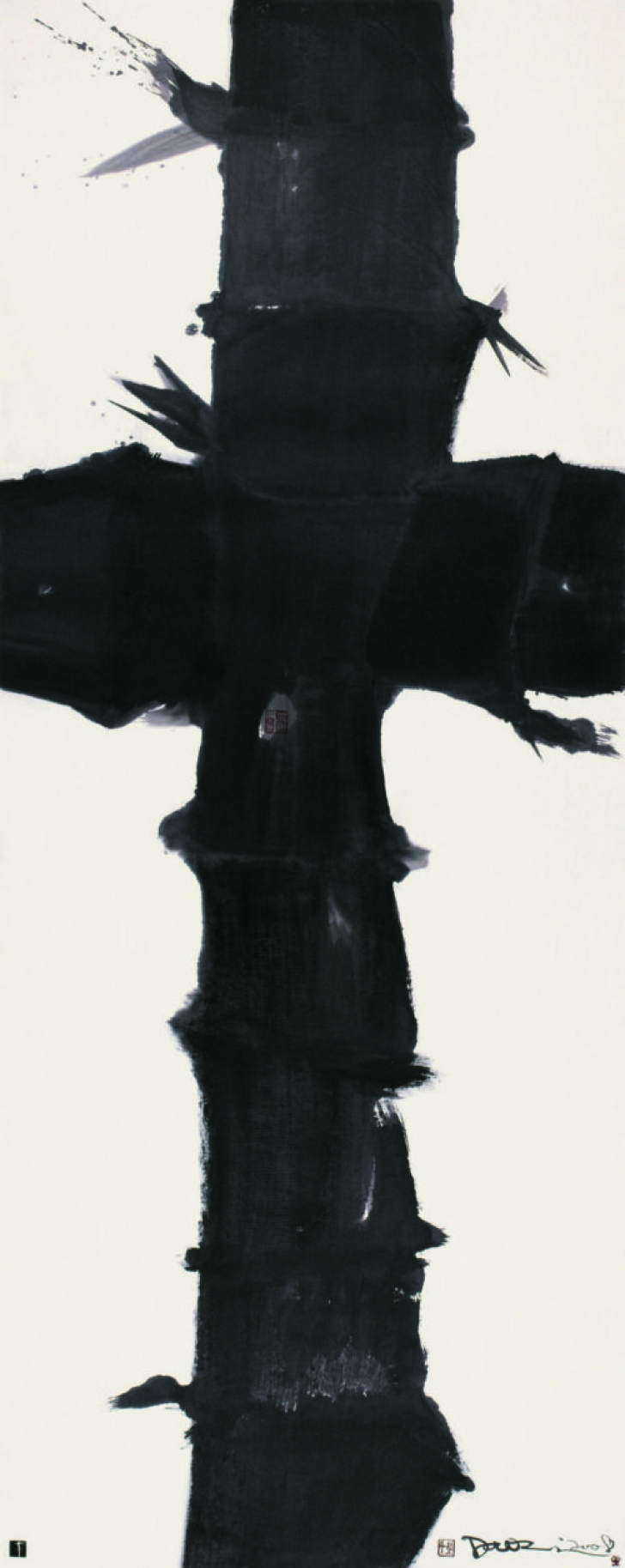
Dao Zi, in his Bitter Bamboo (2008), integrates the image of the cross with the dry-brush techniques of traditional Chinese literati painting, offering a visual metaphor for the resilience of faith in the midst of suffering.
His abstract work An Ever-Repeating Beginning (2012) employs traditional Chinese ink materials while weaving together a range of contrasting formal elements. The piece recalls a pivotal moment in Christian history (the Last Supper with the disciples) while simultaneously engaging the viewer in a deeply personal, spiritual encounter. The work invites participation and reflection, blurring the boundary between sacred narrative and present-day inner experience.
In his 2011 work Waiting for a Reconciled Day, Zhu Jiuyang explores the themes of trauma and reconciliation. Set against the backdrop of the widely publicized Yao Jiaxin murder case in China, the installation features a minimalist arrangement: a rustic wooden table and two chairs purchased directly from the victim’s family. Through these quiet elements, the piece constructs a contemplative space in which viewers are invited to reflect on justice, forgiveness, and healing.
In the late 1980s, Christian artist Dr. Evelyna Liang Yee Woo (affectionately known as “Erhu Grandma”) launched the Art in the Camp project, leading students to organize art activities inside Vietnamese refugee camps in Hong Kong. There, they provided children with meaningful art education and used color and creativity to brighten the prison-like atmosphere of the camps.
In the early 1990s, she founded Art in Hospital, an initiative that brought the concept of art and healing into community spaces by organizing therapeutic art programs for medical staff, patients, and artists. In the early 2000s, she established Art for All, a charitable organization devoted to community art. Its mission is to empower all people (not just the privileged) through art, especially marginalized ethnic minorities and new immigrant laborers. Through these projects, Dr. Liang lives out the teaching of Galatians 6:2: “Bear one another’s burdens.”
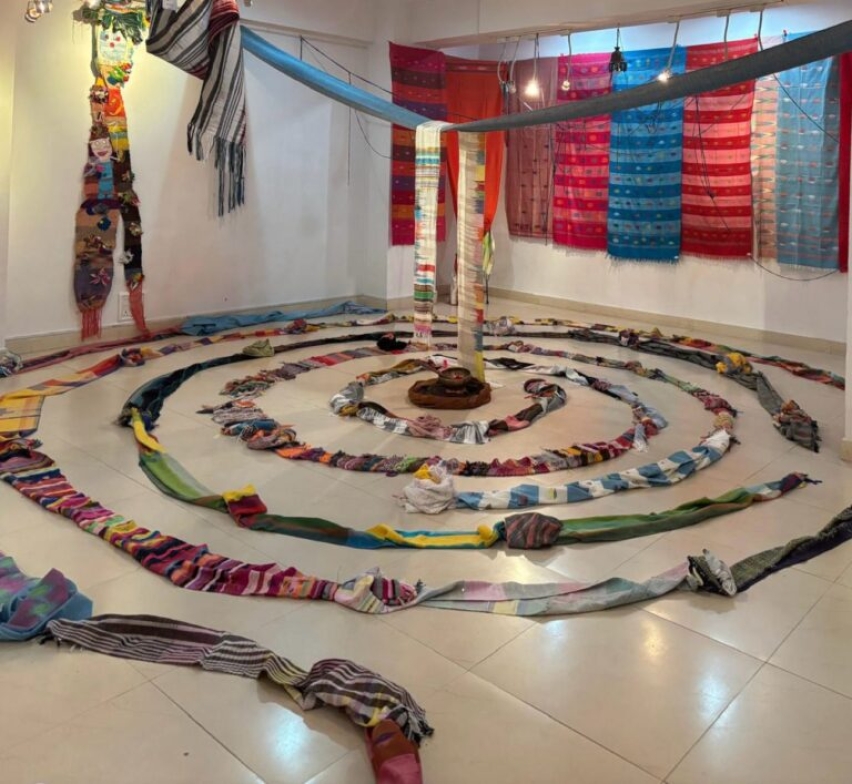
Art must not only expose the wound, it must also participate in its healing.
These artistic practices demonstrate that Christian artists are not confined to merely replicating religious symbols. Rather, they can engage deeply with the texture of culture, becoming agents of transformation and renewal. Art must not only expose the wound, it must also participate in its healing. Traumatic memory requires what is called “narrative reconstruction” in order to be integrated, and art provides a vessel for such sublimation.
As Francis Schaeffer urged, Christians must understand the crisis of modern culture and create in ways that are both faithful to biblical truth and rich in cultural insight. Christian artists should not retreat from this fallen world, but through their work, reveal the honest condition of humanity, including its post-fall brokenness and longing for redemption, and point toward the hope and restoration found in Christ.
Mending and witness
Rooted in truth while attuned to the pulse of the age.
The social engagement of Christian artists is neither moralistic preaching nor utopian sentimentality. Like the apostle Paul, it must be rooted in truth while attuned to the pulse of the age, exposing the wounds of the world, yet reaching out with hands of grace to help mend them.
In an age dominated by images yet starved for meaning, Christian artists are called to be “the salt and light of the world”, salt that enters the wound to preserve, light that penetrates darkness to reveal. If art concerns itself only with aesthetic form or market value, it betrays its deepest vocation.
Christian artists must move beyond self-referential games and become bearers of hope, bearing witness to the Christ who is making all things new through the work of mending the world.
Pathways for creative breakthrough
Contemporary Christian artists may find new breakthroughs in their creative practice by exploring the following five areas...
1. Build cross-disciplinary alliances.
Co-curate public art projects.
Explore the possibility of collaborating with non-Christian artists to co-curate public art projects on themes such as trauma and healing. Through diverse dialogue and shared creative work, these projects can reveal the depth of Christian faith. For example, a collaborative exhibition themed “Trauma and Transcendence” could invite both Christian and non-Christian artists to respond to a specific personal or societal trauma, engaging one another through artistic dialogue and even creative competition.
2. Embrace new media.
Expand... the reach of the gospel through technological imagination.
Move beyond anxiety about new technologies and take proactive steps to engage them. This might include incorporating animation or virtual reality into church stained-glass storytelling, or developing interactive video games based on biblical narratives, expanding the reach of the gospel through technological imagination.
3. Integrate artistic and spiritual formation.
Help artists explore the theological depth.
Establish artist retreats or residencies in seminaries (such as the Brehm Center at Fuller Theological Seminary) or faith-based cultural institutions (such as L’Abri) to help artists explore the theological depth of concepts like incarnation and creation, and to more deeply integrate their faith with their creative practice.
4. Develop theological aesthetic frameworks.
Theological aesthetics should serve not merely to explain biblical doctrine, but to shape a meaningful method of art criticism for contemporary culture. One example is Professor Zha Changping’s exploratory concept of “World Relational Aesthetics,” which interprets art through the relationships between humanity, God, and creation.
5. Practice social compassion through art.
Organize art workshops.
Organize art workshops in prisons or therapeutic drawing sessions for refugee children (such as those initiated by Dr. Evelyna Liang). These practices transform art into a tool for healing and human care, embodying a faith that stands in solidarity with the marginalized and vulnerable.
The ultimate mission of Christian art is to become a signal light through the fog of falsehood.
In a post-truth age, the ultimate mission of Christian art is to become a signal light through the fog of falsehood, not only illuminating the absurdities of existence, but pointing to the God “who calls into being things that were not.”
This calling requires artists who, like Diogenes, bravely lift a lantern in the noonday sun, and like the Good Samaritan, gently bind up wounds. Only then can art truly transcend the false divide between sacred and secular, bearing witness, through the mending of the world, to the power of the cross—“foolishness (to the world), yet wiser than all human wisdom.” (1 Corinthians 1:25)
Originally published in English by ChinaSource from an original publication in Chinese. Republished with permission.
Jiushuang Chen (陈久双) is an artist, art critic, and scholar whose research and creative practice explore the relationship between Christianity and modern and contemporary Chinese art, with particular attention to faith, suffering, and theological aesthetics. He holds a PhD in Art History and Theory from Tsinghua University and an MA in Painting from the China Academy of Art, where he taught from 2007 to 2016.
He has held visiting research appointments at St Benet’s Hall, University of Oxford; the Institute of Sino-Christian Studies in Hong Kong; and Fuller Theological Seminary. He is the 2026–2027 Artist in Residence at the Overseas Ministries Study Center at Princeton Theological Seminary.
His essay “Metaphors and Controversy: The Cross in Modern Chinese Art” appears in Modern Chinese Theologies: Volume 3: Academic and Diasporic (2024). His artwork has been exhibited internationally, including solo exhibitions in Beijing, Hangzhou, and Oxford.