
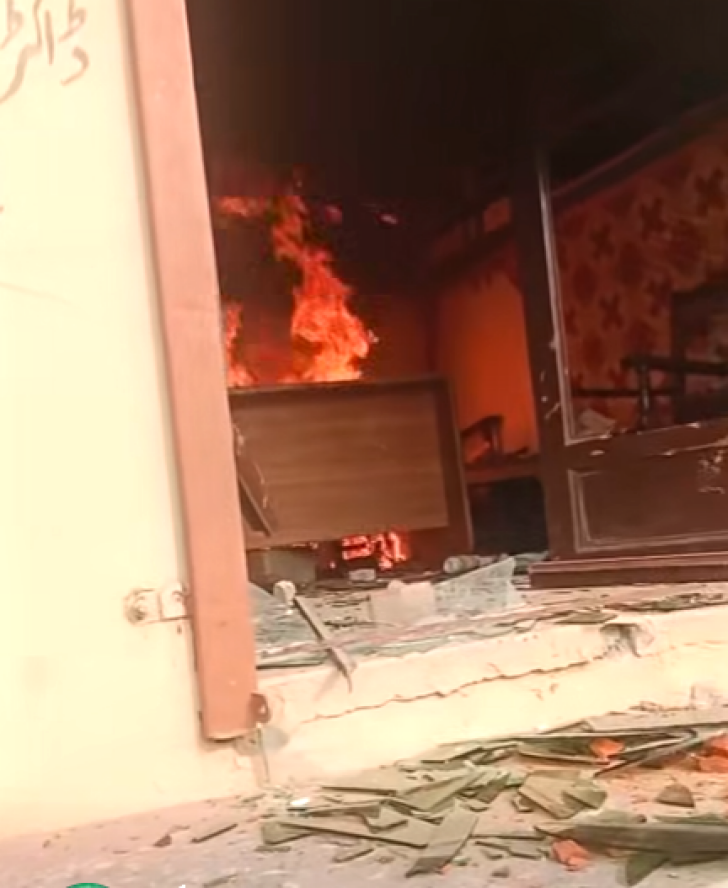
A Muslim mob in Pakistan set fire to a Christian’s house and shop on Friday (Oct. 9) after he was accused of blasphemy, forcing more than 35 Christian families to flee their homes amid fears of further violence, sources said.
Police arrested Kamran Masih, a 40-year-old father of three who ran a small pharmacy in Gharial Kalan village, Narang Mandi, Sheikhupura District, Punjab Province at about 9:30 p.m. on Thursday (Oct. 8) after local Muslims accused him of sharing a blasphemous video in WhatsApp groups, a source said.
“As word of Masih’s arrest spread, his family and other Christians started fleeing the village, fearing a mob attack,” the source told Christian Daily International-Morning Star News on condition of anonymity.
Dozens of Muslims gathered outside Masih’s shop and adjacent residence on Friday (Oct. 9), to protest, and some set both buildings on fire, the source said.
“Fortunately, the mob could not damage other Christian properties due to timely intervention by the police,” the source said.
It remained unclear which provisions of Pakistan’s blasphemy laws have been invoked against Masih, his relative and other sources said. An official at the Sheikhupura District police chief’s office said a large contingent of police had been deployed in the village to protect Christian residents and their homes, adding that an investigation was underway.
“I’m not permitted to share more information due to the sensitivity of the situation,” the official told Christian Daily International-Morning Star News. “However, I can assure you that the situation is under control now, and the law will take its course against all those involved in violence.”
Ejaz Alam Augustine, a Christian member of the Punjab Assembly, said he and other Christian lawmakers had remained in contact with police and district authorities throughout the day to ensure residents’ safety.
“The police’s timely action of taking Masih into custody helped in containing the situation; otherwise, things could have gone out of hand,” Augustine told Christian Daily International-Morning Star News. “Senior police officials have assured me that the incident would be investigated on merit. Police have arrested more than 15 protesters who set Masih’s shop and house on fire.”
Masih’s relative described the violence as unprecedented in the village, where Christians and Muslims had historically lived peacefully alongside one another.
“We have very cordial terms with our Muslim neighbors, and I’m still unable to comprehend how these events unfolded,” he said. “Masih enjoys a very good reputation in the village and is a sensible man. We have no clue how or why he has been accused of such a nefarious act.”
Pakistan’s blasphemy laws have long drawn criticism from human rights organizations and legal experts, who warn that the provisions are vulnerable to misuse in personal disputes and other conflicts and have disproportionately affected religious minorities.
Although Pakistan has not carried out a state execution for blasphemy, accusations have repeatedly triggered mob violence, extrajudicial killings and prolonged detention of suspects awaiting trial.
On July 9, a violent protest erupted in Karachi, Sindh Province, after unidentified people allegedly mailed a desecrated page of the Quran to a Muslim shopkeeper, along with photographs of a Christian man and his mother. Asif Bastian, a Karachi-based activist, said the envelope was delivered to Waleed General Store in Qazafi Colony, Baldia Town. It contained a burnt page of the Quran, photographs of 40-year-old Catholic Azeem Javaid and his mother, and an image of her national identity card.
“As news of the alleged desecration spread, several hundred Muslims, including activists from religious parties, gathered outside the street where Javaid’s home is located and began protesting,” Bastian told Christian Daily International-Morning Star News. “Around 10 to 15 Christian families live on that street, and they were effectively trapped inside their homes.”
Protesters threw stones at police vehicles after officers arrived, forcing an initial withdrawal, Bastian said. The Sindh provincial government subsequently deployed paramilitary Rangers alongside additional police to restore order.
The Karachi incident came just days after more than two dozen Christian families fled their homes in Punjab Province amid fears of mob violence following blasphemy allegations against a pastor living in the United States.
Joseph Nayyar, a human rights advocate based in Hafizabad, said tensions escalated in Jhulan village in Gujranwala Division on July 3 after announcements over mosque loudspeakers accused Pastor Sajeel Robin, a native of the village now residing in the United States, of posting social media videos deemed offensive to Islam and Muhammad, prophet of Islam.
Police from Kot Ladha station subsequently advised Christian residents to leave their homes temporarily as a precaution against possible attacks, Nayyar said.
“Most Christian families fled with only the belongings they could carry,” he said.
Police also took the pastor’s father, Robin Masih, and his maternal uncle, Shamaun Masih, into protective custody, while his brother, Nabeel Robin, went into hiding to avoid arrest, Nayyar added.
He credited local police and some Muslim residents with helping prevent violence through negotiations with local clerics.
“The situation could easily have escalated had the police and local Muslim community not intervened,” he said. “They urged the protesting clerics not to target innocent Christians and assured them that any legal action would be directed only at those found responsible.”
Christian support group Open Doors ranked Pakistan eighth on its 2026 World Watch List of 50 countries where Christians face the most severe persecution. It cited systemic discrimination, mob violence, forced conversions, bonded labor and gender-based violence, warning that weak law enforcement and widespread impunity have allowed perpetrators of anti-Christian violence to evade accountability.








