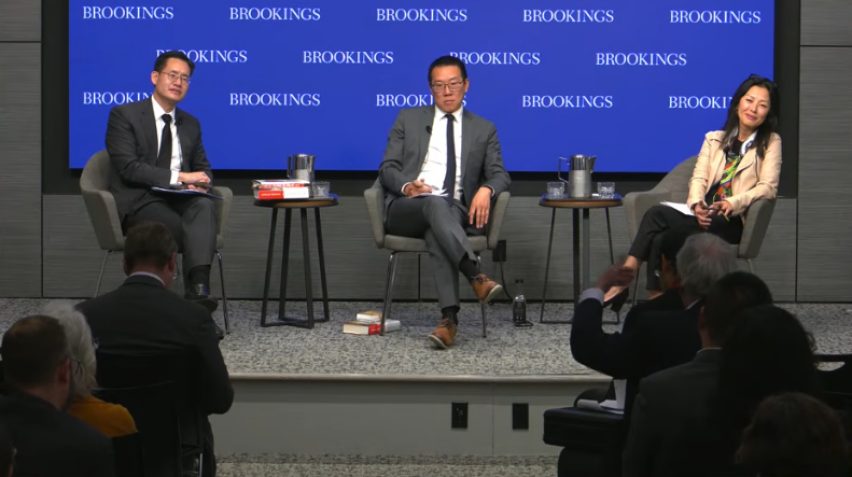
Speakers at a recent forum in Washington examining religion and ideology in North Korea argued that the country’s ruling Kim family adopted elements of Pyongyang’s historic Christian culture and reshaped them into a political system centered on loyalty to the regime.
The discussion, reported by Christian Daily Korea and available on YouTube, took place April 27 at the Brookings Institution under the theme “Power, Religion and Ideology in North Korea.” Participants included Jonathan Cheng, China Bureau Chief of the Wall Street Journal, and Jung Pak, Distinguished Associate Fellow of the Centre for Security, Diplomacy, and Strategy at the Vrije Universiteit Brussel.
According to Cheng, whose latest book “Korean Messiah: Kim Il Sung and the Christian Roots of North Korea’s Personality Cult” was published earlier this month, North Korea’s leadership did more than suppress Christianity after the country’s division and the rise of the communist state. He argued that aspects of Christian religious culture in Pyongyang were adapted to strengthen the personality cult surrounding founder Kim Il Sung and his successors.
Pyongyang was once known as the “Jerusalem of the East” because of its large Christian population and its role in the 1907 Korean revival movement. Cheng said Kim Il Sung grew up in that environment and was exposed to church life from an early age.
“Kim Il Sung grew up within the Christian culture of Pyongyang,” Cheng said during the forum, according to Christian Daily Korea. He noted that Kim reportedly participated in church activities including Sunday school and choir programs during his youth.
Cheng argued that the regime later mirrored some of religion’s structures and emotional dynamics while simultaneously outlawing independent religious practice.
“He hijacked the pure passion believers had for God and designed a false religious system that made people worship him as a ‘living god,’” Cheng said.
North Korea officially guarantees religious freedom in its constitution, but international human rights organizations and Christian advocacy groups have long accused the government of severely restricting religious activity outside state-controlled institutions. Several watchdog groups consistently rank North Korea among the world’s most restrictive countries for Christians.
Pak said the regime uses suffering and hardship to reinforce political loyalty and ideological control. Referring to the famine of the 1990s, commonly known as the “Arduous March,” she said the government framed national hardship through a narrative centered on devotion to the ruling leadership.
“North Korea transforms even the worst disasters, such as the ‘Arduous March,’ into a religious narrative of salvation claiming that ‘only the Supreme Leader can guide people to paradise,’” Pak said.
She also argued that the regime redirects blame for economic hardship away from leadership failures and toward citizens themselves.
“The regime makes residents blame themselves by attributing the cause of starvation not to the incompetence of the leadership but to each individual’s lack of loyalty,” Pak said. “It injects the false message that only Kim Jong Un is the sole savior.”
Participants at the forum also discussed why the North Korean government views religion as a threat to state authority.
Pak said religious belief creates forms of loyalty and community that exist outside government control. Recognition of a higher spiritual authority, she argued, directly challenges the absolute authority claimed by the ruling family.
“Religion allows people to share their hearts without state control and acknowledges the authority of an absolute God higher than the Supreme Leader,” she said.
Pak additionally called for human rights concerns to play a more central role in international engagement with North Korea.
“We must restore human rights — the Achilles’ heel of the Kim Jong Un regime — as a central agenda item in North Korea policy,” she said.