Seminaries worried about AI-written essays and distracted students could teach through games in which students make choices and live with the results, a theological lecturer and game designer told an international online gathering of educators on Nov. 23.
The speaker, an adjunct lecturer at an institution in South Asia who works in the arts and game design, said playing through a ministry situation and then talking it over with a teacher shows what a student can actually do. A well-written paper, he suggested, can no longer prove that on its own.
"If AI owns the search," he said, then teaching that relies mainly on finding and repeating information is teaching the technology can already do.
He spoke at "Game-Based Learning in Theological Education," a webinar hosted by the Technology and Innovation in Learning Impact Team of the International Council for Evangelical Theological Education (ICETE). In June, the same team held a webinar on how seminaries can weigh artificial intelligence against the demands of spiritual formation.
What teachers want to see in their students
The speaker began by asking participants which subjects students pass on exams but find hard in real ministry. Many named handling conflict, evangelism and pastoral care.
He also asked what distracts students most during a long lecture. Social media and short attention spans topped the list, though one participant answered that "the lecture itself is the distraction."
Asked what they most wished they could assess now that tools like ChatGPT are common, many said critical thinking, personal formation and character. If a strong student handed in a flawless Bible study paper that seemed to be written by AI, most said they would first talk with the student or ask questions in person.
The speaker warned against relying on AI-detection software. In many Majority World countries, he said, students learn to write English in a formal, textbook style that "sometimes gets flagged as AI, but it's actually not AI."
Are attention spans really shrinking?
Much of the problem lies with social media, the speaker said. Endless scrolling feeds are designed so users never know what will appear next. "It works like a slot machine," he said. "You don't know exactly what you're going to get next."
Videos that play automatically, one after another, leave no natural moment to stop, he added. "We are attached to our mobile devices," he said, comparing phones to the comfort blanket a small child carries everywhere.
Yet many people will happily play a board game or video game for hours at a time. "Gamers are not a minority in the world," he said.
He cited figures putting the number of digital gamers at 3.6 billion, or 43% of the world's population, with 2.3 billion in the Middle East, North Africa and Asia. India alone has between 500 million and 600 million gamers, most of them in rural or semi-rural areas, he said.
Online theological classes, by comparison, often look like a screen of silent faces on a video call and a pile of PDF files, he said.
Points and badges are not enough
The speaker separated two ideas that are often confused. "Gamification" adds points, badges or rankings to ordinary lessons, such as a quiz after a video. It mostly tests memory.
Some game designers jokingly call this "chocolate-covered broccoli," he said. "I like broccoli. I like chocolate. I don't like the combination."
A true learning game is different, he said, because players step into a story world where "your decisions matter." A wrong choice changes what happens next.
He offered a simple test. "If you strip away all the game elements and the learning is unchanged, then it's gamification," he said.
Businesses have used role-play and simulation exercises for decades, and some universities use classroom role-play to teach history and other subjects, he said. He also pointed to board games in which players take different roles and must cooperate to win.
He invited participants to imagine Jesus' parables as games, where players could make choices, reach a dead end, and then go back and learn the lesson properly.
A Sunday school class in trouble
To show how this works, the speaker presented "Tournament Sunday," a game he made for his students two weeks earlier. It begins in a Sunday school room. Fifteen children are expected, but only four come. The rest are playing a popular mobile game.
Each student takes a role on the church team, such as explorer or peacemaker, and has a limited number of points to spend. Every action costs something. Going to the local tea shop to understand what is happening, for example, uses up 40 of them.
Later, the children ask to hold a video game tournament at church. Three church elders support the idea and two oppose it, and the players must decide how to respond.
The game measures whether players stay connected with the children, help families hold together and keep good relationships with church leaders.
"There is a cost to ministry," he said. "You're losing your ministry resources." Students can play again as many times as they like, and "it's a winnable game," he added.
The real learning happens in the conversation afterward, the speaker said. He meets with students to talk through their choices, much like an oral exam. He admitted that "a very determined student can use AI to play the simulation," but said the discussion still shows what the student has understood.
Games like this let students practice hard situations, such as pastoral counseling, where they can "make their mistakes in their games" and learn not to repeat them in real life, he said.
A conversation with a Buddhist priest
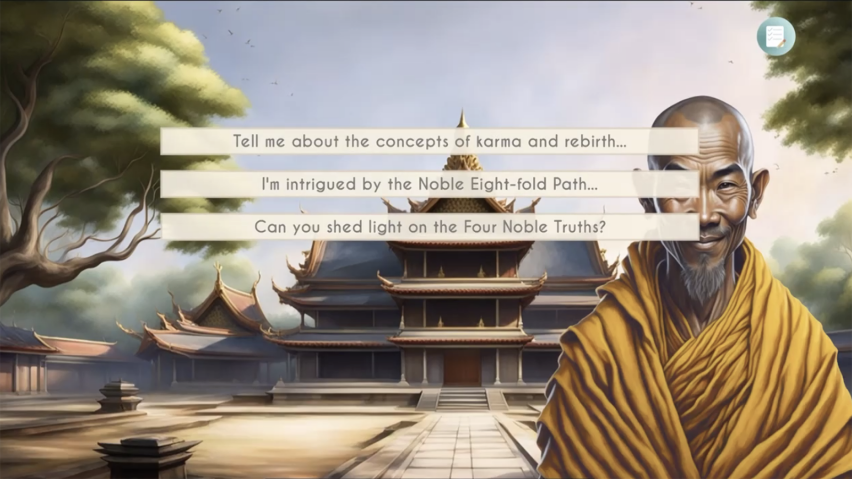
The speaker also showed a story game set in an imaginary town, which he uses to train students to engage with people of other faiths. In one scene, the player meets a Buddhist priest. A player who approaches him with curiosity is invited to see his library. One who comes across as aggressive receives a polite blessing and is sent on his way.
The scene drew on his own conversations with Buddhist priests, he said.
In another game, players talk with AI-powered characters to track down a young gamer who has shut himself in his room. Some characters test whether the player really knows video games, and one speaks in the slang of young gamers.
Two years ago, building such games was expensive, he said. Today an AI tool can write the code for a simple game in an afternoon. The harder part is designing a good game, which teachers need to learn.
"The designing part is the high-tech part, but the distribution is extremely low tech," he said, noting that his games run as small files that work without an internet connection.
Starting with paper and pencil
Several common features of games match the realities of ministry, according to the speaker. Limited resources force players to decide where to spend their time and energy, just as church workers must. Some choices cannot be undone. And when each player has a different role, a game can reflect the many parts of the body of Christ.
Teachers do not need computer programmers to begin, he said. "You can build games with paper and pencil."
He suggested turning one lecture into a scenario with choices, giving students a limited number of points to spend, and replacing a written theology paper with an oral discussion. Teachers can also team up with students who are good with technology.
"Keep it small," he said, recommending games that last five or 10 minutes, with the teacher leading the discussion afterward. "You don't need a computer science degree."