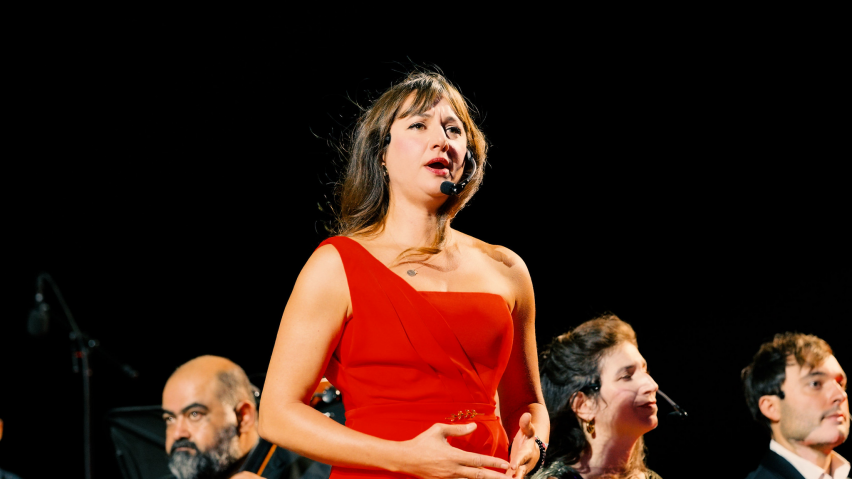
A performance of Handel’s “Messiah” blending Western and Eastern music took place Sept. 12 at Mukawir, the hilltop fortress in Jordan traditionally associated with the beheading of John the Baptist. The concert was held under the patronage of HRH Prince El Hassan bin Talal.
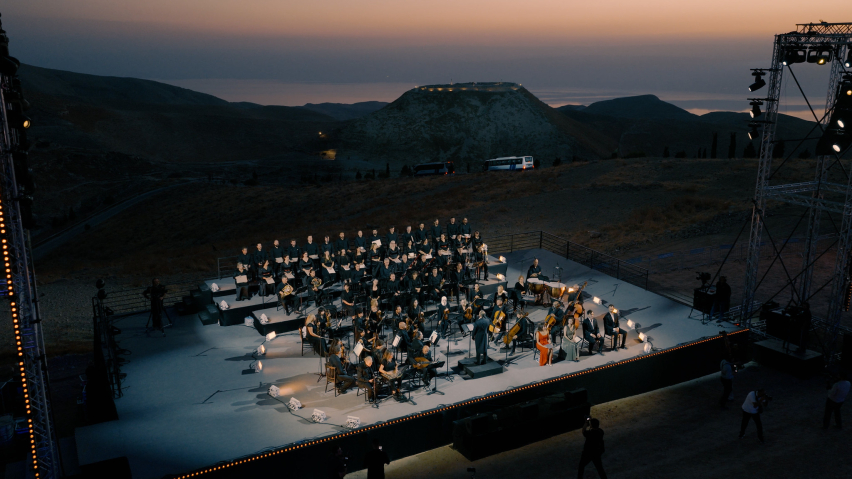
The event featured a Hungarian orchestra, French and Jordanian soloists and oriental instrumentalists. It was held outdoors at the fortress, in an area believed to be connected to where John the Baptist was beheaded by Herod Antipas.
Organized by Friends of Jordan Festivals under the theme “Echoes of Faith, Voices of Heritage,” the performance was presented as the start of a broader cultural and spiritual journey toward the global commemorations of St. John the Baptist in 2030.
The event was part of the European Union’s continued support for preserving and promoting Jordan’s cultural heritage, and its commitment to fostering cultural exchange and bringing Jordan’s historic sites to life through public engagement.
Dima Bawab, the Jordanian soloist, told Christian Daily International (CDI) that when her mother, Souha Bawab, executive director of Friends of Jordan Festivals, contacted her about performing a classical outdoor concert, she knew exactly what would work.
“I wanted a popular, well-known musical which is easy to hear, and appropriate for the location that the Jordanian tourism ministry wanted to promote,” Bawab said.
She had performed “Messiah” 10 years earlier, but this time she faced a few challenges. The concert was allotted 70 minutes, and performing the entire “Messiah” would take more than three hours.
She therefore suggested limiting the performance to the first and second parts, which cover the birth and life of Jesus, and ending the program with the famous “Hallelujah” chorus. She also believed that including parts three and four would not be uplifting and might not be appropriate for an outdoor event.
Bawab told CDI that preparing this mixed act across a long distance and in a short time was not something she was used to, but modern technology helped. “We were able to exchange recordings and hold a number of rehearsals on Zoom.”
She said she had worked with Jordan’s lead instrumentalist, Tareq Jundi, on a performance of “Messiah” 10 years earlier, and she asked him to play the oud. She also contacted Rula Barghouti, who plays the qanun, a harp-like instrument that rests flat on a table.
The plan was to let them improvise on the hijaz scales before the orchestra re-entered with “Messiah,” and to give them an opportunity to support the concert, especially in the final “Hallelujah” chorus.
Jundi, the oud player, said the team from Jordan worked together virtually for months on the concert and even held rehearsals online. “But the actual rehearsals with the entire team from Hungary and Jordan only occurred in the last two days before the concert.”
He said he had performed “Messiah” 10 years earlier, and that he and the Jordanian soloists who live in France, including Bawab, were in regular touch to prepare for the concert.
Jundi said he was proud to be part of a performance that showed real harmony between his oud and Barghouti’s qanun, alongside the full Hungarian orchestra.
“I studied music in the West, and I am familiar with their classical music, and I was delighted to be able to present a joint Western classical instrument with Oriental ones to produce a great musical effort in a historic biblical location,” he said.
Bawab described how the Jordanian musicians achieved musical harmony while preserving the beauty of the Arab instruments. “They would do an improvisation, let’s say, in C major, which then blended seamlessly with the following parts of the orchestra.”
She also noted a technical difference in how the music is tuned. “When Handel created this masterpiece, the tuning standard was closer to A=415 Hz, while modern classical music is performed at A=442 Hz.” She said Arab instruments such as the oud, and performers such as Jundi, can tune to either frequency with ease.
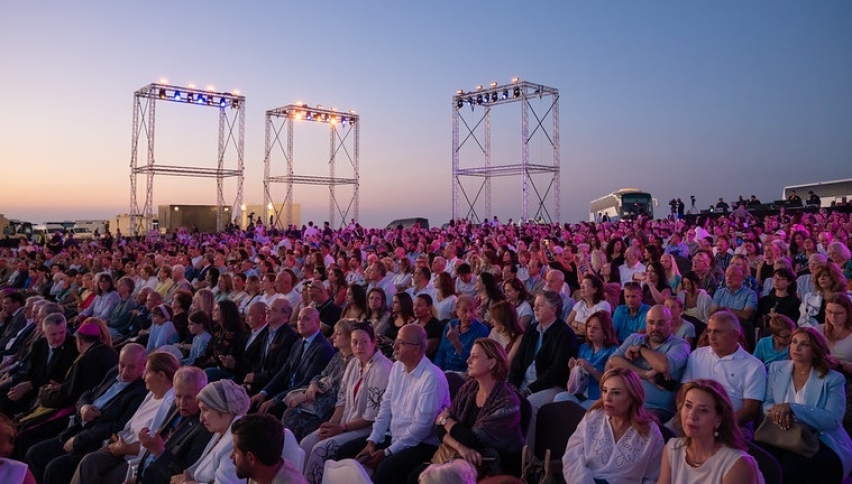
Logistics were complicated. Many people arrived on hired buses, with many leaving at 4 p.m. to be seated by 7 p.m., when the concert started on time to catch the sunset.
“It was a wonderful scene of the orchestra and musicians, and the background was the hill where John the Baptist lost his life, with the Dead Sea further behind,” Bawab said.
More than 2,500 tickets were sold, though some estimates put attendance at 3,000. Large screens displayed text and images telling the story of John the Baptist.
Bawab said that while “Messiah” is about the life and death of Jesus, the concert focused on the life and mission of John the Baptist.
“Remember that this was happening in Jordan, and the goal was to have a wonderful, moving musical like ‘The Messiah,’ but also to promote a location many around the world and even in Jordan didn’t even know about.”
The choice of Mukawir was central to the initiative. The site, traditionally associated with the martyrdom of St. John the Baptist, forms part of Jordan’s cultural and religious tourism landscape.
“The European Union has a longstanding commitment to supporting the preservation, protection and sustainable development of Jordan’s cultural heritage, including the historic site of Mukawir,” said European Union Ambassador Pierre-Christophe Chatzisavas.
He said the EU remains committed to advancing culture as “a driver of sustainable development and community engagement.”
Tourism and Antiquities Minister Emad Hijazeen described the initiative as the launch of “a cultural and spiritual journey towards the global commemorations of St. John the Baptist in 2030.” He said it contributes to preserving shared heritage and strengthens Jordan’s position as a destination for Christian pilgrimage, cultural tourism and international dialogue.
The Rev. Nabeeh Abbasi, president of the Jordanian Baptist Convention, told CDI that attending the performance at Mukawir was a historic and deeply moving experience.
He said the location gave the event a profound spiritual dimension, given John the Baptist’s direct connection to the baptism of Christ in the Jordan River, as preparations continue for the 2,000th anniversary of that occasion.
Abbasi, who is also the Baptist World Alliance’s ambassador to the Middle East and North Africa region, said the performance stood out for its superb organization, high-quality execution and evocative use of visuals.
He said the work’s message — “Christ — the King of Kings and the Risen One” — made it an occasion that instilled pride and strengthened the Christian faith.
Abbasi applauded the Jordanian government for its commitment to “highlighting this authentic Christian heritage, reflecting Jordan’s mission to preserve holy sites and foster values of coexistence and openness.”
Bawab said stage fright is part of the job. “Usually when I return home, this fright is multiplied because of the pressure of having to excel in front of family members and friends, but this time it had a different taste, a mixture of joy and excitement that carried me through the performance with ease.”
She said she was happy with the event, although the biggest challenge was getting the sound right despite the outdoor winds.
“We musicians are perfectionists, and we are used to calibrated indoor settings, so sound was a challenge, but I would love to come back to Jordan, maybe Easter 2027, to do more performances possibly outdoors — but we will need to pay close attention to the sound systems in challenging outdoor settings.”
The event was supported by the European Union, the Jordan Tourism Board, Royal Jordanian, the Goethe-Institute Jordan and the Embassy of Hungary in Jordan.