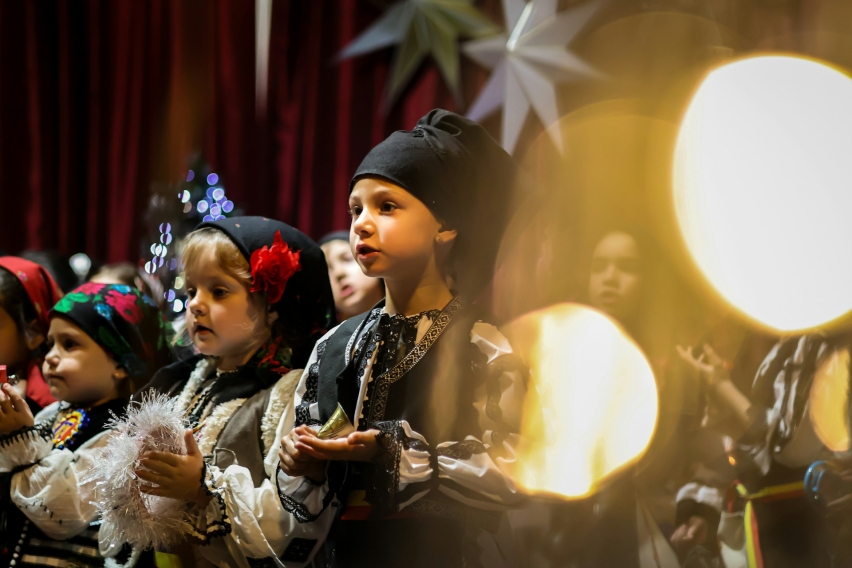
Receiving a chalk blessing at the doorway or decorating wooden boats instead of Christmas trees may seem unfamiliar to many outside the region. Yet across Eastern and Central Europe, Christmas is still marked by traditions shaped by faith, memory and shared life—customs that quietly anchor the season in meaning and community.
Shared recently by church partners connected with Eastern European Mission, these practices reflect a way of celebrating Christmas that remains deeply rooted in worship, hospitality and continuity across generations. While customs differ from country to country, many revolve around candlelight services, family meals, caroling and symbolic rituals that keep the story of Christ’s birth at the center of the season.
Across much of the region, Christmas is observed not as a single day but as a sacred season—one that unfolds slowly, resisting the hurried pace of modern holiday culture and preserving a rhythm shaped by faith and togetherness.
In Romania, early morning Advent services by candlelight mark a reverent start to the celebrations. Families create their own Advent wreaths and candles are light each week in anticipation of the main event. Villages often hold traditional nativity plays with children dressed as shepherds, angels or Roman soldiers—creating a strong sense of continuity from one generation to the next.
Christmas Eve often sees a “charming years-old custom” of decorating the Christmas tree in secret. Children sit enthralled, hearing the story that Baby Jesus himself brought the tree in the night. Others decorate together, surrounding the moment with music and warm conversation before sharing a holiday meal of stuffed cabbage, sweet bread and homemade sausage.
On Christmas Day, children walk through the villages carrying handmade stars and singing carols, keeping the celebration centered on joy, community and shared traditions. Romanian families also hold fast to one simple rule: no one spends Christmas alone.
Neighbors welcome anyone without company, adding a tender sense of hospitality and warmth to the season.
In Kazakhstan, many Christian families also begin preparing for Christmas on Dec. 1 with nightly Advent readings, songs and simple home-centered traditions. Throughout the month, children participate in family Scripture readings to help them reflect on the faith-filled reason for the season.
Gifts are opened on Christmas morning, followed by festive meals, lively music, and joyful family gatherings. Churches echo western traditions by typically holding their main Christmas service on the Sunday closest to Christmas Day, where children perform plays and sing songs.
It is also customary for congregants to enjoy lighthearted gift lotteries in these services and Christmas parties. Many churches also assemble care packages for children in distant villages—a growing expression of service and outreach that has become central to the holiday season.
Croatia’s Christmas season stretches over several weeks and beautifully blends Catholic tradition with older Slavic customs. Advent begins with the lighting of candles on a handmade wreath. On Dec. 6, children place polished boots by the door, hoping St. Nicholas will fill them with sweets — while also hoping to avoid birch branches from Krampus, a Central European folklore figure who punishes misbehaving children at Christmastime.
One of the most symbolic traditions arrives on Dec. 13, when families plant Christmas wheat as a sign of renewal and blessing. Christmas Eve is marked by a traditional meatless meal and Midnight Mass, while Christmas Day centers on feasting—often featuring roast turkey or suckling pig.
The season concludes on Jan. 6 with a traditional “chalk blessing,” performed by priests, who write with chalk above the doors of homes, a customary note “C + M + B,” which stands for “Christus mansionem benedicat.” This signifies both Christ’s blessing over the home and the names of the three wise men.
In Greece, Christmas Eve begins with the cheery sound of “kalanda,” traditional carols sung by children who wander through neighborhoods striking small metal triangles to keep the rhythm. Families open their doors to listen, offering sweets or coins in return. The tradition beautifully connects younger and older generations through shared songs that retell the story of Christ’s birth.
In many coastal communities, families also decorate wooden boats instead of trees — a centuries-old custom honoring Greece’s deep seafaring heritage. On Christmas Day, the focus shifts to family gatherings and lovingly prepared dishes such as roast lamb, honey pastries and rich breads baked with festive spices.
The season culminates on Epiphany with the Blessing of the Waters, when priests cast a cross into the sea or river and swimmers dive into the chilled water to retrieve it — symbolizing renewal and God’s blessing for the year ahead.
Christmas in Ukraine is an act of cultural memory, a living tradition that has carried faith and identity through generations. The season begins with the joyful ritual of caroling, when children and adults move from home to home singing proclamations of Christ’s birth. The homes they visit respond with sweets, warmth and even donations — a small exchange that embodies a much larger spirit of communal care — and a fun incentive for children to partake in the Christmas joy.
From the lively ‘vertep’ performances, where a playful goat briefly “dies” only to spring back to life, to the sacred Christmas Eve meal of ‘Sviatyi Vechir,’ beginning with the first spoonful of Kutia, a sweet and symbolic wheat porridge that carries the meaning of unity, remembrance and hope for abundance, every tradition keeps Ukrainians closely connected to their roots.
Even during Soviet times, when faith was discouraged, these customs endured, quietly safeguarding both spiritual life and national identity. Today, rediscovering these customs is not just nostalgia, it is an act of cultural reclamation and a reaffirmation of joy, community and the enduring strength of Ukrainian heritage.
Austria is widely known for its Christmas markets — cozy, storybook-like gatherings that fill city squares with stalls selling ornaments, beeswax candles, handcrafted gifts and warm cups of Glühwein (hot, spiced wine). These markets date back to the Middle Ages and remain central to Austria’s rich Advent atmosphere.
On Epiphany, children dressed as the Three Kings visit homes, singing carols and offering blessings for the new year. As part of this tradition, they write the aforementioned “chalk blessing” above home entrances for purposes of favor and protection.
Another cherished Austrian tradition is the song “Silent Night,” first sung near Salzburg in 1818. To this day, it is still performed in homes before gifts are opened—a gentle, timeless moment that anchors families in the quiet beauty of Christmas.
“Across Eastern Europe, Christmas traditions continue to highlight connection over consumerism,” commented Dirk Smith, Vice President of Eastern European Mission (EEM). “Candlelit services, shared meals, community carols, simple village customs and a culture of hospitality form a picture of a season still rooted in togetherness and simple joy.”