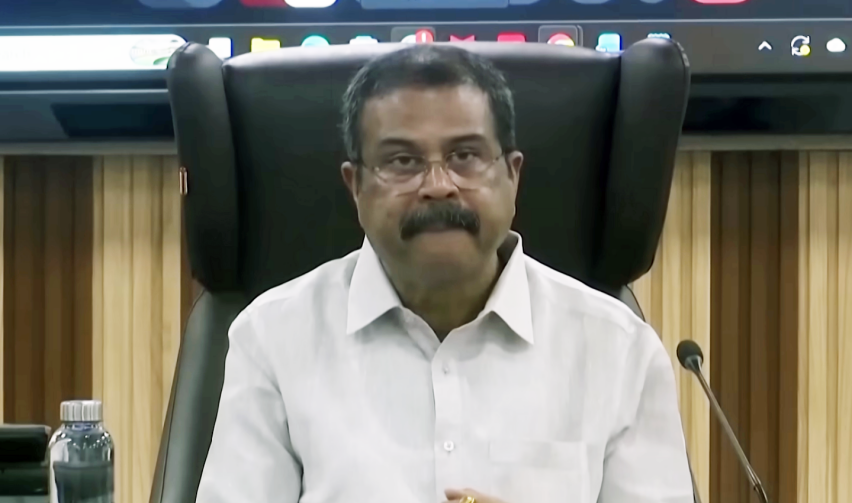
When Christian Daily International last reported on this movement on July 24, India’s government had met two of three demands set by the Cockroach Janta Party (CJP), a youth-led movement mocking Prime Minister Narendra Modi’s ruling Bharatiya Janata Party (BJP) but was withholding an answer on the central one. Forty-nine days after the movement’s first, police-permitted march to Jantar Mantar, New Delhi’s designated protest ground, that answer came: Education Minister Dharmendra Pradhan resigned on Saturday, July 25.
The reversal
Pradhan submitted his resignation to Prime Minister Modi that morning, in a letter written in formal Hindi and posted to X. He said he was stepping down so “anti-national forces” could not exploit the standoff at Jantar Mantar, and so no student’s future would be entangled in legal trouble. He did not apologize for the leaks in NEET, India’s national medical school entrance exam, that triggered the movement.
President Droupadi Murmu accepted the resignation with immediate effect under Article 75(2) of India’s Constitution, and on the prime minister’s advice gave the education portfolio, as an additional charge, to Minister Pralhad Joshi. Joshi told reporters he accepted the job “with a sense of duty and humility.”
Weeks earlier, Pradhan had dismissed the CJP as the “B-team of terrorists.” As recently as Friday, July 24, a government source told reporters that resignation “equates to running away, and running away is not a solution.” By Saturday afternoon, both lines had been abandoned.
We have done it
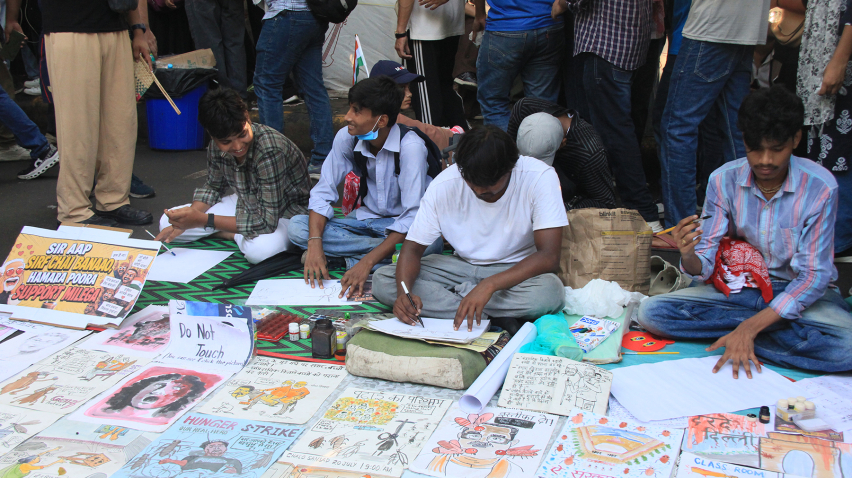
At Jantar Mantar, CJP founder Abhijeet Dipke fell to his knees when the news broke, then raised a fist. “We have done it, we have done it,” he shouted, before reading aloud the names of students who had died by suicide after the exam cancellations.
The CJP’s account on X read simply: “Cockroaches won… Democracy won!” The national anthem played, sweets were passed through the crowd, and the metro stations shut around the site reopened.
From his hospital bed at Medanta, activist Sonam Wangchuk posted a photograph of himself flashing a victory sign. “It is a victory of democracy, and we should all cherish it,” he said in a video statement.
Later he struck a more cautious note. The agitation had entered a new phase, he said, and now needed reforms to build “a robust system that makes us a great nation.” “Resignation alone does not make a nation,” he added, urging the federal government to also honor its commitments to Ladakh, the Himalayan region whose own statehood movement had led to his six months in detention last year.
Among those who came to Jantar Mantar that evening was Rajesh Thapa. His daughter Riya, a NEET aspirant, had died after the exam chaos.
“Children are fighting for their rights, if my daughter were here, she might have joined them too,” he told the Press Trust of India. He said that since she could not be there, he had come in her place, “so that nothing like this ever happens to anyone else’s child.”
The deal
After the resignation, CJP spokespeople Saurav Das and Ashutosh Ranka sat with Ministers J.P. Nadda and Jitendra Singh and announced the protest was over.
Das said the government had accepted all their demands and appealed to protesters to go home. Nadda said FIRs, the criminal complaints police had filed against demonstrators, would be withdrawn in Delhi and BJP-run states, and that families of students who died after the leak would receive “honourable compensation” within existing rules.
Both sides agreed to meet again in four weeks on broader exam reforms.
Don’t make me a hero
In his speech announcing victory, Dipke turned unexpectedly cautionary.
“Don’t make me a hero because Dharmendra Pradhan resigned today,” he told the crowd. “The country has been ruined because of making one person a hero.”
He named specific police officers he held responsible for the July 20 crackdown and warned against complacency. “If we can make a minister resign, what are you?” he said. “Remember, do not mess with cockroach.”
What the deal does not cover
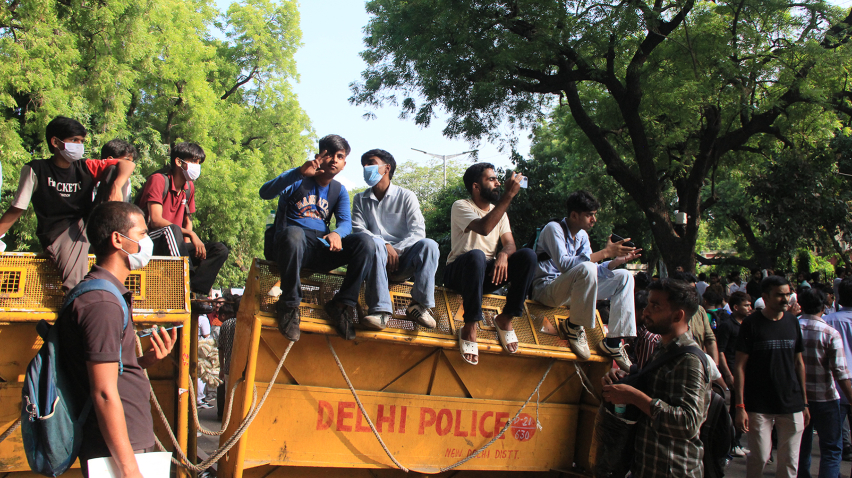
The CJP’s three formal demands, Pradhan’s resignation, compensation, and FIR withdrawal, were all addressed at the press conference. A further demand, pressed separately by opposition leader Rahul Gandhi and by Dipke himself, was not: accountability for the police response on July 20, when officers used batons and tear gas near Parliament.
Gandhi has since written formally to Home Minister Amit Shah, who oversees Delhi Police, demanding accountability for that day. Opposition leader Mayawati went further, calling for the identification of officers who behaved indecently toward female protesters.
A day before the resignation, Gandhi had brought protester Sheikh Irshad Mansuri, who says he suffered pellet wounds in the crackdown, to a press conference and lifted his shirt to show reporters; police have denied using pellet guns. A separate petition from a group called Save India Foundation, seeking criminal action against protesters who allegedly attacked police that day, was declined by the Delhi High Court on July 24; the court disposed of the case and told the group to take its complaint directly to the police instead.
Wangchuk, too, has had to answer online claims that he struck a “secret deal” with the government when he broke his fast in front of two ministers rather than students. He has called his hospital-stay “North Korea-like,” and said he chose to protect students from prosecution over holding out for the resignation himself.
Same event, different story
The government’s messaging afterward told a different story. Ministers queued up to praise Pradhan rather than concede defeat.
Home Minister Amit Shah, whose ministry runs Delhi Police, said Pradhan’s exit showed that for BJP workers, “students are far more important than any position.” He did not address the force used on July 20.
Rajnath Singh, the Defence Minister, called the resignation proof the government treats students’ futures as paramount. BJP president Nitin Nabin said it reflected “the highest standards of integrity and selfless service in public life.”
Modi’s own first social media post after the resignation did not mention Pradhan, the protests, or the CJP. It welcomed Sarnath’s inscription on the UNESCO World Heritage List.
Repackaged as sacrifice
Days before the resignation, Sridhar Vembu, founder of the Indian software company Zoho, called the protests a “malicious agenda” meant to plunge India into chaos. Afterward, he praised Pradhan on X as one of the finest public servants he knew, a man who had “put the nation above self.”
Rev. Vijayesh Lal, general secretary of the Evangelical Fellowship of India, wrote about that shift on his personal blog, noting the views were his own, not an official EFI position. Pradhan’s letter, he wrote, never quite conceded that citizens had forced accountability; it spoke instead of preventing “anti-national forces” from exploiting the moment.
“Accountability demanded by citizens must not be repackaged as sacrifice offered by power,” Lal wrote. “A resignation can be personally painful without becoming personally heroic.”
Lal drew a line to Dipke’s own warning against hero worship: a movement born to challenge one personality cult, he argued, should be careful not to build another in its place.
Why the ministry mattered
Part of the answer may lie in Pradhan’s own history in the Sangh Parivar, the network of Hindu nationalist groups built around the Rashtriya Swayamsevak Sangh, or RSS, the ideological parent body of Modi’s BJP. Pradhan has belonged to the Sangh Parivar since 1983, entering politics through the BJP’s student wing. A 2019 Caravan magazine profile called him the party’s “money man,” crediting his fundraising for much of the BJP’s ground organization in the eastern state of Odisha.
A News Minute investigation published this month found that ONGC, a state oil company under the Ministry of Petroleum and Natural Gas, gave more than ₹668 crore (roughly $70 million) through its corporate social responsibility program to twenty RSS-linked organizations between 2013 and 2025, most of it during and after Pradhan’s tenure as petroleum minister. It did not allege he personally directed the donations, and noted similar giving likely would have continued under any minister; it did note he had publicly welcomed ONGC’s funding of a Hindu pilgrimage-site redevelopment in 2021.
The education ministry itself has carried outsized weight for the RSS since the Sangh’s political arm first entered government in 1967, Seema Chishti, a columnist for the Indian news site The Wire, argued this week. Education’s share of the federal budget has fallen by nearly half under Modi, from 4.6 percent in 2013-14 to 2.5 percent in 2025-26, even as the ministry grew more central to the party’s project, a pattern Chishti says helps explain why Pradhan’s record was defended so vigorously.
The cost of showing up
Not everyone connected to the protests has come out ahead.
In Bareilly, Uttar Pradesh, Assistant Professor Mohit Bhardwaj said he was fired from Ganna Utpadak PG College days after he returned from Delhi. He said he was called to the principal’s office and told the college had seen video of him at the July 20 protest, and that his services were terminated. “Just like that,” he told the Indian outlet The Quint. A Haryana teacher was suspended in June for similar reasons, then reinstated.
Anchal Gupta, a researcher with Yuva Halla Bol, a youth advocacy group, said this is precisely the risk that remains once the cameras and the crowds move on. “The larger challenge,” she said, is making sure organizers and ordinary participants are protected from retaliation now that the headline demand has been met.
Where things stand
The government has given itself four weeks before the next round of talks. Whether that window produces the education reforms Wangchuk says the movement now exists to pursue, or only the compensation and paperwork already promised, will decide whether Jantar Mantar’s cockroaches call this the end of their fight, or only its first chapter.