
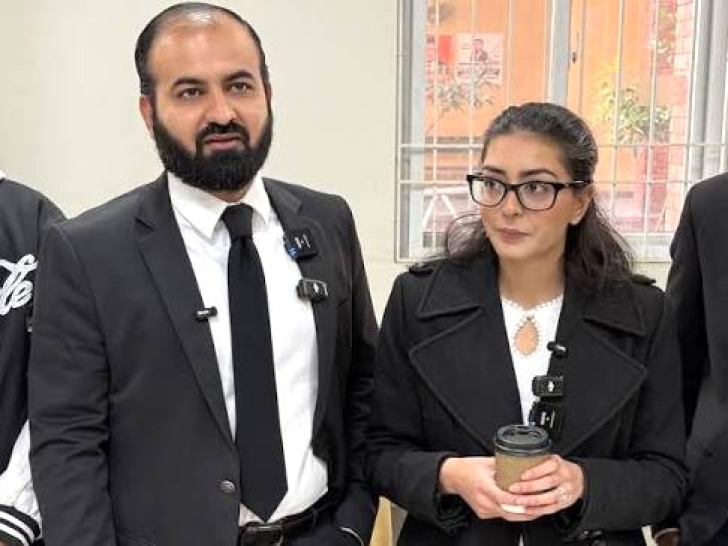
Asserting that the rearrest of two leading human rights attorneys threatens legal defense for victims of religious persecution, 15 international rights organizations on Monday (Sept. 28) demanded the immediate release Imaan Zainab Mazari-Hazir and her husband, Hadi Ali Chattha.
The couple was rearrested on Sept. 17, hours after the Supreme Court ordered their release in a move that the 15 organizations said endangers the ability of lawyers to defend people accused of blasphemy and other victims of persecution without fear of retaliation. The organizations’ joint statement asserted that any continued detention of Mazari-Hazir and Chattha must have a clear legal basis and be subject to rigorous and independent judicial scrutiny.
The case has particular significance for Christians and other religious minorities in Pakistan because Mazari-Hazir and Chattha have represented defendants in high-profile blasphemy cases, including ones motivated by extortion, property conflicts or personal enmity.
The 15 international organizations warned that judicial remedies lose their meaning if a court’s order granting liberty is immediately followed by detention under another proceeding without compelling and independently scrutinized justification.
“The independence of lawyers is an essential component of the right to a fair trial and of the rule of law itself,” the organizations said.
The groups called for all charges against the couple arising from the legitimate exercise of freedom of expression, peaceful assembly, human rights advocacy and lawful professional duties to be dropped. They also demanded authorities disclose the factual and legal basis for the couple’s rearrest and ensure judicial scrutiny of the use of the Anti-Terrorism Act in the latest proceedings.
Mazari-Hazir and Chattha were rearrested only hours after a two-judge Supreme Court bench suspended their convictions in a social media case and granted them bail. Justice Naeem Akhtar Afghan and Justice Ishtiaq Ibrahim granted bail against surety bonds of 200,000 Pakistani rupees (US$720) each, pending the Islamabad High Court’s final decision on their appeals.
Instead of being released, however, the couple were taken into custody in a separate case registered at Kohsar Police Station in Islamabad.
They were produced before an anti-terrorism court later that night. ATC Judge Abul Hasnat Muhammad Zulqarnain rejected a police request for 30 days of physical remand and sent them to jail on judicial remand for 14 days.
The separate case alleges that Mazari-Hazir and Chattha participated in an unlawful assembly, chanted anti-government slogans and blocked roads during a protest. The case was registered in March 2025.
The international organizations said the case was dormant until the couple were about to be released following the Supreme Court ruling. No Anti-Terrorism Act provision was included when the First Information Report (FIR) was registered, while Section 7 of the ATA allegedly was added later by hand, according to the joint statement.
Mazari-Hazir, 32, has represented victims of enforced disappearances, custodial abuse and alleged extrajudicial killings. She and Chattha have also taken on sensitive blasphemy cases, challenging accusations brought against innocent citizens, including Christians, by an organized criminal gang comprising lawyers and officers of the anti-blasphemy unit of the Federal Investigation Agency (FIA).
Such cases can carry enormous risks for lawyers in Pakistan, where accusations of blasphemy can expose defendants, their families and legal representatives to threats and violence.
The international organizations did not limit their concerns to the couple’s case. They called on Pakistan to ensure that lawyers can represent unpopular or politically sensitive clients without being associated with their clients’ causes or subjected to retaliation.
They also demanded full fair trial guarantees for Mazari-Hazir and Chattha, including access to counsel of their choice, adequate time and facilities to prepare their defense, physical presence at proceedings, the ability to challenge prosecution evidence and reasoned judicial decisions.
The groups further called for the lawyers’ safety and dignity while detained, including confidential access to counsel, appropriate medical care, family contact and protection against torture or other ill-treatment.
The international statement follows a separate solidarity effort involving more than 240 Pakistani lawyers, academics and civil society members who condemned the couple’s rearrest. The signatories demanded their immediate release and called for criminal proceedings connected to their legitimate professional activities and exercise of freedom of expression to be dropped.
They also called for protection against arbitrary detention, ill-treatment and intimidation and urged authorities to allow lawyers in Pakistan to perform their professional duties without fear of reprisals.
Among those who joined the campaign were Sen. Farhatullah Babar, former Supreme Court Justice Syed Mansoor Ali Shah, former Senate Human Rights Committee chairman Mustafa Nawaz Khokhar, journalists Hamid Mir, Arifa Noor and Zarrar Khuhro, Supreme Court lawyers Ali Ahmed Kurd and Salahuddin Ahmed, and academic and activist Ammar Ali Jan.
The latest international concern follows a warning issued by five U.N. special experts in December. The U.N. experts, including the special rapporteurs on the independence of judges and lawyers, freedom of opinion and expression, peaceful assembly and association, human rights defenders, and human rights while countering terrorism, raised concerns about the prosecutions of Mazari-Hazir and Chattha.
The U.N. experts said the broader pattern of prosecutions appeared to involve an arbitrary use of the legal system as an instrument of harassment and intimidation in retaliation for the lawyers’ work advocating for alleged victims of human rights violations, according to the civil society organizations.
The couple’s latest detention follows months of imprisonment over a separate social media case. They were initially arrested on Jan. 23 in connection with a case involving a protest outside the Islamabad High Court and allegations that the president of the Islamabad High Court Bar Association had been manhandled.
An Islamabad sessions court sentenced them the following day to a combined 17 years in prison under provisions of the Prevention of Electronic Crimes Act.
Mazari-Hazir received 10 years under Section 10 for cyber terrorism, five years under Section 9 for glorification of an offense and two years under Section 26-A for allegedly disseminating false and fake information. The sentences were ordered to run concurrently.
The case originated from an August 2025 complaint filed by an investigating officer of the National Cyber Crime Investigation Agency in Islamabad. Mazari-Hazir was accused of disseminating and promoting narratives allegedly aligned with hostile terrorist groups and proscribed organizations, while Chattha was accused of reposting some of her social media posts.
The couple denied the allegations and appealed their convictions.
After the Islamabad High Court declined to suspend their sentences, they approached the Supreme Court, which ultimately suspended the convictions and ordered their release on bail on Sept. 17.
Their subsequent rearrest has intensified concerns among Pakistani and international rights advocates over the independence of lawyers and the ability of human rights defenders to represent vulnerable people without fear of prosecution.








