
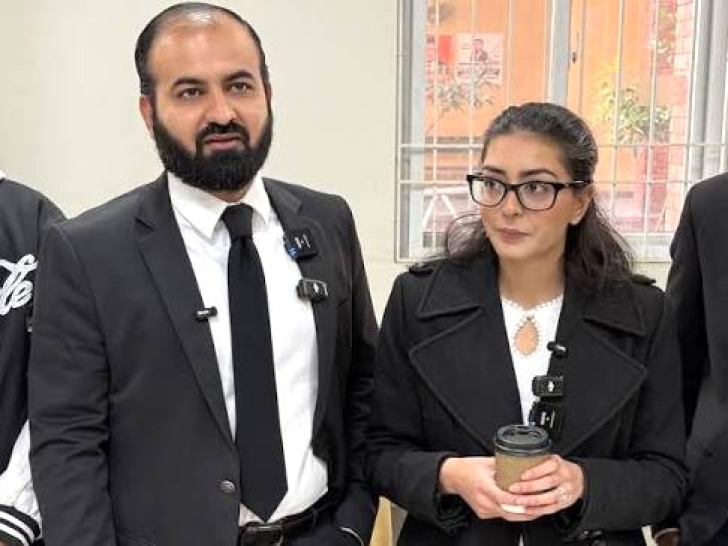
Pakistan’s Supreme Court on Thursday (Sept. 17) suspended the sentences of leading human rights lawyers Imaan Zainab Mazari-Hazir and her husband, Hadi Ali Chattha, ordering their release on bail while their appeals against their convictions continue before the Islamabad High Court.
A two-judge Supreme Court bench comprising Justice Naeem Akhtar Afghan and Justice Ishtiaq Ibrahim heard the couple’s appeals against the Islamabad High Court’s refusal in February to suspend their sentences in the controversial social media case.
The Supreme Court ordered their release on bail against surety bonds of 200,000 Pakistani rupees ($720) each, pending the high court’s final decision.
Christian rights advocates welcomed the ruling, as Chattha has represented Muslims and religious minorities accused under Pakistan’s blasphemy laws. Mazari-Hazir, 32, has represented victims of enforced disappearances, custodial abuse and extrajudicial killings, as well as other human rights cases.
International rights organizations have raised concerns about the prosecution of the couple. The International Commission of Jurists said their arrest and conviction represented an escalation of continued harassment connected to their human rights and professional work. The Clooney Foundation for Justice’s TrialWatch program, which monitored 49 days of the couple’s five-month trial, also raised concerns about their fair trial and freedom of expression rights.
In a communication to the Pakistani government on Feb. 4, U.N. special procedure experts recorded the couple’s contention that the prosecution was intended to harass, intimidate and silence them, including in connection with their representation of more than 50 people accused under Pakistan’s blasphemy laws.
The U.N. experts said the convictions raised concerns because lawyers, like other individuals, are entitled to freedom of expression, and warned that criminalizing protected expression could have a chilling effect on attorneys and human rights defenders.
In several high-profile blasphemy cases, Mazari-Hazir and Chattha have challenged the misuse of blasphemy allegations, including accusations motivated by financial disputes, property claims or personal enmity.
A Christian attorney who has successfully represented several people falsely accused of blasphemy welcomed the Supreme Court’s decision to suspend the couple’s sentences and release them on bail.
“Lawyers who defend Christians and other religious minorities accused under Pakistan’s blasphemy laws are not merely representing individual clients; they are defending the right to a fair trial and the principle that an accusation must be established through due process,” said the attorney, whose name is withheld for security reasons. “When such lawyers themselves face criminal prosecution, it sends a troubling message to others who may be willing to defend vulnerable religious minorities.”
The lawyer said the suspension of the sentences was significant but expressed concern about the broader environment in which lawyers, journalists and human-rights defenders operate when challenging abuses involving blasphemy allegations.
“Christians and other minorities depend on lawyers who are willing to take difficult cases,” the attorney said. “Those lawyers need protection to carry out their professional duties without fear of retaliation.”
Supreme Court Hearing
During Thursday’s hearing, senior counsel Faisal Siddiqui told the Supreme Court that it had already directed the Islamabad High Court on May 12 to decide the couple’s applications for suspension of sentence as expeditiously as possible, preferably within two weeks, according to Dawn newspaper.
That deadline passed without a decision, Siddiqui said, adding that the high court had repeatedly adjourned the matter and that its registrar’s office had rejected requests for an early hearing.
“What transpired at the high court came as a surprise to us,” the report quoted Siddiqui as telling the court, with Justice Ibrahim reportedly remarking, “These days are an era of surprises.”
Siddiqui also read out order sheets from several Islamabad High Court hearings.
Additional Attorney General Rana Asadullah Khan argued that the high court had not issued an adverse ruling and maintained that the high court was the appropriate forum under Section 426 of the Code of Criminal Procedure for suspension of a sentence.
Justice Afghan questioned why the high court continued to cite Supreme Court directives for early disposal of the matter without acting upon them. He asked whether the government could assure the Supreme Court that proceedings would take place at the next high court hearing. Khan replied that he could not give an assurance on behalf of a high court judge.
Justice Afghan also noted that Mazari-Hazir and Chattha were both lawyers and urged them to observe court decorum.
“Both are lawyers, and we are keeping their honor,” he said. “There is a difference between a lawyer and an ordinary person.”
The Supreme Court subsequently suspended the sentences and ordered the couple’s release on bail pending the Islamabad High Court’s final decision.
An Islamabad sessions court on Jan. 24 sentenced Mazari-Hazir and Chattha to a combined 17 years in prison under several provisions of Pakistan’s Prevention of Electronic Crimes Act (PECA). They received 10 years under Section 10 for cyber terrorism, five years under Section 9 for glorification of an offence and two years under Section 26-A for allegedly disseminating false and fake information. The sentences were ordered to run concurrently.
The couple had been arrested the previous day in a separate case relating to a protest outside the Islamabad High Court and alleged manhandling of the president of the Islamabad High Court Bar Association.
The social media case arose from a complaint filed on Aug. 12, 2025, by an investigating officer of the National Cyber Crime Investigation Agency (NCCIA) Islamabad. The complaint accused Mazari-Hazir of disseminating and promoting narratives allegedly aligned with hostile terrorist groups and proscribed organizations. Chattha was accused of reposting some of her social media posts.
According to the First Information Report, the couple had held security forces responsible for cases involving missing persons in Khyber Pakhtunkhwa and Balochistan provinces. It also accused them of portraying the armed forces as ineffective against banned organizations, including the Baloch Liberation Army and Tehreek-i-Taliban Pakistan.
The couple denied the allegations and challenged their convictions before the Islamabad High Court on Feb. 7. When the high court heard their appeals and applications seeking suspension of their sentences on Feb. 19, it issued notices to the respondents but declined to suspend the sentences.
They subsequently approached the Supreme Court on April 30, challenging the high court’s refusal to suspend their sentences. Following Supreme Court intervention, the Islamabad High Court on July 25 declared the couple’s applications seeking suspension of their sentences admissible.
Mazari-Hazir later returned to the Supreme Court seeking an early hearing of the challenge against the high court’s February order.
Thursday’s ruling allows the couple to remain free on bail while their appeals continue before the Islamabad High Court. The Supreme Court’s decision does not amount to an acquittal, and the convictions remain subject to the ongoing appeals process.


