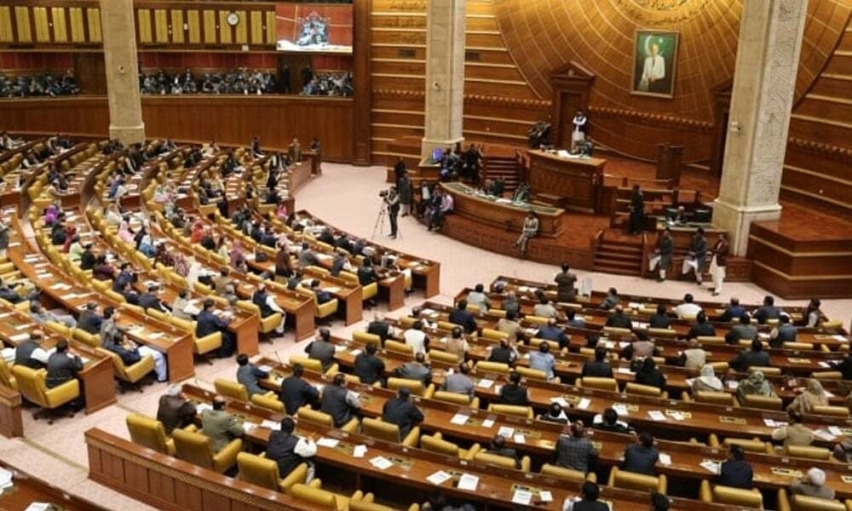
Christian rights activists have welcomed a resolution adopted by the Punjab Provincial Assembly calling for equal opportunities for prisoners from religious minorities to receive religious education, take examinations and qualify for sentence remission.
The resolution, moved by treasury member Raheela Khadim Hussain and adopted by majority vote on Tuesday (Sept. 1), cited Rule 215 of the Punjab Prison Rules 1978, under which prisoners may receive remission in their sentences for acquiring religious education in accordance with the law.
Official data cited in the resolution showed that 2,558 Muslim prisoners benefited from sentence remission after completing religious education between 2020 and 2025. The resolution called for effective implementation of a similar system for prisoners belonging to minority faiths.
It said Christian, Hindu, Sikh and other minority prisoners should be given equal opportunities to study their respective religious curricula, sit examinations and receive sentence remission after successfully completing their studies.
Christian organizations and prison ministries have criticized Pakistan’s religious-education-based remission system, saying that although prison rules provide for minority prisoners to benefit, the provisions have not been implemented effectively.
The Lahore-based Center for Social Justice reported that Punjab granted sentence remission to 1,653 Muslim prisoners for Quranic study between 2022 and 2024, while no minority prisoner received comparable remission during the same period. In Khyber Pakhtunkhwa province, 284 Muslim prisoners received remission between 2023 and 2025, with no recorded beneficiaries from minority communities, according to the organization’s 2025 Human Rights Observer Report.
Safdar Choudhry of the Raah-e-Nijaat prison ministry welcomed the Punjab Assembly resolution, saying minority inclusion was already provided for under prison rules but remained weak in practice.
“A 2008 amendment to the Pakistan Prison Rules expanded the remission framework to include minority religious texts, recognizing that non-Muslim prisoners could qualify for sentence reductions through the study of their sacred scriptures,” Choudhry told Christian Daily International.
He said Punjab’s Law and Parliamentary Affairs Department approved a Bible-based syllabus in 2023 consisting of five units. Under the framework, prisoners can earn remission of between 15 and 60 days per unit over a five-year period, for a maximum of 180 days, he said.
Choudhry expressed hope that the resolution would prompt the prison authorities to address gaps in policy and implementation and ensure that existing provisions are applied equally.
He said the Pakistan Bible Correspondence School had submitted a prison curriculum developed in consultation with the Catholic Church, the Church of Pakistan, Presbyterian churches and the Salvation Army.
“The courses in Urdu language are in a simple format using objective questions and fill-in-the-blank exercises to make them accessible for Christian inmates,” he said. “We hope that the prison authorities will now appoint instructors to teach those courses.”
A significant challenge, however, is illiteracy among a majority of non-Muslim prisoners, Choudhry said.
“Several minority prisoners are illiterate and must first receive basic education before pursuing formal or religious studies,” he said.
A study published in the Journal of Asian Development Studies reported that 1,588 minority prisoners were held in 45 Punjab prisons as of March 2025. Of those, 1,315 were under trial, 232 had been convicted, 34 were unconfirmed condemned prisoners and seven were confirmed death-row inmates.
More recent data from the Punjab Inspectorate of Prisons, through April 2026, recorded 1,075 minority prisoners, including 1,034 Christians, 38 Hindus and three Sikhs.
The June 2025 study said that, with the exception of Punjab, federal and provincial authorities had failed to approve curricula for minority religious education for decades, limiting prisoners’ ability to benefit from provisions allowing sentence remission based on religious education and improved conduct.
“The provinces were sufficiently empowered to make their rules to implement all remedies that were available to the majority of prisoners. Hence, there is no excuse for continued discriminatory attitudes towards minority prisoners,” the study said.
The study also pointed to differences in the remission provisions available to Muslim and minority prisoners.
Punjab’s prison policies provide special remission for Muslim prisoners who regularly perform prayers and observe fasting during Ramadan, in addition to other forms of religious-study-related remission, according to the study.
It said Rule 215(vii) allows prisoners belonging to minority religions, including Hindus, Christians and Sikhs, to qualify for remission by reading and understanding their respective religious texts, including the Bhagavad Gita, Bible and Guru Granth Sahib. They can receive up to six months’ remission, it said.
However, the study noted that special remission for religious observance is available to Muslim prisoners but does not have an equivalent provision for minority prisoners, creating an unequal system of incentives.
In Sindh, the Sindh Prisons and Corrections Service Act 2019 provides various forms of remission related to religious study. The study said Muslim prisoners can receive remission for learning to read the Quran, understanding Islamic teachings and memorizing the Quran, with the potential remission varying according to the level of achievement.
It also noted that Hindu and Christian prisoners may receive three months’ remission for reading the Bhagavad Gita or Bible, respectively, but said there was no structured or approved curriculum for minority prisoners equivalent to that available for Muslim inmates.
In Khyber Pakhtunkhwa, the Prison Rules 2018 provide remission to prisoners who pass examinations on the meanings of the Quran and Islamic fundamentals. The study said non-Muslim prisoners could also sit examinations on their respective holy books and religious fundamentals to qualify for remission.
The rules also provide additional remission for Muslim prisoners who memorize the Quran or learn its translation, as well as special remission linked to regular prayers and fasting during Ramadan, according to the study.
The researchers recommended that prison authorities provide basic literacy education to minority prisoners so they can take advantage of opportunities for formal and religious education.
They also urged prison departments across Pakistan to regularly collect and publish updated data on sentence remission by religious affiliation to monitor equality and identify disparities.
The study further recommended amending provincial prison rules to provide equivalent remission for non-Muslim prisoners who observe their religious practices, including fasting during periods such as Lent for Christians and Navratri for Hindus, and attending regular prayers.
It also called for religious-study-based remission to be made equivalent for prisoners of all faiths, including opportunities to read, memorize and demonstrate an understanding of their respective sacred texts.