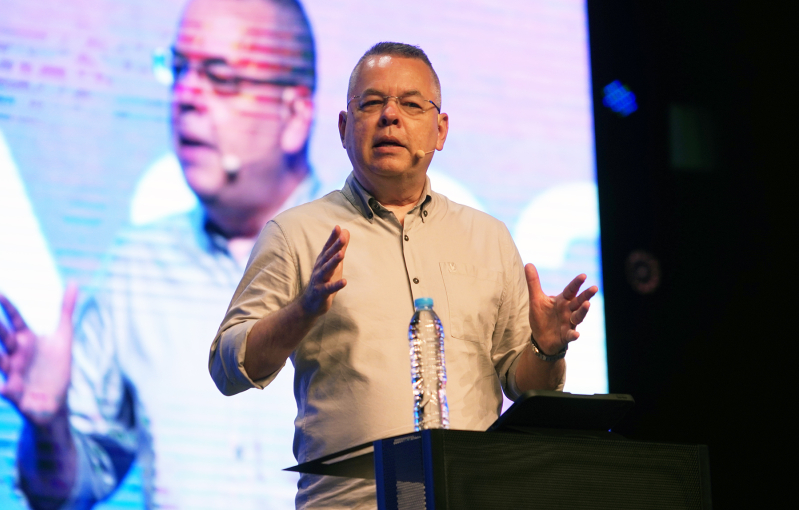
Andrew Brunson spent 23 years planting churches in Turkey. When he was arrested on charges of espionage and terrorism and locked in a Turkish prison for two years, he expected to find God close. What he found instead was silence — and what he did with that silence, he told thousands of delegates at the Arise Asia 2026 Congress in Manila, became the most important test of his life.
Brunson, an American missionary who became the center of an international diplomatic standoff before his release in 2018, addressed delegates during the congress's third day’s evening session on July 29, speaking on what he called the single most important thing a believer can do. It was not, he said, winning converts, acquiring spiritual gifts, or gaining influence. It was love.
A prayer that led to prison
Brunson traced his story back to 2007, nearly two decades before his arrest, when he wrote what he called a "wave starter prayer." He had been working in Turkey, a country he described as the largest unevangelized nation in the world — one where most people have never met a Christian and most cities have no church at all.
"Father God, draw me so close to your heart that you'll be able to trust me with the authority to start waves," he prayed. He wanted, he said, spiritual authority and anointing to move the kingdom of God across that nation. But the prayer went in a direction he had not anticipated.
"God focused me on the first part of that prayer," Brunson said. "He focused me on being drawn close to His heart." For years, he and his wife Norine pursued what he described as a new kind of intentional hunger for God — a practical, daily pursuit rather than an abstract aspiration. "I said, 'God, I don't love you with all my heart, but I want to.' And as I said this again and again, we became hungry for God."
Then came the arrest. Brunson was accused of being a spy and a terrorist. He was held in Turkish prisons for two years, with three life sentences hanging over him.
"I say this prayer took me to prison," he told delegates. "God did not put me in prison — I think that was Satan. But I came to see that God was very involved in my imprisonment, and therefore that it was an assignment from Him."
Breaking badly
What followed, Brunson said, was not the supernatural endurance he had imagined. It was collapse.
"I broke in prison. I broke very badly. I was strong, but I broke — emotionally, physically, mentally. And I went into spiritual crisis with God. I almost didn't make it." He told delegates he nearly did not survive, spiritually or physically. The greatest blow, he said, was not the conditions or the false charges. It was the absence of the one thing he had most pursued.
"When I was put in a solitary cell, I said, 'God, as long as I have your presence, I can do anything.' There went all sense of presence — for two years. I felt like I had been abandoned and left in the dark."
His wife Norine, who had been arrested alongside him for two weeks before her release, refused to leave Turkey. People urged her to go home to the United States and let God take care of her husband. Yet, she stayed.
"She remained there for the entire time I was in prison because she loves me," Brunson said. "She was the only person allowed to visit me. She put herself at personal risk because of her love for me." He held her example up to delegates as a picture of what love, not admiration, actually does. "A lover is willing to suffer for the one she loves. Someone who is just an admirer may not be so willing."
The daily fight
With three life sentences in front of him, Brunson said his mind fixed on one thing: his family. His three children. His wife. His desire to be released consumed him. Reading Paul's letter to the Philippians one day, a verse stopped him: "Everyone looks out for their own interests, not the interest of Jesus Christ."
"I started to cry," he said, "because this was describing me."
He described what became a daily battle — waking each morning gripped by fear and hopelessness, then fighting through the hours to reach a point of surrender. "Eventually I would get there and say, 'God, I cannot embrace being in prison, but I can embrace serving Your purposes. If it will best serve You for me to remain, then I'm willing — but strengthen me, because I cannot do it on my own.'" Then he would find a sliver of peace. Then sleep. Then wake to the same fear.
"What drove me to put God's interests ahead of mine," he said, "was love. Because I love him, I am willing to put his interests ahead of my own."
Worship was harder. For many months his heart was too wounded to sing. He knew the words to "Great Is Your Faithfulness" but could not get them out. His throat would close. He would cry aloud. His wife told him he had to recover this part of his life.
"So I determined: I'm going to worship. Every night I would set aside 30, 45 minutes, sometimes an hour, and I would just sing. Did I feel like it? No. My emotions were in turmoil. But I would sing." That worship, he said, became precious to him in a way he had not expected. "It was my love for God in the dark night of the soul. It was a precious offering to him."
In his second year, he added something stranger still. He decided to dance. Five minutes a day, alone in his cell. He would recite the words from Matthew 5 — "Blessed are you when people persecute you and falsely say all kinds of evil against you on my account. Rejoice and be glad" — and he would leap.
"I'm not feeling any joy. But Jesus commanded me to rejoice. If you love me, you will obey my commandments. He has commanded me to rejoice when I'm persecuted. Therefore I dance, because I love him." Other prisoners, he said, watched through the cell and assumed he had gone mad.
A cry in the dark
Eighteen months into his imprisonment, Turkish authorities moved him to a different prison for his trial — back to the place where he had first broken. The return triggered the same trauma. On the first day of his trial, after not eating or sleeping for two days and after 13 hours of what he called false testimony, he was returned to his solitary cell alone, crying.
"I'm thinking: where are You, God? Why have You not intervened for me? Why are You so far away? Why are You so silent?"
Then he heard himself speak. Not a prayer he had composed or a verse he had rehearsed. Something that rose from somewhere deeper.
"I love you, Jesus. I love you, Jesus. I love you, Jesus."
He paused as he told it. "I realized — this is victory for me. This is what victory looks like in this place. Yes, I do love you. Even if you're silent, I love you. Even if you allow my enemies to hurt me, I love you. Even if you don't give me your presence, I still love you."
He had passed the test, he said — the test of silence, of abandonment, of brokenness, of doubts. He drew a comparison to Abraham raising the knife over Isaac: God may have known Abraham would obey, but until Abraham's arm moved, Abraham did not know. "It was important for Abraham to see. And it was important for me to go through that testing and say: yes, I still love. I am still faithful, even when I am broken."
What only suffering can give
After his release, Brunson said he asked God where His presence had been during those two years. The answer, he said, surprised him.
"God said, 'Andrew, I was answering your wave starter prayer throughout your imprisonment.'"
He had assumed that drawing close to God's heart meant experiencing God's presence. But, he told delegates, those are not the same thing. "Every time I experienced a hardship that Jesus did — insults, lies, betrayal, forgiving enemies, even feeling abandoned by God — and reacted the way that Jesus did, this brought my heart into more overlap with his." He shared in Christ's suffering. And that, he said, deepened a friendship.
"There are things Jesus and I don't have to talk about because we understand each other," Brunson said. "There is a side of Jesus that we cannot know apart from tasting suffering."
He closed with a word about what he now misses from those years — not the prison, not the isolation, but the desperation with which he ran after God. "I had an unusual clarity about what is most important in life. Now I'm free. I don't have the same pressures. I'm also not running after God in the same way."
He asked delegates to consider a life of missions and to count the cost. Then he invited those with a stirring in their hearts to pray the same prayer he prayed nearly 20 years ago — the one he credits with starting everything, including his imprisonment.
"He will take you seriously," Brunson told them. "He will draw you toward his heart. And it will involve difficulties. But if you make this your priority, everything else in your life will come into the right alignment."
Follow Christian Daily International's full reporting on Arise Asia 2026.