

For nearly eight decades, Urbana has stood as one of the most influential missions gatherings in North American evangelicalism, inspiring generations of young Christians to consider their role in taking the gospel to the ends of the earth. But as Christianity’s center of gravity continues shifting toward the Global South, the triennial event grappled with the question: what does mission look like in a world where leadership is no longer primarily Western?
That challenge was central to Urbana 25, the most recent gathering held for the first time in Phoenix, Arizona, from Dec. 28-31, 2025, which drew 7,000 college students ages 17 to 28 and their mentors. Organizers sought to frame the conference not simply as a recruitment platform for missionaries but as a place where a new generation could rethink how they participate in God’s global mission.
According to conference director Mark Matlock, the challenge facing North American Christians today is not simply finding new strategies for mission but adopting a fundamentally different posture toward the global Church.
“I would really love to see North Americans seeing themselves more as equals to their brothers and sisters globally,” Matlock said in an interview with Christian Daily International following the event. “Instead of feeling like we have the money, the power, the ideas, we truly become partners.”
That vision reflects a broader shift in global evangelical thinking: mission is increasingly understood as polycentric, meaning that leadership, innovation and initiative emerge from many parts of the global Church rather than flowing outward from a single Western center.
A historic gathering at a crossroads
Founded in 1946 by InterVarsity, Urbana emerged in the aftermath of World War II during a period of renewed global vision among Protestant Christians. The conferences became a defining moment for thousands of university students discerning a call to overseas missions.
For decades, the model was relatively straightforward. Young North Americans gathered to hear about global needs, meet mission agencies and consider serving abroad. Yet the global context that shaped Urbana’s early years has changed dramatically.
The world population has more than tripled since the conference began, and the global Church has expanded rapidly across Africa, Asia and Latin America. Today the majority of the world’s Christians live outside the West, creating new realities for how mission is understood and practiced.
Over the past decade, Matlock said, Urbana itself has wrestled with how to respond to those changes.
“As the world was changing, I think Urbana was struggling to find its voice,” he said. “What do we do with the majority Church being in the Global South? With so many changes happening in the world and with young people concerned about social issues, Urbana was trying to understand what its role should be.”
Rather than abandoning its historic mission focus, organizers sought to reinterpret it for a new era.
Urbana 2025, Matlock said, represented a turning point—an attempt to clarify how North American Christians can engage in global mission when leadership is increasingly shared across cultures.
A conference reimagined
Historically, missions conferences often focused on identifying specific needs overseas and recruiting individuals to fill them. But Matlock believes that model alone no longer fits the realities of the modern Church.
At Urbana 2025, organizers attempted to reshape the conference into what he calls a “pilgrimage formational event,” where students explore their role in God’s mission rather than simply signing up for a particular ministry path.
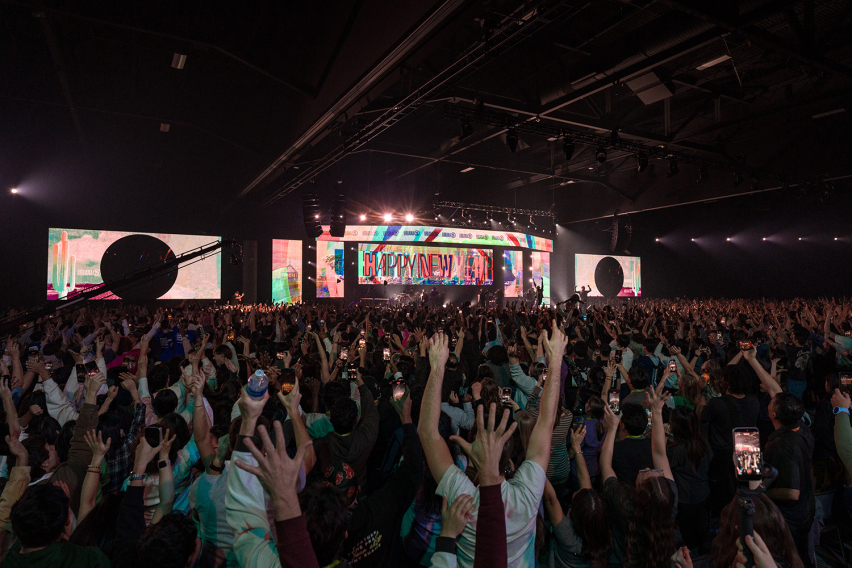
As Matlock studied Urbana’s history and listened to testimonies from previous participants, he realized the conference had always functioned in that deeper way, even if it was not always described that way.
“It really was a pilgrimage formational type of event,” he said. “We designed Urbana intentionally to be that—a pilgrimage for young people trying to find their place in God’s mission.”
Instead of prescribing answers, the conference focused on helping students wrestle with three enduring questions: What is God doing in the world? What is God saying through Scripture? And what is God asking me to do about it?
Matlock believes the strength of Urbana has historically been its ability to create a space where young Christians can explore those questions in community.
“I think when Urbana has been at its best, it has helped a generation answer those questions,” he said.
Five global shifts reshaping mission
One reason the conference has been forced to rethink its approach is the scale of global change.
When Urbana began in 1946, the world population was roughly 2.5 billion. Today it exceeds 8 billion. But demographic change is only one part of a much larger transformation.
In preparing for Urbana 2025, Matlock and his team identified several major global shifts that are reshaping how mission is practiced.
The first is the growth of the “majority-world Church.” Christianity is expanding rapidly in Africa, Asia and parts of Latin America, while many Western churches experience stagnation or decline.
“That’s a huge shift,” Matlock said, noting that its full implications are still unfolding.
Second, the landscape of education is changing. Traditional models of theological training—once tied closely to universities and seminaries—are being disrupted by new forms of learning that allow people to access training from many sources.
Third, Bible translation has dramatically expanded access to Scripture. Portions or full translations of the Bible now exist in many more languages, enabling churches to engage Scripture directly without relying primarily on foreign teachers. “People can self-theologize now,” he said.
Fourth, global urbanization is reshaping societies. As populations concentrate in cities, mission fields increasingly overlap with economic and cultural centers.
Finally, the emergence of Gen Z represents a generational shift unlike any before it.
“This generation has grown up in a hyper-connected world,” Matlock said. “They’re not just a digital generation. They experience presence and interaction in ways that previous generations never did.”
Research suggests that Gen Z believers often feel greater cultural affinity with peers in other countries than with older generations in their own nations, creating new possibilities for global collaboration.

From sending to partnership
These changes have significant implications for how mission is understood.
For much of the 20th century, mission often involved sending workers from the West to other regions where Christianity was less established. While that dynamic still exists in some contexts, many global Christian leaders now emphasize mutual partnership rather than one-directional sending.
Matlock believes North American Christians must adapt their mindset to reflect that reality.
One way he has articulated this shift is through a framework he calls the “five postures of a global Christian,” which encourages believers in North America to see themselves as participants in a worldwide body of Christ rather than as leaders directing its activity.
“It’s really about helping young people become a global Christian,” he said. “Not thinking, ‘We need to go save the lost in these other countries,’ but asking, ‘How do I show up as a Christian in the global body of Christ?’”
The concept aligns with discussions emerging from global evangelical networks such as the Lausanne Movement, where the term “polycentrism” has become a common description of modern mission dynamics.
In a polycentric movement, no single region controls the direction of global mission. Instead, leadership and innovation emerge from many contexts simultaneously.
For North American churches, Matlock said, that reality may require significant adjustment.
“Because North America has so many resources, it requires a different posture,” he said. “The global Church is already on the move, but the North American Church really has to reframe itself.”
Igniting imagination rather than filling roles
Another shift reflected in Urbana 2025 was a move away from treating missions primarily as a set of predetermined roles to be filled.
Instead, organizers encouraged students to imagine new forms of engagement shaped by the realities of their generation.
The conference theme, “Imaginations,” played on the words “imagine” and “nation,” emphasizing the idea that God may be inviting young Christians to think creatively about how they participate in global mission.

“The traditional way of thinking about how we fulfill the Great Commission is probably not the path for the next 20 to 30 years,” Matlock said.
Some participants may still sense a call to traditional missionary service. Others may pursue careers in business, education, technology or other fields while maintaining a global perspective on their faith.
For many students, Matlock said, the most significant impact of Urbana may not be immediate.
“I don’t think Urbana fully realized itself until nine to 12 months after I left,” he said, reflecting on his own experience attending the conference as a university student decades earlier.
The long arc of influence
Matlock’s personal story illustrates the conference’s long-term influence.
He first attended Urbana in 1990 while studying at Biola University. At the time he planned to pursue missionary service as an anthropological consultant with Wycliffe Bible Translators.
But the experience prompted him to reconsider his plans.
“I realized that God was saying, ‘You decided to be a missionary, but you didn’t ask me what I wanted you to do,’” he recalled.
Instead of entering overseas missions immediately, Matlock moved into youth ministry and eventually spent decades organizing large discipleship events.
Years later, when he was unexpectedly approached about directing Urbana, he recognized how the experience had shaped his life.
Standing before thousands of students at the conference, he said he expected that many future leaders were sitting in the audience, just as he once had.
A vision for the next decade
Looking ahead, Matlock hopes Urbana will contribute to a deeper sense of partnership within the global Church.
His vision is not simply that more North Americans will become missionaries, but that relationships between churches across continents will grow more reciprocal and collaborative.
“I’d love to see us breathing in from the global Church,” he said, as Christians in North America learn from the experiences and perspectives of believers in other cultural contexts.
At the same time, he hopes the global Church will continue making progress in reaching communities that still have little access to the Christian message.
“I’d love to see us close the gap on the number of people who are unreached,” Matlock said.
Imagining Urbana’s future
As Urbana looks to the future, discussions continue about the most suitable format to fulfill its vision. Historically the conference has been held every three years, but organizers are exploring whether it might evolve into a broader movement supporting discipleship and mission engagement throughout the year.
“Should it be an event every three years, or should it be more of a movement?” Matlock asked.
It reflects a broader reality facing events and organizations in the digital age: structures shaped in an earlier era must be reevaluated in light of a rapidly changing world.
For Matlock, however, the core purpose of Urbana remains unchanged.
It is a place where young Christians step back from the routines of daily life, listen for God’s direction and imagine how their lives might contribute to the fulfillment of the Great Commission.








