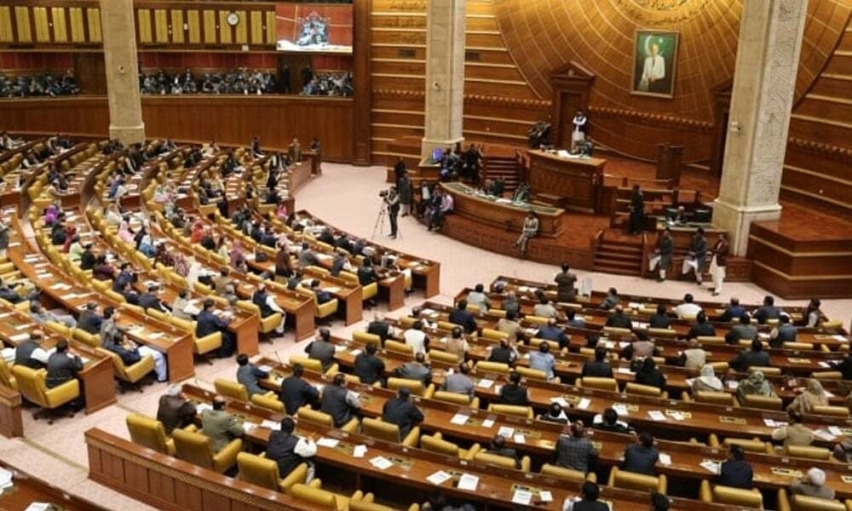
A Punjab Assembly committee has unanimously approved legislation to replace Pakistan’s over 150-year-old Christian marriage law, raising the minimum marriage age to 18 for both men and women and introducing mandatory registration of Christian marriages with the National Database and Registration Authority (NADRA) and local union councils.
The Standing Committee on Human Rights and Minority Affairs approved the Christian Marriage Bill 2026 on Wednesday (Sept. 30), sending it to the Punjab Assembly for vote. The bill seeks to repeal and replace the colonial-era Christian Marriage Act of 1872 with a new framework governing the solemnization, documentation and registration of Christian marriages in the province.
The proposed legislation would standardize the minimum marriage age at 18, replacing provisions under the existing law that allow Christian boys to marry at 16 and girls at 13. Christian Member of the Punjab Assembly Falbous Christopher, who introduced the bill, said raising the age for both genders would strengthen protection against child marriage and ensure that marriages are entered into with genuine consent.
The legislation also seeks to address a longstanding documentation problem for Christian families by making registration with both the relevant union council and NADRA compulsory. Christian marriages currently do not have a comparable registration mechanism under the 1872 law.
Christopher told the committee that the legislation is intended to consolidate and modernize Christian personal law while protecting individual rights and consent. The bill was originally submitted to the committee in April.
Written notice, church announcements and two witnesses required
Under the proposed law, both parties entering a marriage under the Christian Marriage Act would have to be Christian. Authorized pastors and ministers of churches registered with the Punjab government, along with government-appointed marriage registrars, would be empowered to solemnize marriages according to Christian rites.
The bill establishes a formal process before a marriage can take place. Couples would be required to submit basic information and provide prior written notice of their intention to marry. Where a licensed Christian minister solemnizes the marriage, the intended union would also have to be publicly announced in the church for three consecutive weeks.
At least two witnesses would have to be present at the wedding and sign the official marriage record. Marriage certificates and records would then be submitted to the relevant government authorities for registration.
The proposed legislation would also remove restrictions contained in the old law concerning particular days or times on which Christian marriages could be solemnized.
Another provision would give an intending couple the right to approach a civil court if a government-appointed marriage registrar refuses to issue a marriage certificate.
The registration provisions are particularly significant for Christian families whose marriages have faced difficulties in obtaining official documentation.
Activists welcome age change but question absence of divorce reform
While human rights activists and Christian legal experts have welcomed the proposed increase in the marriage age, some have expressed concern that the legislation addresses marriage without comprehensively reforming the Christian divorce law.
Human rights activist Nabila Feroz Bhatti welcomed the proposed 18-year minimum age, saying it would bring the law more closely into line with protections against child marriage and principles of free consent.
She questioned, however, why divorce reform had again been left outside the proposed legislation. According to Bhatti, disagreement among Christian religious leaders over the grounds for divorce has contributed to the issue being excluded from the current reform effort.
“Christian women should be able to seek divorce without being required to make allegations of adultery that are untrue. Section 7 of the Christian Divorce Act, 1869, which historically provided a ground for divorce on ordinary grounds before the provision was removed through a 1981 ordinance during General Zia Ul Haq’s military rule. The provision was restored by the Lahore High Court in 2017,” Bhatti told Christian Daily International.
She said the continued reliance on allegations of adultery in some Christian divorce proceedings places women in a difficult position. “Church leaders and other stakeholders should address the issue as part of broader Christian personal law reform,” Bhatti added.
Attorney proposes wider grounds for ending a Christian marriage
Christian attorney Lazar Allah Rakha also welcomed the proposed changes to Christian marriage law but said that reform should not stop there.
“Necessary amendments are also required in the Christian Divorce Act, 1869, particularly Section 10, as it is a law dating back to the British colonial period and does not adequately address the issues and needs of Christian families in the present day,” Rakha told Christian Daily International.
Rakha said Section 10 should be amended to provide fair and practical grounds for ending a marriage in circumstances recognized by modern family law.
“The law should provide reasonable grounds on which a marriage may be dissolved through divorce, taking into account the realities faced by Christian families today,” he said.
He pointed to the legal restrictions currently faced by Christian husbands seeking divorce, and said a comprehensive reform should address a broader range of circumstances affecting married couples.
Among the grounds the senior attorney proposed were adultery, prolonged and unjustified separation, physical or emotional cruelty, domestic violence, failure to provide family maintenance, persistent neglect of marital responsibilities and other circumstances in which continuation of a marriage becomes untenable.
Similar bill in Sindh draws objections from major churches
The Punjab legislation also comes amid a wider debate over whether Christian family law should be reformed through separate provincial legislation or through a uniform national framework.
A similar controversy has emerged in Sindh province, where Deputy Speaker Anthony Naveed introduced the Christian Family Laws Bill 2026 in the Sindh Assembly on Sept. 8, as previously reported by Christian Daily International.
The Sindh bill proposes to raise the minimum marriage age for Christian men and women to 18 and would replace the colonial-era Christian Marriage Act of 1872 and Christian Divorce Act of 1869 in the province. It also covers matters including marriage registration, divorce, judicial separation, maintenance, remarriage and custody of children.
However, the proposed Sindh legislation has faced objections from major Christian denominations over the extent of consultation and claims that church representatives had consented to the bill.
The Catholic Archdiocese of Karachi said participation by Catholic representatives in consultations did not amount to approval or endorsement and said it had submitted substantive constitutional, legal and ecclesiastical objections. Bishop Frederick John of the Church of Pakistan likewise rejected suggestions that he had formally consented to the legislation.
The Punjab bill now awaits consideration by the provincial assembly. It would not become law unless passed by the assembly and enacted through the required legislative process.
Its passage would also bring the statutory minimum marriage age for Christian men and women into line with the 18-year threshold that has increasingly become a focus of child marriage reform in Pakistan.