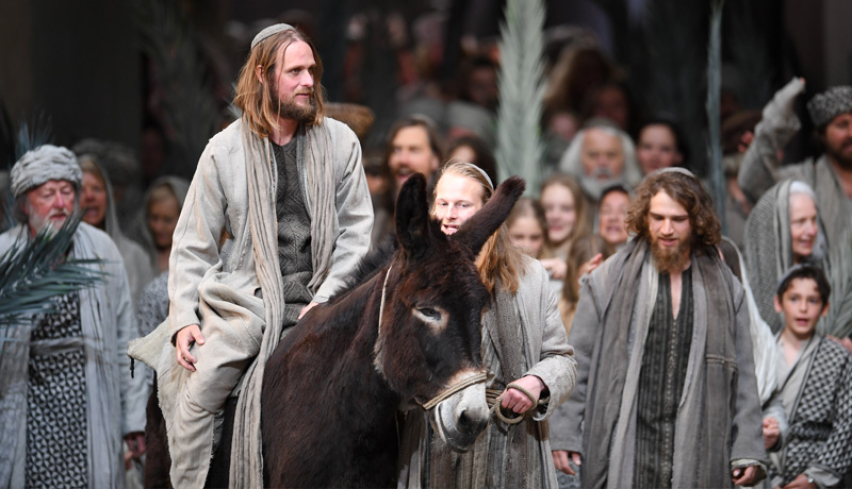
I write this with Palm Sunday immediately in view, the day on which we remember Jesus’ entry into Jerusalem a few days before his trial and crucifixion. As a child, Palm Sunday was always important for me as it marked the start of the Easter school vacation. At Sunday school, the children would parade into the service waving willow branches as a cold climate replacement for palm leaves—I always found this extremely embarrassing.
The story of Palm Sunday has been a familiar one for as long as I can remember. Jesus sent his disciples to find a foal which he then road into Jerusalem as people strewed palm branches on the road and shouted hosanna.
The picture is a joyful happy one which is captured in the traditional name “the triumphal entry” and is all the more poignant as just five days later, Jesus was hung on a cross at the insistence of another crowd baying for blood.
I’ve often wondered whether some of the crowd on Palm Sunday were also there on Good Friday. I think that some of the events of Easter Week could point to why a good many people would change their opinion of Jesus—but that’s a story for another day.
I’ve learned to read (the Gospels) in the social and political context of the times.
Over the last few years, my understanding and appreciation of the Gospels has grown as I’ve learned to read them in the social and political context of the times. The stories of Jesus are not abstract events that could have happened anywhere at any time; as I have noted previously on my Substack, they are firmly rooted in history and must be understood in that way.
The first thing to note about Jesus’ entry into Jerusalem is that the Gospel writers seem to have seen it as extremely important as it is one of the few events which occurs in all four Gospels—compare that to the Christmas story which neither Mark nor John mention as such.
There is more to this event than just a prologue to Easter. If you want to read the passages they occur in Matthew 21, Mark 11, Luke 19 and John 12.
The narrative opens with Jesus and his disciples arriving at Bethphage which is about an hour’s walk from Jerusalem. Their Jesus sent two of his disciples on ahead of him, with instructions to bring back a young donkey, which they will find tied up with its mother. He told them that if they were questioned they should simply respond that their master needed the colt and that it would be given to them.
Jesus had notified the donkeys’ owner that on that particular day he would need the colt.
Again, in my youth, this was often presented as a miracle; Jesus miraculously knew where the two donkeys would be and what words were needed to get hold of them. However, I’m convinced that what actually happened is that Jesus had notified the donkeys’ owner that on that particular day he would need the colt and so he wasn’t surprised when the disciples turned up asking for it. (I’ll touch on why I think this was a planned event below.)
When the disciples brought the colt to Jesus, they placed some cloaks on its back and then Jesus road into the city with the crowds cheering him. Matthew 21 tells us:
This took place to fulfill the prophecy that said, “Tell the people of Jerusalem, ‘Look, your King is coming to you. He is humble, riding on a donkey—riding on a donkey’s colt.’” (Matthew 21:4,5)
The prophecy comes from Zechariah 9:9 and this marks the first reason that I see Jesus actions as being planned. Jesus knew his Old Testament extremely well; he would have memorized huge chunks of it. This might be an obscure passage to most Christians, but Jesus would have been very familiar with it—especially in an age where people were talking about a coming Messiah.
He knew exactly what he was doing and he knew how people would see it.
It’s not so much that he did something that people at some later point realized fulfilled a prophecy; no, he deliberately set out to fulfill it. He knew exactly what he was doing and he knew how people would see it. This is a very deliberate claim to some sort of kingship—which is reflected in the chants from the crowd.
“Blessed is the King who comes in the name of the Lord! Peace in heaven and glory in the highest!” (Luke 19:38)
As Jesus rode into the city, everyone who watched (and Jesus, himself) would have been reminded of a Roman triumph. Commenting on Palm Sunday last year, I wrote:
A triumph was the highest honor awarded to a Roman general. Having fought a successful campaign overseas, a general might be given the privilege of parading through the streets of Rome with his legions and line upon line of vanquished people and slaves.
A triumph was a great holiday for the people of the city of Rome and a clear sign of which generals were “on the up” in political terms. Triumphal parades were held across the empire whenever a city or region was captured or subdued, though these couldn’t compare with the huge events in Rome.
Jesus was staging his own version of a triumph.
In a provincial backwater, riding on a young donkey, Jesus was imitating and subverting, the biggest displays of power that the greatest empire in the world could stage. I’m sure that there would have been a few voices in the crowd mocking Jesus, asking who exactly he thought he was, while others would have loved the way that he ridiculed Roman pretensions. In any case, Jesus was staging his own version of a triumph—and this is the other reason that I believe that this was planned in advance.
However, this was a rather bizarre triumph. Rather than riding proud on a powerful warhorse, Jesus was perched on the rear of a young donkey. We don’t ride on donkeys much in my part of the world, but the technique is different to being on a horse.
A donkey—especially a young one—is more fragile than a horse and sitting on its back is dangerous. The rider actually has to sit right at the rear, on the animal’s buttocks directly above the rear legs. It looks nothing like the stately progress of a great man on a charger.
His kingship isn’t rooted in demonstrations of military or political power, but in humility and self sacrifice.
This is a deliberate demonstration of what sort of king Jesus is. His kingship isn’t rooted in demonstrations of military or political power, but in humility and self sacrifice. He was riding into Jerusalem to face death on a cross, not a life of luxury while he ordered people around.
Jesus' ride into Jerusalem mocked the Roman emperor and his minions in Judea and it stands in marked contrast to the pride of “Christian” nationalists in our day—those who would use the name of Jesus to promote one nation over others, whether they are dressed in Union Jacks, or MAGA hats have not understood the nature of Jesus’ kingship. Theirs is a Christianity without a cross, without shame, and ultimately, without a resurrection.
Luke’s Gospel mentions one more display of Jesus strange, inverted kingship which is worth pondering on:
"And when he drew near and saw the city, he wept over it, saying, 'Would that you, even you, had known on this day the things that make for peace! But now they are hidden from your eyes. For the days will come upon you, when your enemies will set up a barricade around you and surround you and hem you in on every side and tear you down to the ground, you and your children within you. And they will not leave one stone upon another in you, because you did not know the time of your visitation.'” (Luke 19:41-44)
He doesn’t condemn them, he doesn’t curse them as his enemies.
Jesus looks at the city and he weeps for its people. In the city are the Jewish leaders who will plot to have him killed, there is the crowd who will bay for his blood, the corrupt Roman authorities who will permit his illegal execution and the soldiers who will nail him to a cross; and Jesus weeps for them. He doesn’t condemn them, he doesn’t curse them as his enemies, he weeps and he regrets the choices that they have made.
It is saddening to compare Jesus’ attitude with the US Secretary of Defense at the recent Pentagon worship service...
“Let every round find its mark against the enemies of righteousness and our great nation. Give them wisdom in every decision, endurance for the trial ahead, unbreakable unity, and overwhelming violence of action against those who deserve no mercy.”
From the days of Constantine, through the Holy Roman Empire, the Crusades, the Spanish Conquistadors, the British Empire, on to today’s Christian Nationalists, there have always been people who would cloak their bid for power and greed in the name of the Christian faith.
That is not our calling. We are to join with a young man, riding on a donkey, weeping over those that would kill him and making a mockery of military and political power.
Originally published on Dr Eddie Arthur's Living in the Venn Diagram Substack. Republished with permission.
Dr Eddie Arthur has been a member of Wycliffe Bible Translators for over thirty years. For twelve years he and his wife Sue lived in Ivory Coast where they were part of the team translating the scriptures for the Kouya people. He is now based in the UK where he researches, writes, and talks about the future of global missions and provides contextual perspectives on societal change. Eddie's more recent writing can be found on his Substack "Living in the Venn Diagram".