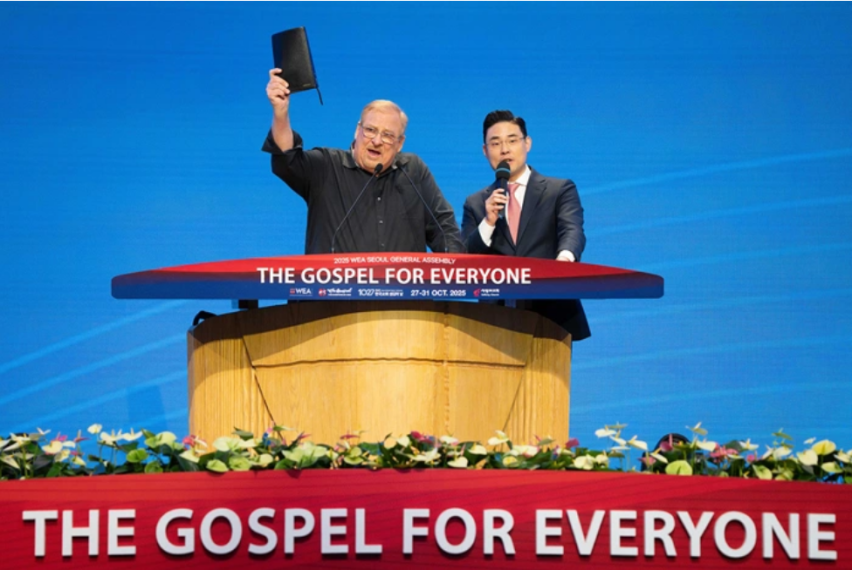
Global evangelical leaders should move beyond conferences and slogans toward practical collaboration if the goal of sharing the gospel with every person by 2033 is to become reality, pastor and author Rev. Rick Warren said during an online interview hosted by the World Evangelical Alliance.
Speaking to church leaders from multiple regions during the March 12 conversation, Warren warned that the initiative often described as “the gospel for everyone by 2033” risks remaining symbolic unless churches coordinate more intentionally in evangelism and mission.
“One of my greatest fears is that the phrase ‘the gospel for everyone by 2033’ will be just a slogan and literally nothing more,” Warren said during the event. “We’ll hold up banners, we’ll clap, we’ll applaud, we’ll sing about it—but it doesn’t actually get done.
The timeline refers to the year 2033, which many evangelical leaders note will mark 2,000 years since the resurrection of Jesus Christ. Some mission networks and church coalitions have adopted the date as a symbolic milestone for expanding global evangelization.
Warren said the target is not tied to predictions about the end of the world but serves as a practical deadline that can help mobilize churches and mission organizations around a shared objective.
“Having a date makes you work faster,” he said. “It gives you a goal.”
A milestone for global evangelization
According to Warren, the year 2033 will represent the 2,000th anniversary of several foundational events in Christian history, including the crucifixion and resurrection of Jesus, the giving of the Great Commission and the founding of the church at Pentecost.
He suggested that churches could mark the anniversary by ensuring that every person has had an opportunity to hear the Christian message.
“The greatest gift we can give to Jesus on the 2000th anniversary of the church is to make sure that everybody by that time has heard the gospel in some way,” Warren said.
Evangelical leaders involved in global mission efforts have increasingly used the 2033 timeframe to frame collaboration between denominations, mission agencies and local congregations.
Warren emphasized that the goal is not that every person will become a Christian but that everyone should have the opportunity to hear the message.
“We’re not responsible for people’s response,” he said. “But we are responsible for sharing the good news so that everyone has the opportunity.”
Unity seen as critical for global mission
A central theme of Warren’s remarks was the importance of unity among Christians as a condition for advancing global evangelization.
He cited Jesus’ prayer for unity among believers in the Gospel of John as a theological foundation for cooperation among churches and ministries.
“Unity is not uniformity,” Warren said. “The only way we will ever have unity is to love variety.”
Warren argued that differences in culture, worship style and church tradition should not prevent cooperation in mission.
“If the whole church looked, smelled, talked, acted and sang the same way, we wouldn’t reach a lot of people,” he said. “It takes all kinds of churches to reach all kinds of people.”
During the interview, Warren outlined multiple reasons he believes unity is essential for the church, including strengthening evangelistic witness, fostering spiritual growth and protecting churches from internal division.
He also pointed to Jesus’ prayer recorded in John 17, where Christ asked that believers would be united so that the world would believe the Christian message.
“The purpose of unity is evangelism,” Warren said. “May they be one so that the world may believe.”
Moving beyond conferences
Warren also challenged church leaders to rethink how collaboration works in practice.
He described three levels of cooperation among Christian organizations: networking, cooperation and collaboration.
Networking, he said, occurs when leaders gather at conferences to exchange ideas before returning home without further joint action. Cooperation typically involves working together for a single event.
Collaboration, by contrast, requires sustained joint strategy and shared responsibility for reaching communities.
“Collaboration means you sit down with the people around you and get out a map of your city,” Warren said. “Who’s going to reach that group? Who’s going to climb that mountain? Who’s going to work with that neighborhood?”
He encouraged churches to develop local partnerships aimed at reaching entire cities or regions rather than operating independently.
As an example, Warren pointed to a coalition of churches in Tijuana, Mexico, that began with a small group of pastors meeting to discuss how to share the gospel with the city’s population. The effort eventually expanded to hundreds of congregations working together to reach residents.
Technology reshaping mission work
Another major factor shaping global evangelization, Warren said, is the rise of digital technology.
Unlike earlier generations of missionaries who faced significant travel limitations, Christians today can communicate across continents instantly through online platforms.
“You don’t have to even get on a plane to share the gospel in another country,” Warren said. “You can do it through technology.” 
He suggested that the internet may represent a turning point similar to earlier technological developments such as the printing press, which helped spread the Bible during the Protestant Reformation.
“Every time God has given us a new technology, we’ve had revival and growth in the Christian church,” Warren said. 
Debate over numbers and evangelism
During the conversation, Warren also addressed criticism sometimes directed at evangelical movements that emphasize numerical growth.
He argued that counting conversions or church attendance should not be seen as a focus on statistics but as a way of recognizing the value of individuals.
“We count people because people count,” he said. “Every number represents a name, and every name represents a soul.”
Warren, who founded Saddleback Church in California in 1980 and later helped launch global mission initiatives, said tracking participation can help churches identify people who may still need pastoral care or outreach.
Local churches in a global mission
Despite his emphasis on global cooperation, Warren stressed that international mission begins with local action.
Pastors and church leaders who cannot travel widely can still contribute through prayer, partnership and digital communication, he said.
“You don’t have to travel to a country to care about it, pray about it and work for its evangelization,” Warren said. 
He also encouraged churches to form alliances across denominational lines to coordinate outreach in their communities.
In many cases, he said, churches with different traditions can complement one another’s strengths in reaching diverse populations.
“We’re not in competition,” Warren said. “It takes all kinds of churches to reach all kinds of people.” 
A seven-year window
With roughly seven years remaining until 2033, Warren said the coming period represents an opportunity for churches to intensify collaboration and outreach.
The scale of the challenge remains significant, with many communities and people groups still lacking access to Christian teaching in their own language or cultural context.
But Warren suggested that the growing interconnectedness of the global church may make broader cooperation more possible than in previous generations.
“If we mobilize the whole church,” he said, “we can do far more together than any single organization or denomination could ever do alone.”