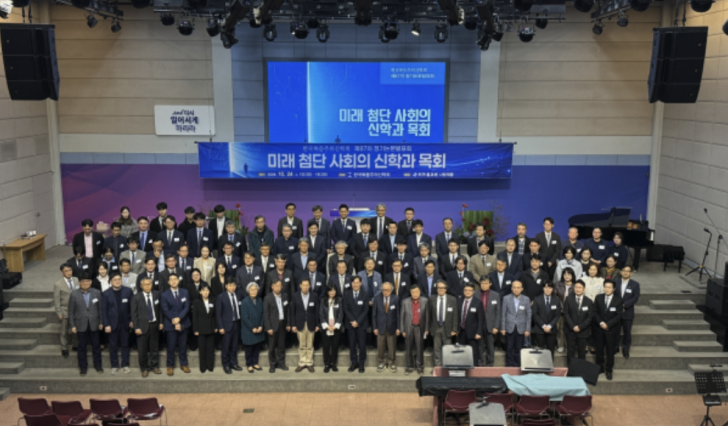
Artificial intelligence and new brain technologies are changing how people think and make moral decisions, and churches should respond with embodied community and a renewed account of human worth, two South Korean scholars told a gathering of evangelical theologians Saturday.
Shin Kuk-won, professor emeritus at Chongshin University, and Eom Ju-hee, a professor at Konkuk University, gave the main lectures at the Korea Evangelical Theological Society's 87th regular paper presentation in Seoul, Christian Daily Korea reported. The meeting's theme was "Theology and Ministry in a Future High-Tech Society."
Shin approached the subject through the theology of technology, while Eom drew on neurolaw and theological ethics. Both argued that AI, brain-computer interfaces and biotechnology raise questions that reach past industry and economics to the nature of the human person and the practice of ministry.
Technology as environment
In his keynote, Shin said modern technology no longer works simply as a tool. It has become a system that shapes how people think and see the world, he argued.
A hammer or a pair of glasses extends physical ability, Shin said, but AI takes over mental work such as memory and reasoning. By hiding complex processes and delivering only finished results, such devices can weaken people's capacity to think and judge for themselves.
"AI can analyze the Bible and write sermons, but it cannot obey that Word, nor can it understand or be moved as a person is," Shin said. "It can generate eloquent prayers, but it cannot communicate and have fellowship with God."
He warned that automated technology could carry dehumanization into the life of faith. Scripture, he said, treats human limitation as part of being a creature, something that draws people to depend on God rather than a flaw to be engineered away.
"The world's ultimate problem is not a lack of technology but sin," Shin said, "and true hope lies not in technological progress but in the kingdom of God."
For the church's response, Shin pointed to the incarnation. God did not save humanity by sending information, he said, but through Jesus Christ taking on a human body. "AI can never stay at the side of a grieving believer and weep with them," he said.
A church that offers convenient religious services will end up competing with technology platforms, Shin argued. One that practices worship, Communion and face-to-face fellowship can serve as a "countercultural community" that technology cannot imitate, he said.
Neuroscience and moral responsibility
Eom's lecture, "When Christian Ethics Meets Neuroscience: The Constitution and Ministry in the Age of Neuroscience and AI," examined what she described as a threat to human dignity from neuro-reductionism and determinism.
She referred to experiments by Harvard psychologist Joshua Greene and others that some researchers read as evidence that moral judgments arise from automatic emotional responses in the brain, with reasoning supplied afterward.
Such findings appear to undercut the foundations of law and ethics, Eom said. From a theological standpoint, however, she said they expose as self-deception the "Pelagian optimism" that people can reach moral perfection through their own intellect. The term refers to Pelagius, an early fifth-century monk whose teaching on human moral ability the early church condemned.
"We must lay down the legalistic arrogance that says we can build a perfect moral system," she said, calling for education in moral humility to become central to future ministry.
Eom also discussed brain-computer interfaces such as those developed by Elon Musk's company Neuralink. As the technology moves toward reading and writing data directly in the brain's neural circuits, she said, it creates for the first time a risk that outside algorithms and commercial interests could monitor and manipulate human thought.
She called for constitutional protection of a "right to cognitive liberty" and of mental privacy. Eom linked that protection to Proverbs 4:23: "Above all else, guard your heart."
Transhumanist proposals to upload human consciousness to computers drew similar criticism. The movement dismisses the soul as superstition, Eom said, yet revives an ancient dualism by treating "information" as a new immaterial soul. Citing Swiss theologian Karl Barth, she described the human being as the inseparable "soul of his body" rather than a collection of data.
Dignity of the vulnerable
Eom cited research by neuroscientist Adrian Owen, whose brain-imaging studies detected signs of awareness in some patients diagnosed as being in a vegetative state.
She criticized what she called the utilitarian standard of bioethicist Julian Savulescu and others, which she said would deny personhood to people lacking capacities such as rational thought and self-awareness. Eom said the view would rank the human dignity guaranteed under Article 10 of South Korea's Constitution by function and usefulness.
"Human worth derives not from inherent capacities but from our relational standing with God, who loves us as covenant partners," she said.
Eom also urged churches not to treat addiction only as moral failure. Drawing on Augustine's description of a will bound to sin, she said congregations should pair medical treatment with grace and become communities of healing and hospitality for vulnerable people, according to Christian Daily Korea.