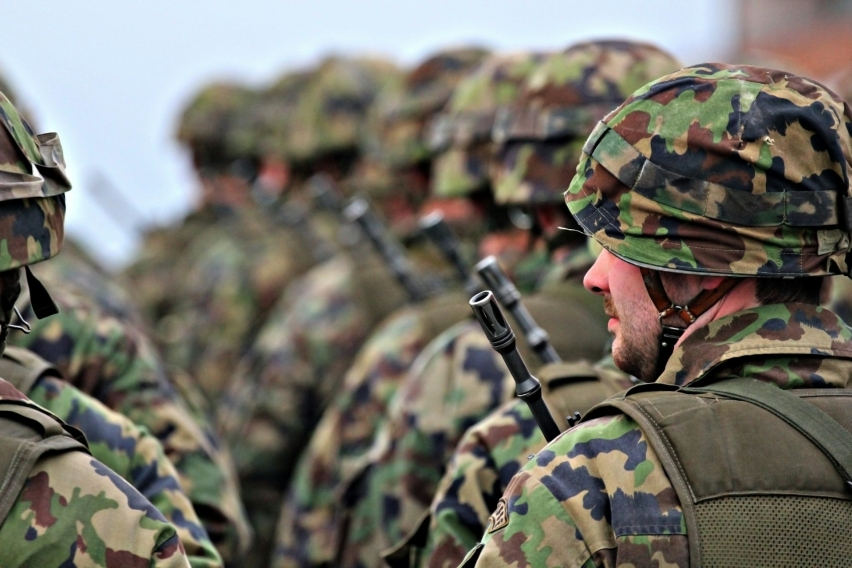
The end of a long-standing exemption from compulsory military service for clergy in Switzerland points to a broader retreat by the state from the idea that churches serve a public purpose, a leading free church figure has argued, while faulting the government for changing the law without consulting the churches affected.
The argument came from Peter Schneeberger, president of the free church umbrella body Freikirchen.ch, in an opinion piece published July 2 by the evangelical news portal Livenet.ch, and echoes a June 29 statement from his organization.
Under a revision of Switzerland's Federal Act on the Armed Forces, the general exemption that clergy held under Article 18 was repealed as of June 1, according to the Freikirchen.ch statement. Pastors judged fit for service now carry the same military obligations as other citizens and are no longer exempt on the basis of their office alone.
A change made without the churches
Freikirchen.ch said it learned of the change only indirectly. According to the association, neither the free churches, the country's established regional churches nor the pastors' associations were invited to take part in the formal consultation that normally precedes Swiss legislation.
"We regret this procedural flaw," Schneeberger said in the statement. "From our standpoint, this does not correspond to a proper legislative process."
The removal of the article drew little notice, the group said, and members of parliament did not register the deletion as the measure advanced. In his Livenet.ch piece, Schneeberger wrote that the Swiss daily NZZ had raised the same concern about the missing consultation.
Consulting those affected is one of the strengths of Swiss lawmaking, Schneeberger argued in the op-ed, because it lets people with direct experience contribute expertise. He wrote that skipping that step weakens both the quality of a law and its acceptance, and that because only a small number of clergy are affected, workable solutions could have been developed with the churches.
The government's rationale
The Federal Council, Switzerland's executive, justified the move on the grounds that the exemption had become outdated, the Freikirchen.ch statement said. The provision was originally meant to keep clergy available to care for civilians during disasters, emergencies or armed conflict, but widespread departures from the churches in recent decades had changed the scale of that pastoral work, according to the council's reasoning as cited by the association.
The council also distinguished clergy from other exempted groups, such as workers in health care, transport and the security sector, which it described as essential to the country's core functioning, the statement said.
A signal beyond military law
Schneeberger wrote in the op-ed that the policy change itself was politically defensible. The greater significance, in his account, lies in what it signals rather than in its practical effect, which touches few people.
By repealing the exemption, he argued, the state is stepping back from an assumption held for decades: that pastoral care in extraordinary situations is a public task of particular value. He described the shift as a form of what he called state "self-secularization" — not a move toward or away from religion, but a quiet reassessment of the churches' contribution to society without any open debate about it.
He called that step contradictory at a time of rising geopolitical uncertainty. Governments regularly invoke resilience, mental fortitude and social cohesion in times of crisis, he wrote, and pastoral care feeds into all three. In his framing, such care is not a service the church performs for itself but a resource for society as a whole.
The op-ed grounded the point in the case of a free church pastor in his 30s who was told in the spring that he had been reassigned to his former unit. According to the piece, the man, a father of two young children, first assumed the notice was an error and later learned his exemption had been revoked under the new law. He must now complete 41 remaining days of service.
Chaplaincy rather than exemption
The free churches are not seeking to restore the exemption, Schneeberger wrote, and clergy liable for service should contribute. What matters, he argued, is where that contribution does the most good.
He pointed to military chaplaincy as the strongest option, saying pastors bring skills in crisis support, conversation and ethical orientation that serve soldiers regardless of belief. Army chaplaincy has been open to pastors from free church backgrounds for several years, both the op-ed and the association's statement said, and the Freikirchen.ch release noted that clergy who can envisage such a role may apply to serve.
Schneeberger closed the op-ed by arguing that good laws depend on hearing from those directly affected, even when few people are involved. Because the state relies on social cohesion more than ever, he wrote, it should cultivate its dialogue with the churches rather than scale it back.