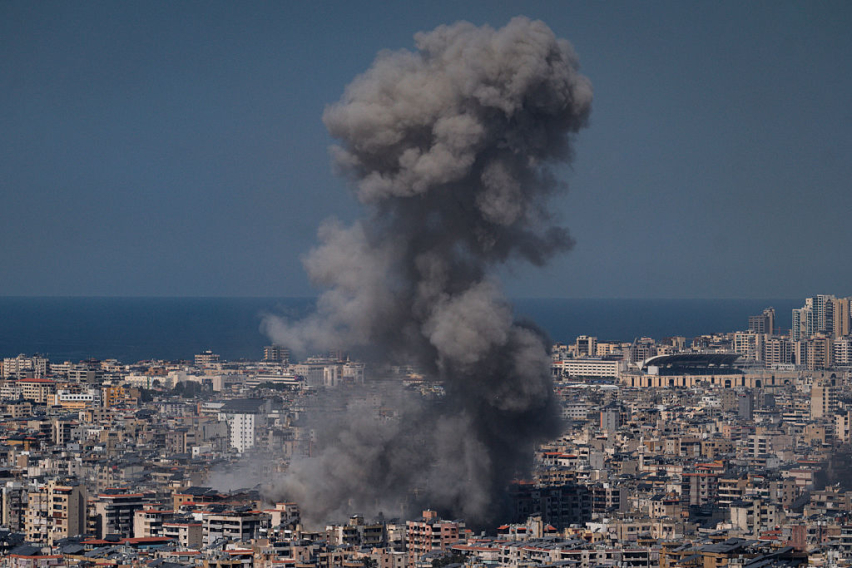
The president of the Arab Baptist Theological Seminary has called on Christians worldwide to pray for Lebanon and the wider Middle East as renewed conflict between Israel and Hezbollah forces has displaced hundreds of thousands and intensified humanitarian needs across the country.
In a letter dated March 10, Wissam Nasrallah urged prayer for “restraint, real peace and mercy upon this land,” while also asking supporters to intercede for displaced families and for Christian ministries responding to the crisis.
“Once again, Lebanon finds itself in a war it did not choose, and facing widespread displacement,” Nasrallah wrote. “Once again, the roads are filled with families carrying what they can, leaving behind what they love.”
The appeal comes as violence has escalated following a confrontation between Israel and the Iran-backed Lebanese militant group Hezbollah. According to reporting by Reuters, Israel launched a military offensive against Hezbollah after the group began firing rockets on March 2, saying the attacks were in retaliation for the killing of Iran’s supreme leader during a broader U.S.-Israeli conflict with Iran.
Lebanese authorities say Israeli strikes have killed nearly 600 people and displaced about 700,000 residents. The Israeli military has said it has targeted hundreds of Hezbollah positions, conducting airstrikes in southern Lebanon, Beirut’s southern suburbs and the Bekaa Valley.
Nasrallah described the conflict as both a geopolitical crisis and a deeply human tragedy affecting families across the country.
“In a matter of days, hundreds of thousands have been displaced,” he wrote. “Behind every number is a name, a child, a mother, a grandfather, a home now silent.”
Founded in 1960 and based near Beirut, the Arab Baptist Theological Seminary trains Christian leaders from across the Middle East and North Africa. Nasrallah said the seminary has opened its campus to displaced families since the early days of the current conflict.
“Our guesthouse and campus are receiving families who have nowhere else to go,” he wrote, adding that partner ministries are helping provide meals and coordinating assistance for those affected by the fighting.
He framed the response as part of the seminary’s Christian witness during a time of crisis.
“To receive the displaced is to echo the heart of Jesus who ‘did not come to be served but to serve,’” Nasrallah said.
Despite the upheaval, the seminary’s academic programs remain operational online, allowing approximately 250 students across the Middle East and North Africa to continue their theological studies.
Nasrallah also reflected on the broader uncertainty facing the region, suggesting the current conflict could reshape the Middle East’s geopolitical landscape in the coming years.
“What may emerge from this is a new Middle East order and a new regional security architecture that will define the next decades,” he wrote.
Still, he emphasized that Christian hope rests not in political outcomes but in faith in God during times of upheaval.
“As Christians, we are people who take reality seriously without surrendering to it,” Nasrallah wrote. “We do not minimize the gravity of what is happening, but neither do we yield to fear.”
He concluded by urging Christians to continue praying for Lebanon and the region, asking that the Gospel would be both proclaimed and demonstrated through acts of compassion during the crisis.