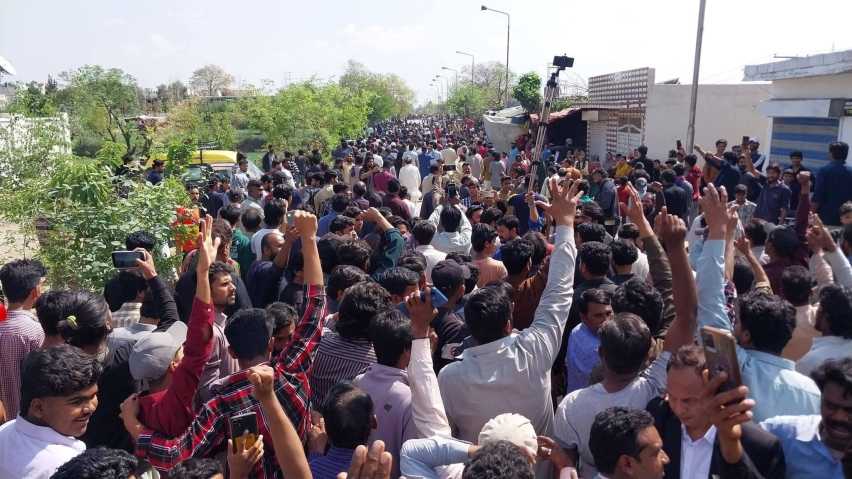
Thousands of Christian families living in informal settlements in Pakistan’s federal capital say they fear losing their homes after authorities issued verbal directives last week ordering residents to vacate government land, triggering protests and raising concern among human rights advocates about the possible displacement of an already marginalized community.
The warnings were issued by the Capital Development Authority (CDA), the municipal body responsible for managing Islamabad, and affect several settlements across the city, including Rimsha Colony in Sector H-9/2 and Sharpar Colony in Sector G-7. Both areas are home to large numbers of low-income Christian families who have lived there for more than a decade.
Residents say the announcements have created panic among families who fear the loss of homes they have gradually built over many years.
“Where will we go?” asked Anwar Masih, a resident of Rimsha Colony, speaking to Christian Daily International. “We have small children. Ever since this situation began, everyone in my house is worried. The children cannot sleep at night.”
Since March 12, hundreds of residents from Rimsha Colony and nearby Sharpar Colony have staged demonstrations against the possible evictions, warning that the move could displace thousands of poor families if carried out without relocation plans.“Issuing directives to slum dwellers to vacate the land without offering them alternative shelters is a great injustice,” said community leader Imran Shahzad Sahotra.
According to Sahotra, most residents have few options for relocation because of their limited incomes and the widespread discrimination they face in Pakistan’s housing market.
“People are settled here and have no other options,” he said, urging authorities to provide resettlement arrangements if the land is required for development projects.
Rimsha Colony is among the largest informal settlements in Islamabad and houses thousands of working-class residents. Many are Christians employed as sanitation workers, domestic helpers, construction laborers and other low-income workers who help sustain the city’s daily functioning.
Over the years, the settlement has developed into a close-knit neighborhood with small churches, informal schools and community organizations serving residents. Yet activists say the area still lacks basic services, including reliable access to clean water, sanitation and healthcare.
For many families, however, the settlement represents rare stability after years of hardship and displacement.
The colony’s history is closely linked to one of Pakistan’s most widely reported blasphemy cases involving a Christian minor.
In 2012, a teenage Christian girl, Rimsha Masih, who had a mental disability, was accused of burning pages of the Quran in Islamabad’s F-12 sector. The allegations were later found to be fabricated, but the case sparked widespread fear and tension in nearby Christian neighborhoods. During the crisis, many Christian families living in the Mehrabadi area near G-12 fled their homes overnight fearing violence.
Sahotra said the displaced families were later allowed to establish temporary shelters in Sector H-9.
“Initially there were tents,” he said. “Over time those shelters turned into permanent homes, and the community became known as Rimsha Colony.”
Today Rimsha Colony and the adjacent Akram Gill Colony together house an estimated 25,000 residents, the majority of them Christians.
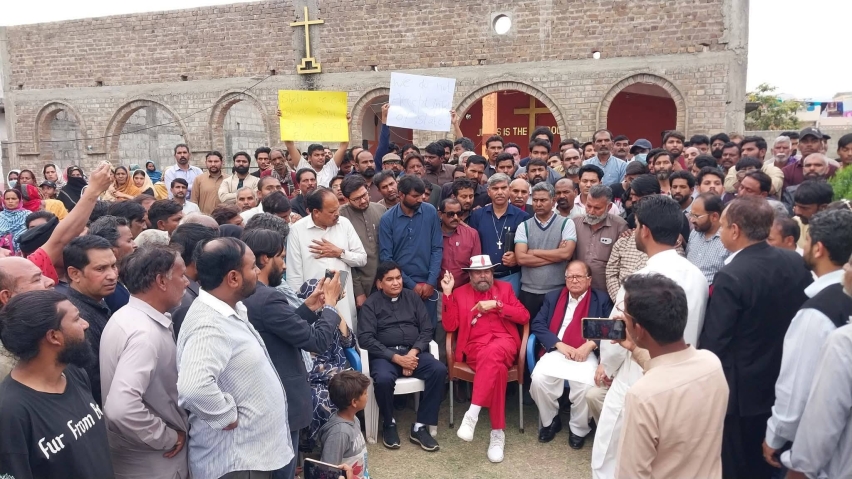
Human rights advocates say the potential eviction carries a painful irony.
“The authorities themselves relocated these families here after the Rimsha case,” the Human Rights Commission of Pakistan (HRCP) said in a statement. “Yet today they are being threatened with eviction.”
The Commission also raised legal concerns. It noted that informal settlements in Islamabad are protected under a 2015 stay order issued by Pakistan’s Supreme Court, which prohibits the eviction of slum residents without proper resettlement arrangements.
“We urgently call on the prime minister, law minister, interior minister and religious affairs minister to take notice of these imminent evictions,” the HRCP said, urging authorities to halt any demolition plans until guaranteed resettlement is ensured in line with national law and international human rights obligations.
Minority rights activist Samson Salamat also criticized the proposed evictions, saying such action without relocation would violate Pakistan’s 2001 National Housing Policy.
“The policy clearly states that residents of informal settlements should not be evicted unless they are relocated under formal resettlement plans,” said Salamat, chairman of Rwadari Tehreek (Movement for Equality).
The policy also calls on government institutions to develop low-cost housing programs aimed at improving living conditions in slum areas, he added.
Residents argue that their communities have long been recognized by several state institutions.
“The National Database and Registration Authority (NADRA) and the Election Commission of Pakistan accept these settlements as residential addresses. Electricity and gas infrastructure has also been installed here,” residents said in a joint statement.
“These facts clearly demonstrate that our presence has been formally recognized for many years.”
Sajid Sandhu, chairman of the Interfaith League Against Poverty, said Christian settlements have existed in Islamabad since the early years of the city’s development.
“The government is violating Article 24 of the Constitution of Pakistan which guarantees the protection of property rights,” Sandhu said.
The constitutional provision states that no person shall be deprived of property except in accordance with the law and prohibits compulsory acquisition without legal authority and fair compensation, he added.
Sandhu said Pakistan’s Christian minority has long faced discrimination in housing, employment, education and healthcare.
“The government should either grant property rights to the affected families or provide them with alternative land where they can rebuild their homes,” he said, adding that residents should also be compensated for the money they have invested in constructing their houses.
The CDA, however, maintains that it has launched an indiscriminate anti-encroachment campaign across Islamabad aimed at removing illegal constructions and reclaiming government land under the city’s master plan.
“CDA categorically rejects the impression of adopting any dual standards in its operations,” CDA spokesman Shahid Kiani said in a statement to Christian Daily International.
“The actions being taken against housing societies regarding amenity plots and against illegal katchi abadis (slums) are part of the same commitment to enforce the law and protect the master plan of the city.”
Kiani said recent operations had targeted commercial facilities rather than residential areas.
“Regarding Rimsha Colony, CDA will review claims that the authority had previously allowed displaced families to settle there. If any such agreement exists, CDA will honor it,” he said.
The authority also said residents possessing documentation supporting their claims over the land could present it for review.
However, the CDA official emphasized that the administration distinguishes between recognized and illegal settlements. “There are about 10 recognized katchi abadis in the federal capital. Out of these, four have already been resettled under various government policies. All other settlements, including the one referred to as ‘Sharpar Colony,’ are illegal encroachments,” the statement said.
For thousands of Christian families now living under the threat of eviction, the uncertainty continues to grow.
Zeeba Hashmi, a Muslim educationist and rights activist, echoed residents’ concerns in a Facebook post that quickly circulated among activists.
“Irrespective of legal grounds for eviction, these residents have been allowed to stay here since 2008,” she wrote. “Schools have been built, people have NADRA cards issued with the same address, and even local elections have been held.”
“Imagine the catastrophe that is coming their way with forced evictions,” she added. “Where will they go?”